

Your Guide to the Type 2 Connector and Mobile EV Charging Profits
The Type 2 connector has become the universal plug for AC electric vehicle charging right across the UK and Europe. The easiest way to think of it is as the EV world’s version of a USB-C cable—a single, reliable standard that simplifies charging whether you are at home, at the office or using a public charge point. Its widespread adoption is what makes innovative services like mobile charging truly viable.
Why the Type 2 Connector Is the UK Standard
Imagine the chaos if every mobile phone brand still used a completely different charger. It would be a nightmare. Thankfully the EV industry in the UK and Europe avoided that mess by settling on the Type 2 connector as the undisputed king for AC charging. This was not just a happy accident; it was a strategic move to build a seamless and dependable charging experience for every driver.
The connector’s biggest strength is its sheer versatility. It comfortably handles both single-phase power, which is what you will typically find at home, and the more potent three-phase power used at commercial sites. This means it can deliver anything from a slow 3kW top-up to a much quicker 22kW charge, making it the perfect all-rounder for nearly every scenario short of rapid DC charging on the motorway.
A Quick Look at Its Capabilities
To get a clearer picture of what the Type 2 connector brings to the table, here is a simple breakdown of its key features.
Type 2 Connector At a Glance
| Feature | Specification | Primary Benefit |
|---|---|---|
| Power Delivery | Single-Phase & Three-Phase AC | Supports everything from slow home charging to faster public top-ups. |
| Charging Speed | 3kW to 22kW (AC) | Flexible speeds to match different locations and vehicle needs. |
| Compatibility | Nearly all UK/EU EVs | Creates a unified, predictable charging experience for drivers. |
| Safety Features | Locking Mechanism & Comms Pins | Ensures a secure connection and safe energy transfer during charging. |
| Regional Standard | UK & European Union | Dominates public infrastructure, guaranteeing widespread availability. |
This combination of flexibility and standardisation is precisely why the Type 2 connector has become the bedrock of the UK’s charging network.
Building a Predictable Charging Network
This standardisation has been the driving force behind the incredible growth of the UK's charging infrastructure. With the Type 2 connector at its core the public network has expanded with confidence, which in turn encourages more people to make the switch to electric. As of late 2024, the UK had installed over 73,000 public chargers after a remarkable 36% growth in just one year and the vast majority of these feature the Type 2 plug.
This unified approach delivers some massive wins:
- Driver Confidence: EV owners can travel knowing their car will be compatible with almost any public charge point they find. No more plug anxiety.
- Infrastructure Simplicity: Manufacturers and installers can focus on producing one type of AC hardware. This drives down costs and speeds up the rollout of new chargers.
- Future-Proofing: Its design is robust enough to handle future improvements in AC charging technology without needing a complete overhaul.
Paving the Way for Mobile Charging
Crucially this universal standard opens the door for entirely new business models. Because almost every EV on UK roads uses a Type 2 connector for AC charging, a single mobile charging unit can serve the entire market. An operator does not need a van crammed with different adaptors; they just need one reliable system.
This makes launching a mobile charging business incredibly straightforward and scalable. To learn more about how different plugs compare, check out our complete guide on UK EV charger connector types explained. It is this simple yet powerful standard that makes an on-demand service like mobile charging a genuinely viable and profitable venture.
How the Type 2 Connector Actually Works
At first glance the Type 2 connector looks fairly straightforward, but behind that simple exterior is a clever bit of engineering that blends robust power delivery with smart, safety-first technology. Think of it less as a simple plug and more as a communication device that lets your vehicle and the charger have a quick chat before any electricity starts flowing. This ensures every charge is safe and efficient.
It all comes down to a carefully choreographed ‘digital handshake’. When you plug the connector into your car a specific sequence begins. The pins create a secure link, allowing the charging station to confirm the cable is properly locked in at both ends—in the car and in the charger itself. Only when this secure connection is verified will the system give the green light for the main power transfer to start.
This digital handshake is managed by two dedicated communication pins, which are essentially the brains of the whole operation.
The Seven Pins Explained
Each of the seven pins inside a Type 2 connector has a specific and vital job. Some do the heavy lifting, delivering the electricity, while others are all about communication and safety. It is this teamwork that makes the whole process so seamless and secure.
Here is a quick breakdown of what each pin is responsible for:
- L1, L2, L3 (Live Pins): These are your main power lines. For single-phase AC charging—the kind you typically have at home—only L1 is used. For faster three-phase AC charging, all three kick in to deliver a much bigger punch of power.
- N (Neutral Pin): This pin works with the live pins to complete the electrical circuit, making sure the alternating current is transferred safely.
- PE (Protective Earth): This is a critical safety feature. The PE pin grounds the connection to protect against any electrical faults, keeping both you and your vehicle safe from harm.
- CP (Control Pilot): This is the chief negotiator. The CP pin is a communication line that tells the vehicle how much current the charging station can supply, so the car knows exactly how much power it can safely draw.
- PP (Proximity Pilot): This pin has a dual role. First it tells the car that a charging cable is physically connected. Second it communicates the cable’s maximum current capacity, preventing it from ever being overloaded.
It is the constant dialogue between the CP and PP pins that prevents electricity from flowing until the connection is 100% secure, making the Type 2 connector incredibly safe to handle.
This infographic helps visualise how all these features come together.

As the graphic shows, the connector’s dominance in the UK is no accident—it is built on a foundation of versatility, safety and standardisation.
AC Charging vs DC Charging
The Type 2 connector is the undisputed king of AC (Alternating Current) charging. This is the same type of electricity that comes out of the wall sockets in our homes and offices. When you use a Type 2 plug your vehicle’s onboard charger takes this AC power and converts it into DC (Direct Current) power, which is the form it needs to be stored in the battery.
If you want to get into the nuts and bolts, you can learn more about how an AC to DC battery charger works in our detailed guide.
But for the seriously fast rapid charging you find at motorway services you need a different approach. That is where the Combined Charging System ( CCS ) comes in. A CCS plug is essentially a Type 2 connector with two chunky DC pins added underneath. This clever design allows the charger to bypass the car’s onboard converter entirely and pump high-voltage DC power directly into the battery.
The result? Dramatically faster charging speeds. Even in this setup the Type 2 portion of the plug still handles all the crucial communication, proving just how fundamental its design is to the entire EV charging world.
The Financial Case for Mobile Charging Operators
The universal adoption of the Type 2 connector in the UK has not just made life easier for drivers; it has opened the door for new, incredibly flexible business models. While installing fixed charging points means serious upfront cash for groundwork and grid connections, mobile charging offers a much leaner, high-margin alternative. It is the business of ‘charging as a service’, delivered right where the customer needs it.
The main advantage of mobile charging is its convenience. Operators can charge premium prices for on-demand power, turning an EV driver's problem into a profitable solution. The business model is simple: buy electricity cheaply during off-peak hours, store it in a mobile unit and sell it at a significant mark-up to drivers who need it most. This could be a stranded motorist, a fleet manager needing overnight top-ups or even attendees at an outdoor event.
Breaking Down the Earning Potential
The beauty of a mobile charging business is its low overheads and high-value delivery. Unlike a fixed installation business your main asset is the mobile charging unit itself. It can be deployed anywhere, generating revenue from day one. There are no costly planning permissions or lengthy grid upgrade negotiations to worry about.
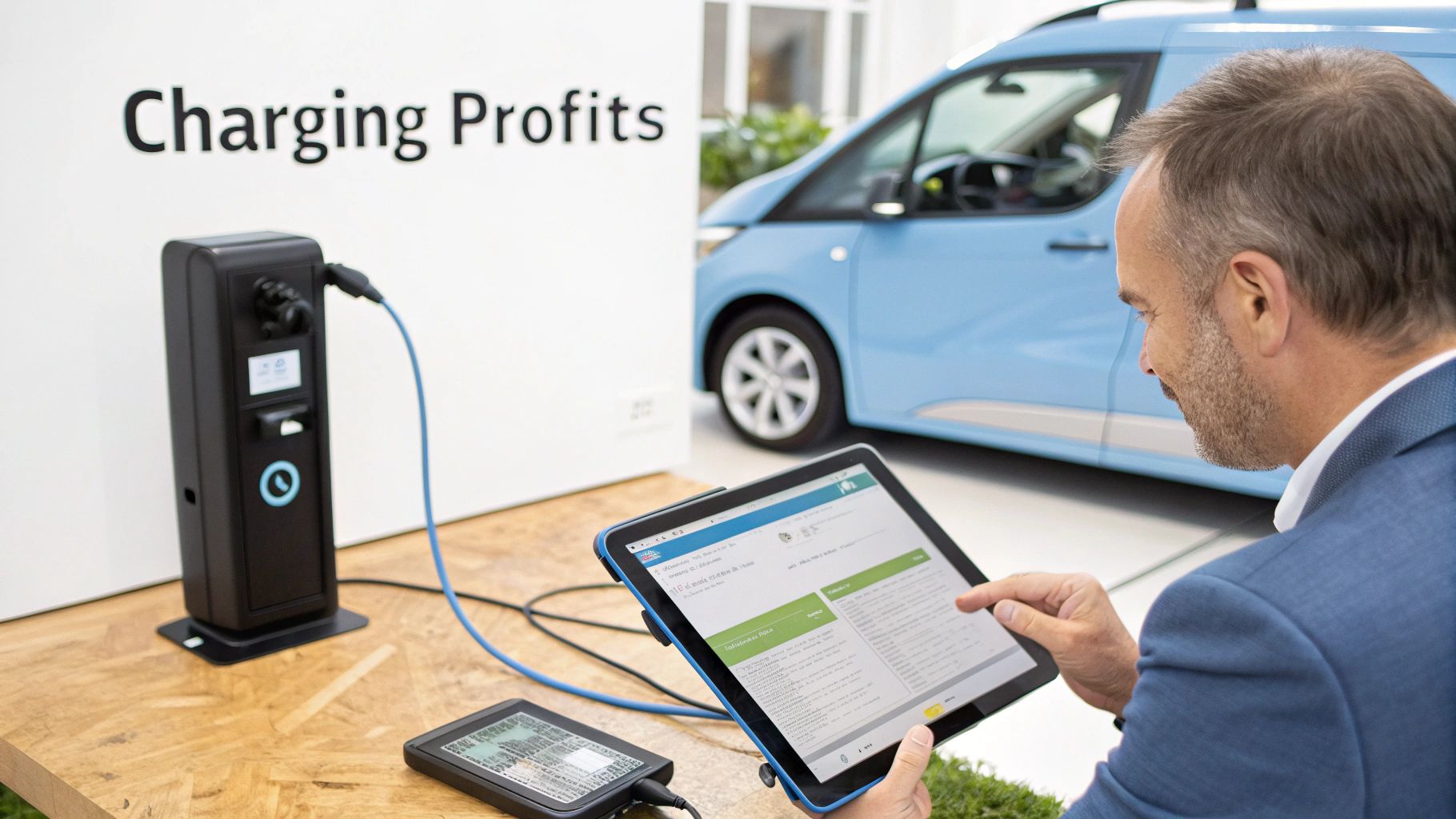
Let us run through a realistic scenario for an operator using a ZAPME mobile unit.
- Emergency Call-Outs: This is the most lucrative service. A stranded driver will happily pay a premium, often between £70 and £90 , for a rescue charge. Completing just two of these calls a day could generate over £150 in revenue .
- Scheduled Fleet Charging: Businesses with electric vans often lack on-site charging. Offering them a contract for overnight charging provides a steady, reliable income. An operator can build a profitable route servicing multiple business clients.
- Event Services: Music festivals, country fairs and outdoor markets are ideal opportunities. You can charge premium rates for providing temporary EV charging where permanent infrastructure does not exist, potentially earning hundreds of pounds per day.
The real financial advantage of mobile charging is turning a single asset into a constant revenue generator. You are not waiting for customers to come to you; you are actively taking the service to where the demand—and the profit—is highest.
Calculating Your Margins
To get a true picture of the financial returns you need to understand the cost of the electricity you sell. An operator typically charges their mobile unit at cheap off-peak rates and then sells that energy at a healthy mark-up. Your margin is simply the difference between that low electricity cost and the premium price a customer pays for on-demand convenience.
Getting this calculation right is the key to setting your prices effectively. If you want to dive deeper into the numbers, you can learn more by checking out our guide on how to calculate a kilowatt-hour .
By managing your costs carefully and pricing your services based on demand a mobile charging business can be incredibly profitable. The scalability is fantastic too; as demand grows, you just add more units to your fleet, with each one representing a new stream of income.
How Mobile Charging Solves Real Problems for EV Drivers
Mobile charging is far more than just a neat idea; it is a practical solution to some of the biggest headaches facing UK electric vehicle drivers. For an operator these driver frustrations are where the business opportunities lie. The fact that the Type 2 connector is now almost universal is the key that unlocks this market, letting a single mobile unit serve practically every EV on the road.
The most obvious problem it solves is range anxiety . Every EV driver has felt that knot in their stomach as the battery percentage drops faster than the miles to their destination. Knowing a rescue charge is just a phone call away offers genuine peace of mind, making longer journeys less of a gamble and encouraging more people to make the switch to electric.
For operators this translates directly into a high-margin emergency service. A stranded driver is a highly motivated customer, creating a reliable and profitable line of business.
Bridging the UK's Charging Gaps
Beyond roadside rescue mobile charging plugs a massive hole in our national infrastructure. Millions of people in the UK live in flats, apartments or terraced houses with no driveway for home charging. This is not just an inconvenience; it is a major roadblock to EV ownership, creating what many call an 'infrastructure postcode lottery'.
The patchy rollout of fixed chargers means your access to reliable power can depend entirely on where you live. This leaves many residents almost completely reliant on public and on-street charging points. In fact a staggering 53% of drivers without driveways are forced to depend entirely on the public network, which underlines just how vital widespread, reliable charging really is. You can get a deeper look at these challenges from the team at Willow Leasing.
Mobile charging operators step right into this gap. By bringing the charge to the customer they offer a real-world, convenient fix for anyone unable to install a home unit. You are not just selling power; you are selling a solution to an infrastructure problem.
Paving the Way for Wider EV Adoption
By tackling these core issues mobile charging services do more than just make money; they actively help the UK move towards electric transport. Every driver who buys an EV with confidence, knowing a mobile top-up is an option, is another win for a cleaner future.
This kind of service makes electric cars a practical choice for a much wider audience, including:
- City Dwellers: Offering a dependable charging alternative for people in high-density housing.
- Fleet Managers: Providing scheduled charging for commercial vehicles without needing expensive depot upgrades.
- Rural Drivers: Delivering power in areas where the public charging network is still thin on the ground.
At the end of the day a mobile charging business is not just selling electricity. It is selling confidence and convenience. And thanks to the standardisation of the Type 2 connector, operators are perfectly placed to meet this growing demand and build a successful business around it.
Using ZAPME to Launch Your Mobile Charging Business
The near-universal adoption of the Type 2 connector is more than just a technical standard; it is the foundation for a new kind of business. ZAPME provides the turnkey solution to capitalise on it. This is not just theory—it is a practical business-in-a-box, designed to turn the UK's EV infrastructure gaps into genuine profit centres.
By building each mobile unit around the Type 2 standard, ZAPME ensures operators can serve nearly every electric vehicle on the road from day one. There is no need to worry about compatibility issues.
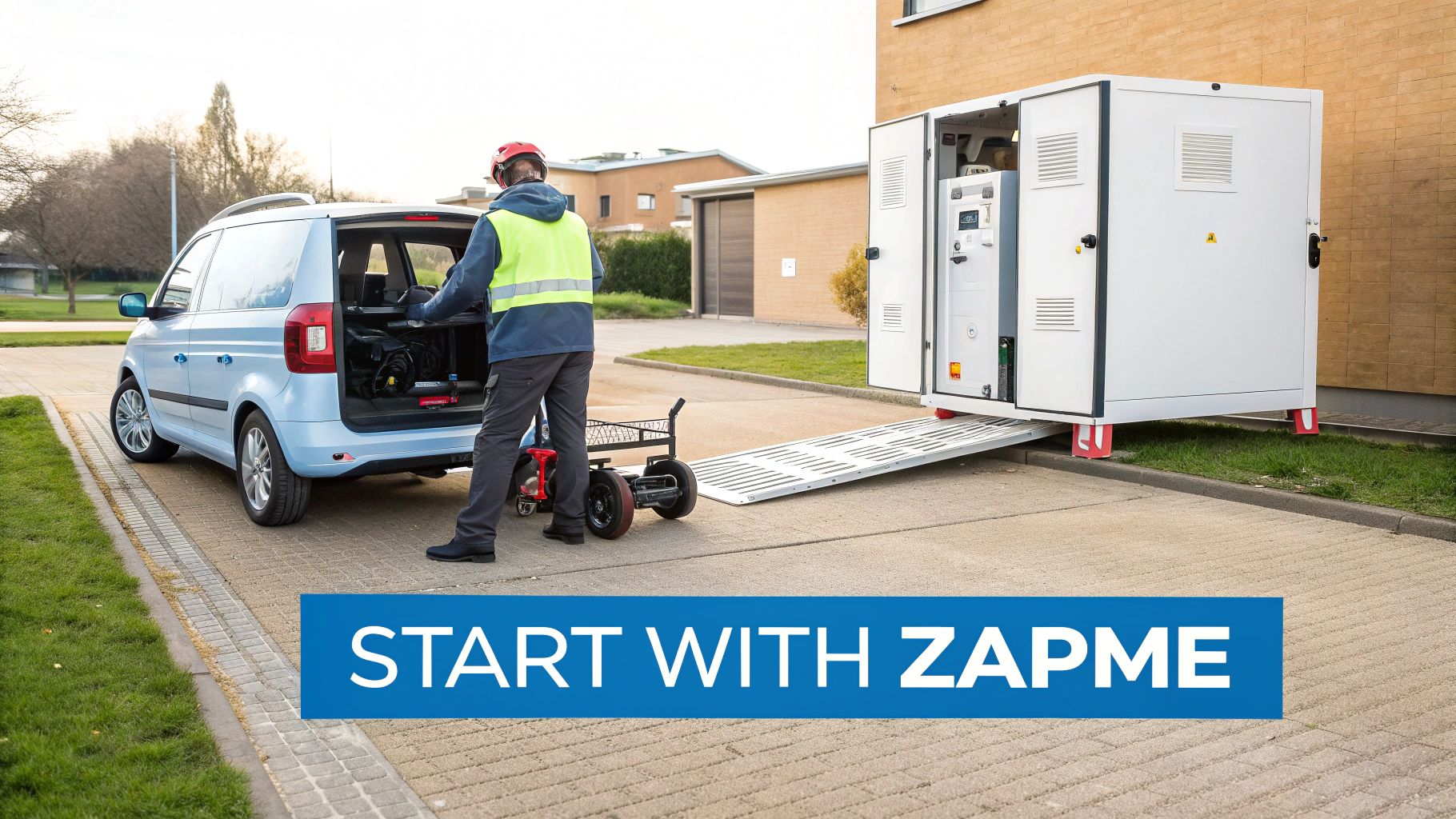
This universal compatibility is what unlocks the full financial potential of mobile charging. You are not just buying hardware; you are investing in a versatile tool that can generate revenue absolutely anywhere. The entire ZAPME system is engineered for rapid deployment, getting a stranded driver back on their way or delivering a scheduled top-up to a commercial fleet with incredible efficiency.
Designed for Profitability and Ease of Use
ZAPME mobile chargers are far more than just big batteries on wheels—they are powerful business tools. Each unit, from the portable 11.5kWh ZAPME Go to our larger fleet-focused models, is designed for portability and dead-simple operation.
This focus on ease of use means an operator can be up and running almost immediately, minimising downtime and maximising the number of billable call-outs each day. And the potential returns are significant.
For an operator, a single emergency call-out can generate £70 to £90 in revenue. Just a couple of these high-margin jobs each day can quickly build a profitable business, turning the initial hardware investment into a consistent income stream.
This model allows an entrepreneur to enter a lucrative market with far lower overheads than installing fixed, grid-tied infrastructure.
The Turnkey Business Opportunity
At its core ZAPME provides the reliable hardware needed to succeed. The smart features built into each unit allow for efficient management and billing, while the robust construction ensures they can handle the daily demands of mobile operation. Every charger's specification is tailored to real-world needs, delivering enough power to give drivers a meaningful range boost, fast.
Here is what makes it such a compelling business proposition:
- High-Margin Services: You can focus on premium offerings like emergency roadside assistance and event charging, where demand is high and price sensitivity is low.
- Low Operational Costs: With no need for groundwork or grid connections, your primary cost is simply recharging the unit, which can often be done using cheap off-peak electricity rates.
- Immediate Market Access: The Type 2 connector standard means a single ZAPME unit is your key to serving a huge and ever-growing customer base right across the UK.
Your Questions About Mobile Charging Answered
Stepping into the mobile charging business naturally brings up a few questions. As the EV market continues to expand so does the demand for flexible solutions that fixed charge points simply cannot meet. Here we tackle some of the most common queries we hear from operators considering a business built around the Type 2 connector and on-the-go charging.
The real benefit for an operator is tapping into a high-margin, flexible market. You are not just selling electricity; you are selling convenience, which always commands a premium. Whether it is a roadside emergency or a scheduled top-up for a commercial fleet, you are solving an immediate and often urgent problem for your customer.
What Is the Earning Potential?
The profitability of mobile charging is directly linked to the services you offer. An emergency call-out for a stranded driver is a high-value transaction, where you can reasonably charge £70 to £90 for a single top-up. Just a couple of these calls a day can build a very substantial income stream.
Beyond that securing contracts for scheduled fleet charging or providing power at events adds a stable, recurring revenue. The key is that your main asset—the mobile charger—is always working for you rather than sitting idle waiting for customers at a fixed location. This agility is what makes the business model so financially sound.
How Does the Type 2 Connector Fit In?
The Type 2 connector is really the linchpin of this entire business model in the UK. Because it is the established standard for AC charging a single mobile unit can serve nearly every electric vehicle on the road today. This universal compatibility removes a huge barrier to entry, meaning you do not need a boot full of adaptors or specialised kit.
This standardisation is crucial as the UK's EV fleet continues its rapid expansion. By 2025 fully electric cars on UK roads surpassed 1.6 million , with EVs now making up around 22% of all new car sales. This explosive growth, driven by government mandates, guarantees an ever-increasing customer base for mobile charging services that use the Type 2 plug. For a closer look at these market trends, you can explore more insights on electric vehicle adoption.
Mobile charging is not just a backup plan for drivers; it is a primary solution for the millions who lack access to home charging. By offering on-demand power you are providing an essential service that supports wider EV adoption across the country.
Are There Any Safety Concerns to Consider?
Modern EV charging systems are incredibly safe but it is always wise to be informed. Professional mobile charging units, like the ones we build at ZAPME, are engineered with multiple safety protocols that mirror the protections found in fixed charge points. These include features that prevent power from flowing until a secure, locked connection is established.
As mobile charging grows it is natural for drivers to have questions about all aspects of EV safety, including the rare but serious concern of fire. For those interested in the broader context, resources on understanding electric car fire safety provide valuable information and peace of mind. Ultimately using professionally designed equipment ensures both operator and customer safety is always the top priority.
Ready to turn the UK's charging gaps into your business opportunity? ZAPME provides the industry-leading mobile charging units you need to launch a profitable, in-demand service. Explore our range of mobile chargers at zapme.biz and start your journey today.