

how many watts in kilowatts: your quick conversion guide
Let's cut straight to the chase: there are exactly 1,000 watts (W) in one kilowatt (kW) .
It’s a simple conversion but it’s the key to understanding electrical power. Think of it like this: a single watt is like one millilitre of water, whilst a kilowatt is the full one-litre bottle. Once you get your head around that, everything else starts to click into place.
Understanding Watts and Kilowatts
Knowing how many watts are in a kilowatt is the first real step towards making sense of your energy use. It’s the difference between seeing jargon on an appliance and actually understanding what it means for your bills—from the cost of boiling a kettle to the charging speed of an electric vehicle.
This simple relationship between watts (W) and kilowatts (kW) is fundamental to getting to grips with electricity in the UK. Because one kilowatt (kW) equals 1,000 watts (W) , you can start to properly interpret your energy bills and appliance ratings. If you want to dig a bit deeper, Sunsave has some great insights into UK electricity consumption.
To make it even clearer, here’s a quick reference table.
Quick Conversion Watts to Kilowatts
This little table shows the direct conversion between common watt and kilowatt values, helping you quickly visualise their relationship.
| Watts (W) | Kilowatts (kW) |
|---|---|
| 500 W | 0.5 kW |
| 1,000 W | 1.0 kW |
| 2,000 W | 2.0 kW |
| 3,500 W | 3.5 kW |
| 7,000 W | 7.0 kW |
| 22,000 W | 22.0 kW |
Getting comfortable with this basic maths moves these terms from confusing jargon to useful tools. It empowers you to make more informed decisions about your energy use and spot opportunities to save a bit of money along the way.
Understanding Power vs Energy (kW vs kWh)
One of the biggest hurdles when you first get into electrics is untangling the difference between power and energy. Whilst they sound similar and are often used interchangeably, they measure two very different things. Getting this right is the key to understanding your electricity bill and how devices like EV chargers actually work.
Let’s use a simple car journey analogy. Power , measured in kilowatts (kW) , is like your car's speedometer. It tells you your speed at any single moment—how fast you’re using energy right now. A powerful sports car can accelerate rapidly, just like a high-kilowatt appliance draws a huge amount of power the instant you switch it on.
Energy , on the other hand, is measured in kilowatt-hours (kWh) . This is more like the odometer on your dashboard, which records the total distance you’ve travelled over time. It’s the total amount of power you’ve used, not just how quickly you used it.
Why This Distinction Matters
Your electricity supplier doesn’t bill you for your ‘top speed’ of power usage. Instead, they charge you for the total ‘distance’ your home has electrically travelled over the month. This is why your bills are measured in kWh and not kW —it represents the total volume of energy you've consumed.
This concept is crucial for managing your costs. When you understand the difference, you can see that it’s not just about which appliances use the most power but also how long you leave them running. For a deeper dive, you can learn more about how to calculate a kilowatt-hour and see how small changes in usage can lead to big savings.
A simple way to remember it is: Kilowatts ( kW ) measure how fast you use electricity and kilowatt-hours ( kWh ) measure how much electricity you’ve used over time.
For example, a 2 kW heater running for one hour uses exactly 2 kWh of energy. But if you run that same heater for just 30 minutes, it only uses 1 kWh . The power rating ( kW ) stays the same but the energy consumed ( kWh ) changes depending on time.
Putting It All Into Practice: Calculating Appliance Costs
Theory is one thing but seeing how watts and kilowatts affect your household budget is where this knowledge really comes alive. You can figure out the running cost of any appliance in your home with a simple formula, giving you a crystal-clear picture of where your electricity bill is actually going.
This simple bit of maths puts you back in the driver's seat. By spotting which devices are the biggest energy guzzlers, you can make smarter choices about how you use them or decide when it’s time to upgrade to a more efficient model. It’s all about combining an appliance's power rating with how long you use it and what you pay for electricity.
The Simple Formula for Calculating Costs
You only need three bits of information to work out the running cost of any device. Once you have them, the calculation is incredibly straightforward.
The formula looks like this:
Appliance Power (kW) × Hours Used × Price per kWh = Total Cost
Let’s run through a classic UK example. A typical electric kettle is rated at around 3,000 watts , which is 3 kW . If it takes five minutes (that’s 0.083 of an hour) to boil and your electricity tariff is £0.25 per kWh , the maths is simple:
- 3 kW × 0.083 hours × £0.25/kWh = £0.06
That means it costs about six pence every time you fancy a cuppa. It does not sound like much but when you add up all those small costs across every appliance, it makes a real difference over the month.
This is where the distinction between power (kW) and energy (kWh) becomes crucial. Think of power as speed and energy as the total distance you’ve travelled. You’re billed for the energy you consume over time, not the instantaneous power draw.
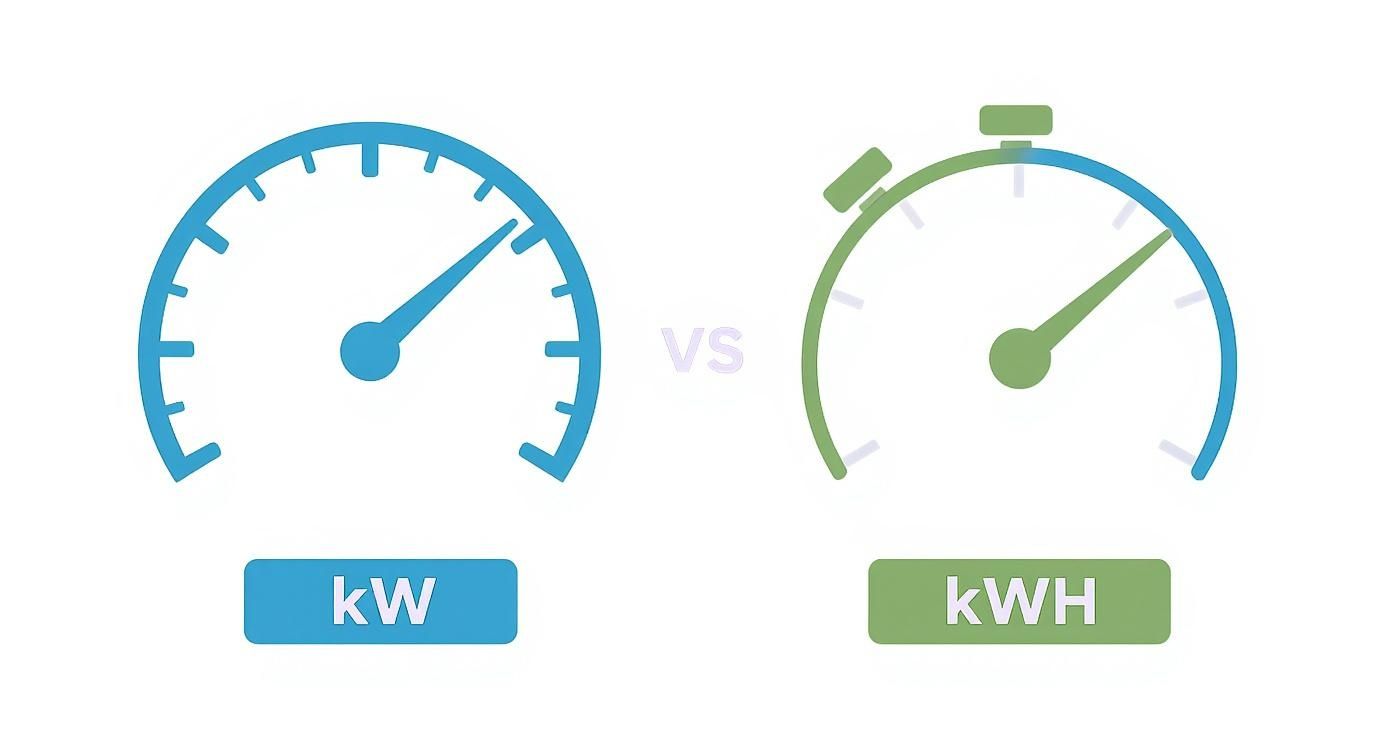
As the image shows, an appliance's power rating (kW) is its demand at any given moment, whilst the energy (kWh) is what you've used over a period, like an hour.
Applying It to Other Household Items
Let's try another one. A modern TV might be rated at 150 watts (or 0.15 kW ). If you settle in for four hours of viewing, the calculation is:
- 0.15 kW × 4 hours × £0.25/kWh = £0.15
So, a typical evening in front of the telly costs around fifteen pence in electricity. Once you get the hang of this, you can build a complete picture of your household’s energy habits. For a deeper dive, check out our guide on what kilowatt-hours are and how they impact costs. This practical knowledge is key to spotting savings and taking control of your energy bills.
Kilowatts and Mobile EV Charging Opportunities
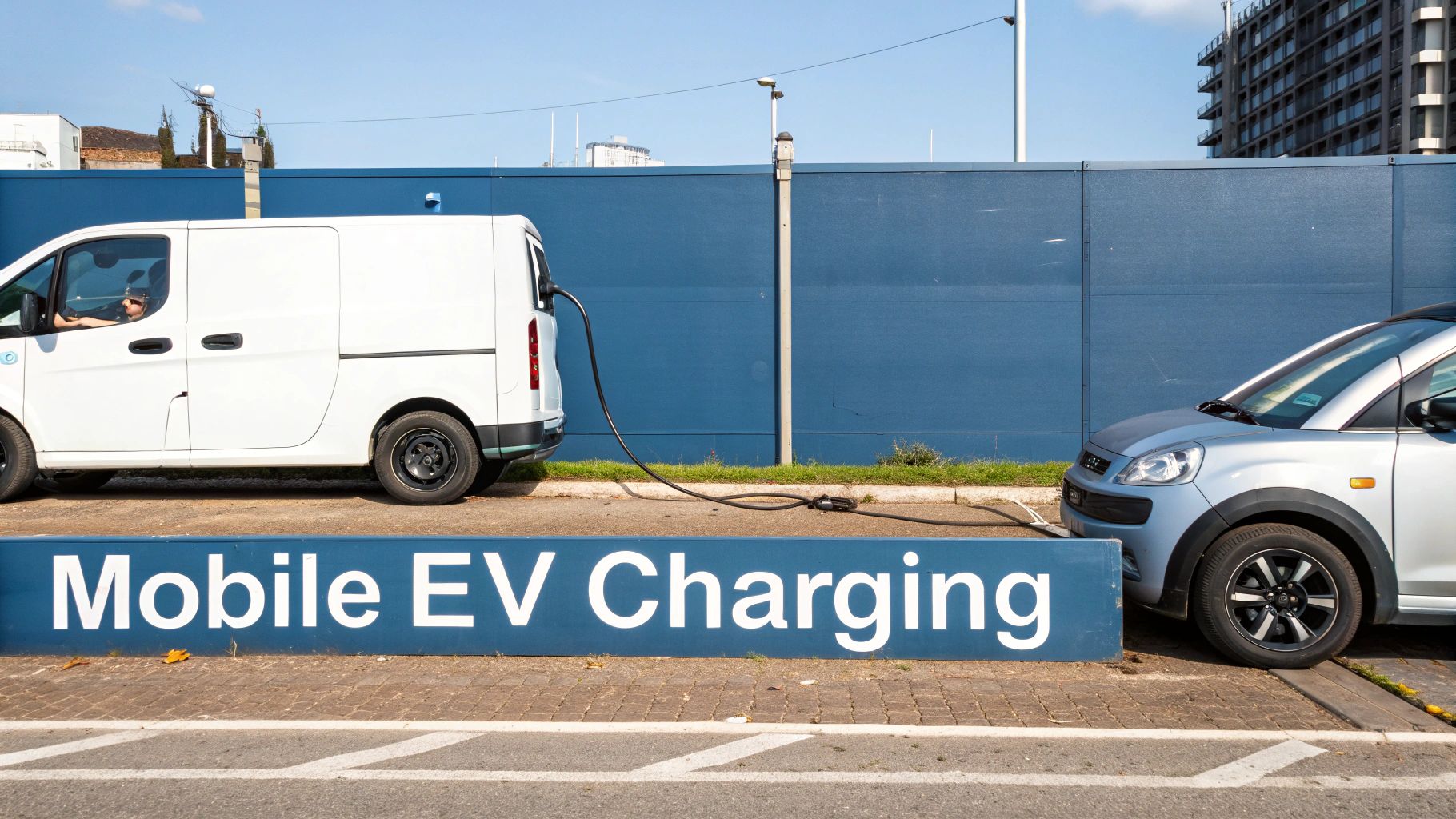
The world of electric vehicles runs on kilowatts. For an EV charger, its power rating—measured in kW—is a direct indicator of how quickly it can top up a car's battery. This is not just a technical detail for drivers; it is the foundation of a significant business opportunity.
For anyone looking to operate a mobile charging service, understanding how many watts in kilowatts is the first step towards calculating profitability. The power of your charging unit defines the speed of the service you can offer, which ultimately determines how much revenue you can generate from each call-out. Mobile charging is an excellent business because it offers convenience to EV drivers who may be stranded or simply lack home charging facilities, turning a modern problem into a profitable solution.
Turning Kilowatts into Profit
Let's apply this concept to a real-world service. Imagine an operator using a ZAPME mobile charging unit to provide on-demand power. The potential earnings are directly linked to the unit's kilowatt output, making it a lucrative venture.
A higher kilowatt rating means more energy delivered in less time, freeing you up to serve more customers each day. This efficiency is precisely what makes the business model so profitable. An operator can turn a significant profit by buying electricity at a standard rate to charge their mobile unit and selling it at a premium to customers in need.
Consider a typical mobile charging scenario:
- Charger Power: A 22 kW mobile unit.
- Charging Duration: One hour.
- Energy Delivered: 22 kilowatt-hours (kWh) .
- Potential Profit: If an operator pays £0.25/kWh to charge their unit and sells the power at £1.00/kWh, they make a gross profit of £16.50 (£0.75 profit per kWh x 22 kWh) from a single one-hour job, before accounting for other running costs.
Each session turns the unit's power rating into direct cash flow, all whilst providing a vital service that helps tackle 'range anxiety' for drivers in the expanding EV market.
The core advantage of mobile charging is its flexibility. Operators can bring high-power charging directly to customers, whether they are stranded at the roadside, parked at work or at home without access to a fixed charge point. This convenience is what customers will pay a premium for.
The Profitability of Power
It follows that the financial benefits for an operator scale with the power of their equipment. A more powerful mobile charger, like a 50 kW unit, can deliver more than double the energy of a 22 kW unit in the same amount of time. This does not just offer a faster, more convenient service for the customer; it significantly boosts the operator’s earning potential, allowing them to complete more jobs per day and maximise their income.
By calculating the cost of electricity to charge their mobile unit and setting a competitive price per kWh for the customer, an operator can build a profitable business from the ground up. Understanding the numbers is crucial and you can learn more about how many kilowatts are needed to charge an electric car in our detailed guide. This knowledge transforms a technical unit of measurement into a practical tool for business success.
Scaling Up to the UK National Grid
Whilst we’re used to thinking in watts and kilowatts for our homes and cars, the same ideas apply to the entire country – just with much bigger numbers. That single, humble watt is the foundational building block for the whole system that powers the United Kingdom.
When we zoom out to look at the UK's National Grid, the conversation quickly shifts from kilowatts (kW) to megawatts (MW) and gigawatts (GW) . These are the massive units of power needed to keep everything running, from bustling city centres to quiet country villages.
Let's break it down:
- One megawatt (MW) is the same as 1,000 kilowatts , or a cool 1,000,000 watts .
- One gigawatt (GW) is even bigger, equalling 1,000 megawatts or 1,000,000,000 watts .
Powering the Nation with Megawatts and Gigawatts
These huge numbers start to make sense when you tie them to real-world examples. A single large offshore wind turbine, for instance, can have a capacity of over 10 MW . That's enough power to supply electricity to thousands of homes all at once.
The sheer scale of the UK's energy infrastructure is incredible. In a recent year, the total electricity consumption in the UK was around 280 terawatt-hours (TWh) , generated by a mix of sources like wind and gas. You can find more insights on UK electricity consumption at Heatable.
Understanding these larger units helps you appreciate the immense challenge and achievement of shifting the UK's energy supply towards renewable sources. Every megawatt generated from wind or solar is another step towards a cleaner, more sustainable national grid.
From the single watt lighting up a tiny LED to the gigawatts flowing across the country, the maths behind it all stays the same. This knowledge connects your personal energy use to the national picture, showing how every single kilowatt really does count in the grand scheme of things.
Your Common Questions Answered
Getting a handle on how kilowatts and watts work is the first step towards properly managing your energy use. It’s the difference between blindly paying your electricity bill and actively understanding where your money is going. Let's clear up some of the most common questions.
Why Are My Electricity Bills in kWh, Not kW?
This is a great question and it gets to the heart of the difference between power and energy . Think of it like speed versus distance. A kilowatt (kW) measures power, which is the rate you’re using electricity—like how fast a car is travelling.
A kilowatt-hour (kWh), on the other hand, measures the total amount of energy you’ve used over a period of time. So, if power is your car's speed, energy is the total distance you’ve driven. Your bill charges you for the total ‘distance’ your home has travelled electrically over a month, not just the top speed it hit.
How Do I Easily Convert Watts to Kilowatts?
The magic number here is 1,000 . That's all you need to remember.
To turn watts into kilowatts, you just divide the number of watts by 1,000 . For example, a powerful 2,400-watt appliance is simply 2.4 kilowatts ( 2,400 ÷ 1,000 = 2.4 kW).
And if you need to go the other way? Just multiply the kilowatts by 1,000 to get back to watts. Simple as that.
Is a Higher Wattage Better for an Appliance?
Not necessarily. Whilst a beefy 3,000 W kettle will certainly boil your water faster, a higher wattage means the appliance is drawing more power. For something like a TV or a light bulb, where you want sustained performance, a lower wattage that does the job just as well is far more energy-efficient.
Choosing lower-wattage appliances for tasks that don’t need a massive power surge is a smart way to cut down your energy consumption. Over time, those small savings add up, lowering your electricity bills and shrinking your environmental footprint.
This is especially critical for businesses. A mobile charging operator, for instance, can serve more customers and make more money by using efficient, high-output chargers. Delivering more kilowatts faster turns a technical spec into a direct driver of revenue.
Understanding kilowatts is key to unlocking new business opportunities in the EV market. ZAPME offers pioneering mobile EV charging solutions that empower operators to deliver power where it's needed most. Explore our range of vehicle-mounted chargers at https://www.zapme.biz.