

UK Commercial EV Charger Installation: A Business Guide
Getting your commercial EV charger installation right starts way before a single piece of equipment shows up. It all begins with a solid plan, one that takes a hard look at your property’s layout and, crucially, its electrical muscle. Nailing this foundational stage is the key to setting a realistic project scope and dodging those eye-watering, unexpected costs later on.
Planning Your Commercial EV Charging Project
Putting in commercial chargers is a serious undertaking, not something you jump into lightly. It is a world away from a simple home wallbox. A commercial project demands a much deeper dive into site suitability, how much power you actually have available, and what your future needs might look like. Get this bit right, and you are building an investment that is efficient, reliable, and ready for the ever-growing number of EV drivers.
Conducting a Thorough Site Assessment
The first thing to do is get your boots on the ground. Walk the site and try to see it through the eyes of an EV driver pulling into your property for the first time. Are your proposed charger spots obvious and easy to get to? Tucking them away in a dark, forgotten corner of the car park is a surefire way to put people off.
A few key things to zero in on during your walk-around:
- Visibility and Accessibility: Chargers need to be well-lit, clearly signposted, and in spots that are a breeze to park in. Think about placing them near building entrances or other amenities to make the experience as convenient as possible.
- Existing Infrastructure: Eyeball the distance from your main electrical room or intake point to where you want the chargers. The further you go, the more you will spend on trenching and heavy-duty cabling.
- Ground Conditions: Take a look at the surface. Is it tarmac, concrete, or maybe soft ground like grass or gravel? Each one requires a different level of prep work, which directly impacts your costs. For larger projects, it is vital to understand the distinction between residential and commercial excavation , as the rules and requirements are completely different.
Understanding Your Power Supply
This is the big one. Your site’s electrical capacity is the single most important factor, and it is non-negotiable. Most commercial buildings have a fixed maximum supply from the grid and a bank of new EV chargers can gobble that up surprisingly quickly, potentially tripping the power for your entire operation.
I’ve seen it happen: a business underestimates the total electrical load and ends up with major issues. A single 50kW rapid charger can draw as much power as a small office building. You absolutely have to plan for this demand from day one.
A good starting point is to look over your recent electricity bills to see what your peak demand has been. But that is just a rough guide. To get the real picture, you need a professional electrical survey to determine your site's maximum import capacity (MIC) . This survey will tell you exactly how much spare power you have to play with for your new chargers.
Engaging with Your Distribution Network Operator
What if the survey reveals you do not have enough juice? Your next call is to your local Distribution Network Operator (DNO) – the company that owns and manages the cables and transformers in your area.
Be warned: applying for a grid connection upgrade is not a quick job. It can easily take several months. The DNO has to do its own surveys to figure out if it is even feasible to boost your supply and what it will cost. This could be as simple as upgrading a local transformer or as complex (and expensive) as laying entirely new high-voltage cables. Talking to the DNO early is one of the most important things you can do to keep your project timeline and budget grounded in reality.
Choosing the Right EV Chargers for Your Business
Picking the right hardware is a huge decision. It is going to define your service, the experience your customers have, and, ultimately, how profitable you are. A commercial EV charger installation is not a one-size-fits-all job; the best choice hangs entirely on what you want to achieve, whether that is offering a simple top-up for employees or running a high-turnover public charging hub.
The Two Main Flavours: AC and DC Chargers
Your first big decision is between AC (Alternating Current) and DC (Direct Current) chargers.
AC chargers, often called Level 2, are the workhorses of destination charging. They are a perfect fit for workplaces, retail parks, and hotels—places where vehicles will be parked for a few hours. They offer a slower, more affordable charging solution that gets the job done without a massive upfront investment.
On the other hand, DC chargers deliver rapid or ultra-rapid charging, capable of adding serious range in under an hour. These are non-negotiable for service stations or any location where quick turnaround is the name of the game. Just be prepared; they come with a much higher price tag and demand a far more substantial grid connection.
A New Contender: The Rise of Mobile EV Charging
While fixed chargers have been the go-to, a more flexible—and often more profitable—option is making waves: mobile EV charging . Think of a mobile unit as a large, vehicle-mounted battery pack that acts as a rapid charger on wheels. This approach neatly sidesteps many of the headaches that come with a fixed commercial EV charger installation.
For an operator, a mobile charger unlocks revenue streams you simply cannot capture with static hardware. Instead of waiting for customers to find you, you can take the power directly to them, creating a premium, on-demand service that people are happy to pay for. This flexibility is the key to maximising profit.
Whether you're looking at a fixed or mobile strategy, the core planning principles are the same: you need to understand your site, your power supply, and your location.
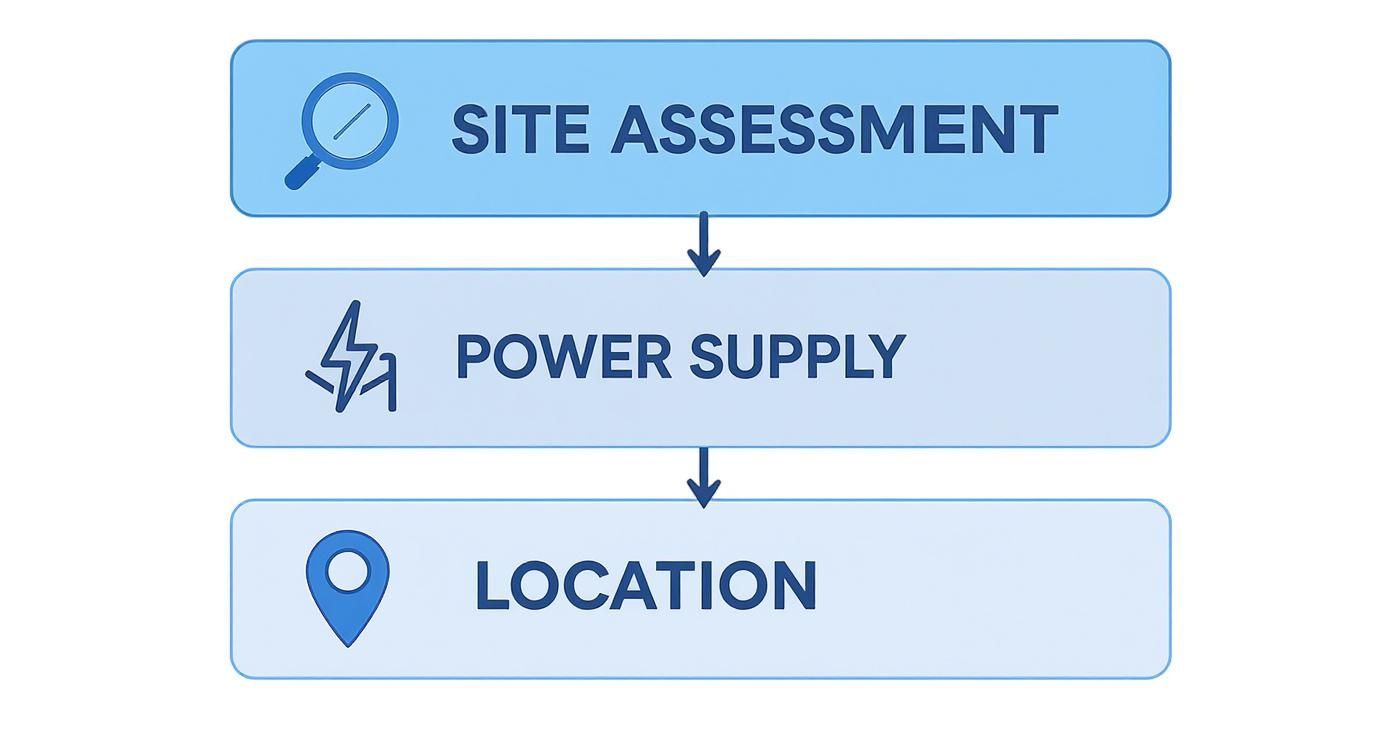
The key takeaway is this: whether you are digging trenches for a fixed point or deploying a mobile unit, a crystal-clear understanding of your operational area and its power resources is the bedrock of your success.
Finding the Profit in Flexibility: How Much Can You Make?
The real magic of mobile charging is its earning potential. Because it offers unmatched convenience, operators can command premium prices. It is like the difference between a standard taxi and a chauffeur service; customers will always pay more for a service that meets their exact needs, right when they need it.
Just think about these highly profitable scenarios for a mobile charger operator:
- Emergency Roadside Assistance: An EV driver is stranded, miles from the nearest station. A mobile unit can swoop in, provide a rapid boost to get them moving, and charge a call-out fee plus a per-kWh rate far higher than any fixed charger.
- Fleet Charging Depots: Many commercial fleets are going electric but do not have the depot space or electrical capacity for rows of fixed chargers. A mobile unit can service an entire fleet overnight, making it a lucrative B2B contract.
- Servicing "Charging Deserts": Residential streets with only on-street parking or rural towns often have zero charging infrastructure. A mobile service can schedule regular visits and become the go-to provider for an entire community.
- Events and Festivals: Temporary events like music festivals or county shows are magnets for EV drivers. A mobile operator can set up a pop-up charging hub and generate huge revenue over a single weekend.
A single, well-utilised mobile EV charger can generate hundreds of pounds in daily revenue. The business model is built on flexibility and convenience—two things for which consumers and businesses will always pay a premium. The lower initial capital outlay compared to a fixed rapid charging hub means a much faster path to profitability.
Match the Charger to Your Goal
To help you weigh the options, here is a quick comparison of the main commercial charger types.
Comparing Commercial EV Charger Types
| Charger Type | Typical Power Output (kW) | Best Use Case | Installation Complexity | Relative Cost |
|---|---|---|---|---|
| AC (Level 2) | 7kW - 22kW | Workplaces, retail parks, hotels (long-dwell time) | Moderate | £ |
| DC Rapid | 50kW - 350kW+ | Motorway services, public hubs (quick turnaround) | High (Grid upgrade often needed) | £££ |
| Mobile EV Charger | 50kW - 160kW+ | On-demand service, fleets, events, charging deserts | Minimal (No fixed installation) | ££ |
Ultimately, the right charger comes down to what you are trying to do.
For businesses looking to attract and retain top talent, a bank of affordable AC chargers in the staff car park is a fantastic perk. For a shopping centre, a mix of AC chargers for long-stay shoppers and a couple of DC rapid chargers for those needing a quick top-up is a smart move. You can find more information about ensuring vehicles and chargers work together by reading our guide to EV charging compatibility.
But for entrepreneurs or businesses aiming to create a new, high-margin revenue stream, the mobile charging model is a compelling opportunity. It allows you to bypass the lengthy and costly process of grid upgrades and planning permissions that bog down fixed rapid charger projects. Instead, you can invest in a versatile asset and start earning from day one, adapting your service to meet demand wherever it pops up.
In the fast-moving EV charging market, that kind of agility is how you win.
Managing the Installation from Start to Finish
Moving from a detailed plan to a fully operational charging station is not a single leap. It is a series of critical stages, and a successful commercial EV charger installation really comes down to choosing the right partners and knowing the steps of the physical build. This is our practical roadmap to get your project from procurement to power-on, smoothly and efficiently.
Finding and Selecting Qualified Installers
The single most important decision you will make is picking your installation partner. In the UK, this means finding an electrician or specialist firm that is OZEV-approved . This is not just a shiny badge; it proves they meet government standards for safety and quality. Crucially, it is also a must-have for accessing certain grants.
When the quotes start coming in, look past the final price. A professional proposal should break down every single cost.
- Hardware Costs: The price of the chargers themselves.
- Labour Charges: The cost for the electricians and groundwork crews.
- Civil Works: Any expenses for trenching, laying concrete bases, or resurfacing.
- Grid Connection Fees: Charges from the DNO if an upgrade is on the cards.
- Software and Commissioning: Fees for setting up the management software.
Honestly, a vague quote is often a red flag. A professional installer will give you a transparent breakdown so you know exactly what you are paying for, avoiding nasty surprises down the line.
The Physical Installation Phase
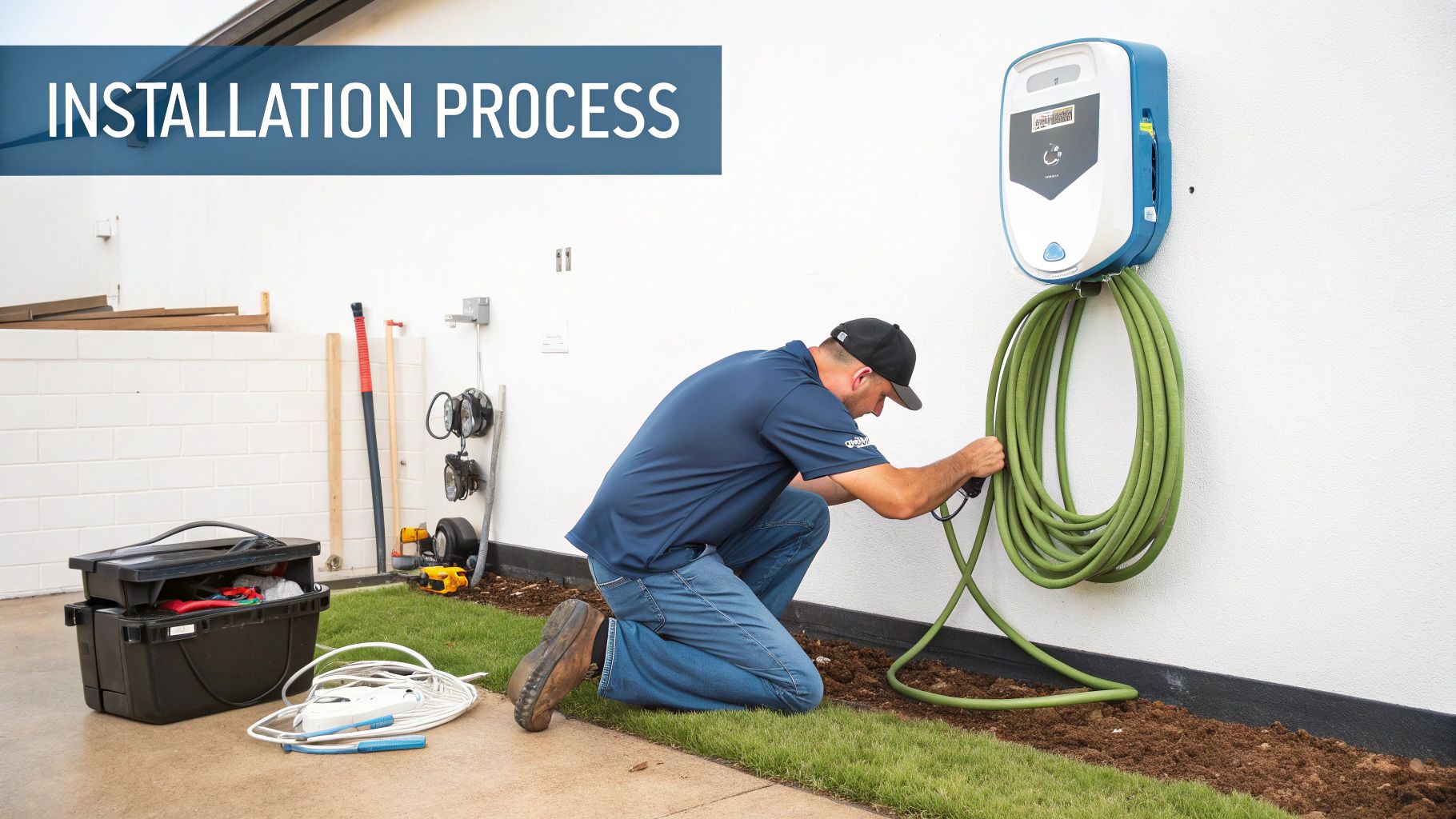
With an installer chosen, the real work begins. This phase can vary massively depending on the charger type and your site's conditions. For a few wall-mounted AC units in a covered car park with power nearby, it might be a relatively quick job of drilling and running armoured cable.
But for ground-mounted DC rapid chargers, it is a different story entirely. The process is far more involved, often starting with groundwork to create concrete plinths for the chargers to be bolted onto. After that comes trenching, where heavy-duty power and data cables are laid from your main electrical supply to each charging bay.
Remember that the complexity of the groundwork is a major cost driver. Trenching through soft ground is one thing, but cutting through reinforced concrete or navigating around existing underground utilities requires specialist equipment and significantly more labour.
Once the cabling is in, the chargers are mounted and connected. Installers will also fit protective bollards, paint bay markings, and put up clear signage to guide drivers. For a more detailed look at what is involved, you can explore our complete guide on how to install an EV charger in the UK.
Commissioning Your New Charging Stations
The final step before your chargers go live is commissioning . This is much more than just flipping a switch; it is a vital technical process that makes sure everything is safe, functional, and ready for use. Your installer will run a series of electrical tests to verify the installation meets all UK safety standards, like BS 7671 .
This stage also involves configuring the software that runs your chargers. This means:
- Connecting the chargers to your network, whether via Wi-Fi, Ethernet, or a 4G connection.
- Setting up your payment system and pricing structure (e.g., pay-as-you-go, subscription).
- Integrating the chargers with a management platform so you can monitor usage, uptime, and revenue remotely.
The project is not truly finished until the installer has completed these checks and handed over all the necessary safety certificates. This meticulous final step guarantees your investment is not only operational but also fully compliant and secure for years to come.
Funding Your Project and Maximising Profitability
A commercial EV charger installation is a serious business investment, but it is one that can deliver substantial returns. The key to turning your charging project into a profitable venture is navigating the costs and unlocking new revenue streams. With the right strategy and a clear understanding of the financial support available, you can make the numbers work for you.
Understanding the Full Cost Breakdown
Before you even think about funding, you need a realistic grasp of the total project cost. The price of the charging hardware is just one piece of the puzzle. A proper budget for a commercial EV charger installation needs to account for several key elements.
You will often find these on the bill:
- Hardware and Software: This covers the chargers themselves, plus the management software you will need for operations and taking payments.
- Installation Labour: The fees for qualified electricians and groundwork teams who will physically install the equipment.
- Grid Connection Fees: If your site needs a power supply upgrade, your Distribution Network Operator (DNO) will charge for this work.
- Civil Works: This is where the costs for trenching, laying concrete bases, and any necessary resurfacing of your car park come in.
Getting a detailed breakdown of these expenses is vital. For a clearer picture, take a look at our in-depth guide which explains how much it costs to install an EV charger in the UK. This kind of transparency ensures there are no hidden surprises and allows you to plan your funding approach with confidence.
Tapping into UK Government Grants and Schemes
The UK government is actively encouraging businesses to invest in charging infrastructure through several grant schemes. These can significantly reduce your initial outlay and speed up your return on investment.
One of the most well-known is the Workplace Charging Scheme (WCS) . It is a voucher-based scheme that provides support towards the upfront costs of buying and installing EV chargepoints. It can provide up to £350 per socket for a maximum of 40 sockets across all sites for each applicant.
It is clear that government policy and grant schemes are a major influence on commercial EV charger installations in the UK. Official statistics show that funding programmes have accelerated charger rollouts across local authorities. For instance, Local Electric Vehicle Infrastructure (LEVI) schemes are allocating huge funds for on-street charger projects, especially benefiting urban areas with limited private parking. You can discover more about the government's approach in the EV charging infrastructure statistics on GOV.UK.
Understanding and applying for these grants should be a priority. They are designed to make commercial EV charging more accessible and financially viable for businesses of all sizes, from small enterprises to large corporations.
Monetising Flexibility with Mobile Charging
While fixed chargers offer a steady revenue stream, the most lucrative opportunities often lie in flexibility. Mobile EV charging is a business model built on providing power where and when it is needed most, allowing operators to command premium rates for a convenient service.
This approach neatly sidesteps many of the costs and complexities of a fixed commercial EV charger installation, like extensive groundwork and grid upgrades. Instead, you invest in a mobile asset that can start generating revenue almost immediately.
How Much Can a Mobile Charger Operator Earn?
The earning potential of a mobile charging unit is directly tied to how much you use it and the pricing strategy you adopt. Unlike a passive, fixed charger, a mobile unit lets you actively seek out high-value customers.
Just think about these profitable scenarios:
- On-Demand Services: You can charge a call-out fee plus a per-kWh rate that is higher than public chargers, reflecting the convenience of bringing the charge directly to the customer.
- Fleet Support: Many businesses with electric fleets do not have the infrastructure for overnight charging. A mobile unit can service an entire fleet at their depot, providing a valuable contracted service.
- Event Charging: Music festivals, trade shows, and sporting events attract huge numbers of EV drivers. A mobile charger can operate as a pop-up charging hub, generating significant income over a single weekend.
- Targeting 'Charging Deserts': Plenty of residential areas with on-street parking or rural communities have poor charging infrastructure. A mobile service can become the go-to charging provider for these underserved locations.
An operator who effectively markets their service and keeps utilisation high can expect to generate substantial daily revenue. A single mobile charging unit could realistically bring in several hundred pounds per day, making it a highly profitable asset with a much faster path to breaking even compared to a fixed rapid charging hub. The key is to price your service based on the value you provide: convenience, speed, and reliability.
Keeping Your EV Charging Network Running Smoothly for the Long Haul
Right, the chargers are in the ground and the power is on. It is easy to think the job is done, but in many ways, this is where the real work begins. The focus now shifts from construction to smart, day-to-day operations. Long-term success is not just about having the hardware; it is about managing it efficiently, keeping it in top shape, and making sure every driver who plugs in has a flawless experience.
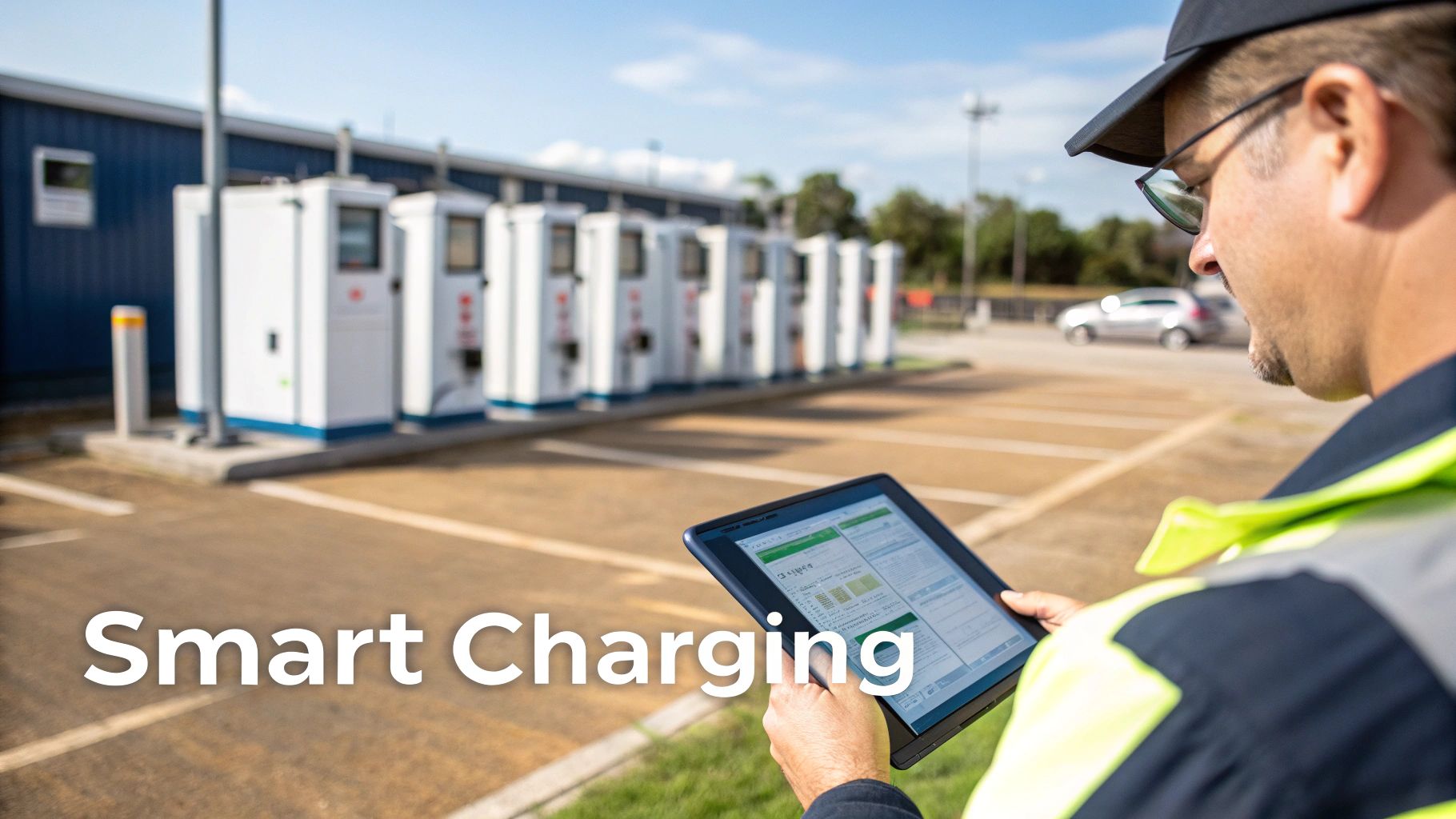
This is the phase where your investment really starts to pay off. It demands a different mindset—one geared towards uptime, driver satisfaction, and getting the most out of your new assets.
The Brains of the Operation: Smart Charging Software
Modern EV chargers are far more than just glorified power sockets. They are connected devices that generate a ton of useful data, and the key to unlocking their full potential is a solid smart charging software platform, often called a Charge Point Management System (CPMS).
Think of this software as the central nervous system for your entire network. It lets you see everything that is happening in real-time from a single dashboard. You can monitor which chargers are in use, see how much energy is being consumed, and spot any faults before they turn into major headaches for your customers.
More importantly, it is your tool for actually making money. A good CPMS will let you:
- Process Payments Seamlessly: Handle transactions through contactless card readers, mobile apps, or RFID cards, giving drivers the flexibility they have come to expect.
- Set Dynamic Pricing: You can adjust your per-kWh rates based on the time of day, demand, or even the live price of electricity to maximise your profit margins.
- Manage Access: Need to reserve certain chargers for staff or fleet vehicles while keeping others open to the public? A good system lets you control all of that remotely.
Honestly, choosing the right software is just as critical as choosing the right hardware. It directly impacts your ability to operate efficiently, keep drivers happy, and ultimately, run a profitable charging business.
A Practical Guide to Ongoing Maintenance
Just like any other piece of valuable commercial equipment, your EV chargers need regular attention to perform at their best. Skimping on maintenance is a false economy—it only leads to charger downtime, frustrated drivers, and expensive emergency call-outs. A proactive approach is always the better route.
The good news is that a lot of the routine upkeep can be handled in-house with a simple, consistent checklist. This ensures the small stuff gets caught early before it escalates.
Your Routine Maintenance Checklist
Here is a practical list for regular inspections. Running through these checks weekly or bi-weekly can make a huge difference to the reliability of your network.
- Visual Inspection: First, just walk around each unit. Look for any signs of physical damage to the casing, screens, or charging cables. Make sure all signage is still clear and easy to read.
- Cable and Connector Check: This is a big one. Examine the charging cables for any fraying, cuts, or exposed wires. The connector heads are a common point of failure, so ensure they are clean and free from debris or moisture.
- Functionality Test: Plug into a vehicle and start a test charge on each unit. You want to confirm it communicates correctly, starts the charge, and stops the session properly when told to.
- Cleanliness: Give the charger casings, screens, and payment terminals a good wipe-down. A clean, well-maintained station gives users confidence that your service is reliable.
Knowing When to Call in the Professionals
While these routine checks are vital, some jobs just have to be left to qualified technicians. Your maintenance plan should be crystal clear about what your team can handle and when it is time to pick up the phone.
You should always call a professional technician for:
- Internal Electrical Faults: If a charger is tripping circuits or showing persistent error codes that a simple reboot will not fix, do not mess with it.
- Software and Connectivity Issues: When a charger repeatedly fails to connect to your management network or cannot process payments.
- Annual Servicing: It is a wise investment to schedule a professional service once a year for a thorough inspection and preventative maintenance. This is crucial for safety and longevity.
By combining diligent in-house checks with expert support when needed, you will guarantee maximum uptime and protect the long-term value of your commercial EV charger installation.
Common Questions on Commercial EV Installations
Stepping into the world of commercial EV charging always throws up a few questions. From how much you can actually make to the nitty-gritty of planning permission and project timelines, getting straight answers is key to making the right move. Let's tackle some of the most common queries we hear from UK businesses.
How Much Can I Realistically Earn from a Mobile EV Charger?
This is the big one. Your earnings from a mobile EV charger really come down to your business model, how you price your service, and how often the unit is out working. Unlike a fixed charger, the real value of a mobile unit is its sheer convenience and on-demand power. Most operators charge a call-out fee on top of a per-kWh rate that is a bit higher than public chargers, reflecting the premium service you are offering.
A well-used mobile unit, charging several vehicles a day, could easily bring in hundreds of pounds in daily revenue. The true potential, though, is in finding those specific, high-value niches:
- Emergency Roadside Assistance: Coming to the rescue of a stranded EV driver is a premium service, and you can price it accordingly.
- Fleet Charging: Securing a long-term contract to service an entire commercial fleet at its depot overnight can create a steady, lucrative income stream.
- Event Services: Pop-up charging hubs at festivals, trade shows, or outdoor events are a brilliant way to tap into concentrated, short-term demand.
For a fleet operator, the return is not just in charging revenue; it is in eliminating costly vehicle downtime. For a service provider, a mobile unit is a highly profitable asset with a much lower initial cost than building a fixed rapid charging hub.
The secret to mobile charging profitability is flexibility. You are not waiting for customers to find you; you are taking the power directly to them. You are solving an immediate problem, and businesses and individuals will pay a premium for that.
What Planning Permission Do I Need in the UK?
Good news. For most commercial EV charger installations, you will not need planning permission, as they fall under 'permitted development' rights. This usually applies as long as the chargers meet certain conditions about their size and location on your property. That said, it is always smart to have a quick chat with your local planning authority before any work begins.
You are more likely to need full permission if your property is a listed building, sits in a conservation area, or if the installation involves major construction. Think building a new substation or digging significant trenches across public land. Your installer should be able to give you the right advice for your site and help you through the application process if one is needed.
How Long Does a Commercial EV Charger Installation Take?
The timeline can really vary. A simple job, like installing a few wall-mounted AC chargers where the electrical supply is already sufficient and easy to get to, might only take a couple of days once the hardware arrives.
On the other hand, a complex project with groundwork, multiple DC rapid chargers, and a grid connection upgrade can take several months from start to finish. The biggest hold-up is often the Distribution Network Operator (DNO). Waiting for them to assess your application and carry out any necessary upgrades to the local grid can take anywhere from a few weeks to over six months. A clear, detailed project plan right from the start is absolutely crucial for setting a realistic timeline.
Ready to skip the complexities of fixed installations and find a more flexible path to profit? The ZAPME range of mobile and portable EV charging solutions offers a faster way to get your business moving. Find out how our vehicle-mounted rapid chargers can work for you at https://www.zapme.biz.