

How much to install an EV charger: UK Costs Explained
Figuring out the cost of an EV charger installation can feel a bit like guesswork but for most UK homes, there's a pretty clear price range. For a standard 7kW home charger , you're typically looking at a total cost of somewhere between £800 and £1,200 . That figure covers both the charger unit itself and the professional fitting, though the final bill will naturally vary depending on the model you choose and the layout of your property.
Your Quick Guide to EV Charger Installation Costs
Thinking about home charging is a lot like planning for a new boiler; there's an initial outlay but it unlocks long-term convenience and cheaper running costs. While that headline figure gives you a good ballpark, it's worth digging into what that price actually includes to set a realistic budget.
The journey starts with picking the charger itself, which makes up a good chunk of the total cost. Then you have the labour for the installation, which is a job for a certified electrician to make sure everything is safe, compliant and ready to go.
The total price isn't just for the box on the wall. It reflects the expertise needed to safely connect it to your home's electrical system, ensuring your car charges efficiently without putting your wiring under dangerous strain.
Estimated Cost Breakdown for a Standard 7kW Home EV Charger
To give you a clearer picture, this table summarises the typical costs you can expect when installing a 7kW smart EV charger at a UK home. These numbers are a solid guide for a standard, straightforward job.
| Cost Component | Typical Price Range (£) |
|---|---|
| Smart 7kW Charger Unit | £500 - £800 |
| Standard Professional Installation | £300 - £500 |
| Potential Electrical Upgrades | £100 - £400+ |
| Total Estimated Cost | £800 - £1,200 |
All told, the average installation price often lands around the £1,000 mark for a 7kW charger , which is powerful enough to fully charge a typical EV in about 10 hours. As this guide on how much to install an EV charger at home points out, the charger unit alone can be a substantial part of the bill.
Of course, the installation is just one side of the coin. Understanding the day-to-day running costs is just as important and you can learn more about that in our article explaining how to calculate a kilowatt-hour.
Ultimately, these figures give you a solid foundation. Next, we’ll explore the specific factors that can push your final quote up or down.
So, what really drives the final figure on your installation bill?
Seeing quotes for EV charger installations that vary by hundreds of pounds can be confusing but the price isn't just plucked from thin air. It’s a direct reflection of three key factors that are unique to your property and what you actually need. Once you get your head around these, you'll see exactly what you're paying for.
It all starts with the charger itself. Just like any other bit of home tech, there’s a whole range of models out there, each with different features and price tags. A beefy 22kW charger built for rapid top-ups will naturally cost more than a standard 7kW unit, which is more than enough for most people's overnight charging needs. In the same way, a charger with a built-in cable ( tethered ) adds convenience but usually bumps up the price compared to an untethered model where you use the cable that came with your car.
The Complexity of Your Installation
Next up is the physical layout of your property and this plays a massive role. A straightforward job is one where the charger can be mounted on an outside wall right near your fuse box (or consumer unit, as it's officially known). Simple.
However, if your designated parking spot is a long trek from your consumer unit, the cost will start to climb. This is because the electrician has to run a much longer, armoured cable to connect the two. That means more materials and a lot more labour, especially if that cable needs to be threaded through walls, buried under paving slabs or trenched across your garden.
Think of it like this: you're getting a powerful new oven. If the right wiring is already in place in the kitchen, it's a quick job. But if the electrician has to run a new, heavy-duty cable from the fuse box on the other side of the house, it suddenly becomes a much bigger and more expensive project.
Your Home’s Electrical Health
Finally, and this is a big one, we need to look at your home’s existing electrical system. An older property might have a consumer unit that simply wasn't designed for the sustained power draw an EV charger demands. If that's the case, an upgrade is non-negotiable to make sure the installation is safe and meets all the current regulations.
Upgrading your consumer unit is a bit like fitting a new, more powerful circuit board in your house to handle modern demands. It’s a crucial safety measure that ensures your home's wiring can support the charger without any risk of overload.
The typical cost to install a home electric vehicle charger in the UK ranges from approximately £900 to £1,500 and the condition of your electrics is one of the main reasons for that spread. For a deeper look into these costs, you can get more details about EV charger installation costs in 2025. This upfront investment makes sure your setup is not just working but safe for years to come.
How Government Grants Can Trim Your Costs
Paying the full sticker price for an EV charger installation isn't always necessary, as the UK government offers a few helpful incentives to make the switch more affordable. Getting your head around these grants can seriously lower your upfront costs and bring the convenience of home charging within much easier reach.
The main scheme on offer is the EV Chargepoint Grant and it’s specifically designed to help people who might otherwise struggle with the initial expense of getting a charger fitted.
Who's Eligible for the Grant?
The grant is laser-focused on supporting those who face the biggest barriers to installing a home charger. If you live in a flat or rent any type of property in the UK, you’re exactly who this scheme is for. It’s a practical acknowledgement that not everyone owns a detached house with a private driveway.
To qualify for the grant and knock a chunk off your installation bill, you’ll need to tick a few specific boxes. The criteria are pretty straightforward:
- Renters: You can apply if you rent your home, whether it’s a house or a flat.
- Flat Owners: If you own a flat (or maisonette), you’re also eligible for support.
- Landlords: Social housing providers and other landlords can apply for grants on behalf of their tenants.
- Parking Spot: This is a key one – you must have a designated off-street parking space where the charger can be installed.
The process itself is designed to be painless. You don't apply for the cash directly. Instead, your government-authorised installer claims the grant for you and simply takes the amount off your final bill. It cuts out the admin and makes the saving immediate.
This financial support sends a clear signal that accessibility is a priority. The grant helps ensure people in flats and rented homes aren't left behind in the shift to electric, levelling the playing field for home charging.
For most people who qualify, the grant provides up to £350 towards the cost of buying and installing a home charger. This can bring the total you pay out of pocket down to around £650 for a standard installation. This support is vital because, once the charger is in, the running costs of charging an EV at home are so low, making that initial investment pay for itself even faster. You can discover more insights about EV charging statistics that really highlight these long-term savings.
And while these grants are specific to the UK, it’s part of a global trend. Over in California, for instance, there are major opportunities to cut costs through programmes like the $55 Million CALeVIP 2.0 Incentive for EV charging. It just goes to show there’s a worldwide commitment to making EV infrastructure more accessible for everyone.
The Untapped Income of Mobile EV Charging
So far, we've focused on the costs of getting fixed EV chargers installed but there’s another side to this world—one that’s all about earning money, not just spending it. This is the growing field of mobile EV charging, a business opportunity that offers incredible flexibility and a direct route to profit.
Think of it less like a permanent fixture on your wall and more like a power bank on wheels. It’s a service ready to go where fixed chargers simply can’t, creating a valuable new income stream for savvy operators.
This model turns a vehicle into a mobile energy asset, opening up very real business opportunities. Instead of a driver hunting for a charger, the charger comes directly to them. This simple but powerful shift creates several distinct—and potentially lucrative—ways for an operator to make money.
Turning Kilowatts into Cashflow
The core advantage of mobile charging is its sheer flexibility. An operator isn't tied to one location and can therefore go wherever demand is highest, commanding premium rates for the convenience. This on-demand service is particularly valuable in emergencies, like when a driver runs flat unexpectedly.
This "roadside rescue" model is one of the most direct routes to generating income. An operator can charge a call-out fee plus a per-kWh rate that's significantly higher than you’d find at public charging networks. The price reflects the immediate, critical nature of the service they’re providing, turning a driver's problem into a profitable solution.
Mobile charging fills a crucial gap in the existing infrastructure. It provides an elegant solution for 'charging deserts' in rural areas, busy city centres with no available charging bays or for commercial vehicle drivers on tight schedules who just can't afford the downtime.
Another huge opportunity lies in setting up contracts with commercial fleets. Delivery vans, taxis and corporate cars all need to stay charged to stay operational. A mobile charging service can offer scheduled top-ups at depots overnight or provide on-demand charging to vehicles out on their routes, ensuring they never suffer from costly downtime. For the operator, this means reliable, recurring revenue.
How Much Can a Mobile Operator Earn?
The earning potential isn't just limited to emergencies and fleets. Mobile charging units are perfectly suited for temporary events where the demand for power suddenly spikes. A smart operator can turn a local festival or a corporate event into a highly profitable venture.
Here are a few examples of how an operator can generate significant income:
- Events and Festivals: Provide on-site charging for attendees at concerts, festivals and sporting events, charging a premium for the convenience.
- Commercial Fleet Support: Offer contracts to local businesses to keep their electric vans and cars topped up without them needing to return to base. A fleet of 10 vans needing a 20kWh top-up three times a week could generate over £3,000 a month in revenue.
- Dealership Services: Partner with car dealerships to make sure their EV inventory stays fully charged for test drives and customer handovers.
This table gives a clearer picture of how these different services can translate into actual income streams.
Potential Revenue Streams for a Mobile Charging Operator
| Service Type | Target Customer | Potential Earning Model | Estimated Monthly Revenue |
|---|---|---|---|
| Emergency Roadside Assistance | Stranded EV Drivers | Call-Out Fee + Premium per-kWh Rate | £1,500 - £4,000+ |
| Scheduled Fleet Charging | Delivery Companies, Taxis | Monthly Retainer + Agreed per-kWh Rate | £3,000 - £8,000+ |
| Event Charging Services | Event Organisers, Attendees | Fixed Fee + Pay-per-use by drivers | £1,000 - £5,000+ per event |
As you can see, the business model is incredibly versatile and profitable. The potential for a mobile charging business is significant, offering a real chance to build a successful company in the expanding EV market. For those looking to understand the financial side in greater detail, our article on the economics of mobile EV charging offers a deep dive into the business models that make this a viable and profitable venture.
Comparing Home, Mobile and Public Charging Options
When you own an electric vehicle, you've got a few different ways to top up the battery. It's key to understand how each one fits into your life because they all serve a different purpose. Think of it like this: you have your own kitchen, the local takeaway and a private chef you can call on. Each one is perfect for a different situation, budget and need.
For most EV drivers, home charging is the absolute bedrock of their routine. It's the cheapest and easiest way to handle daily driving. You just plug in when you get home, take advantage of lower overnight electricity rates and wake up to a full battery. It’s a seamless setup for the daily commute and local errands.
Public charging, on the other hand, is the network that unlocks long-distance travel. It’s the EV equivalent of motorway service stations, giving you that essential boost on journeys that go beyond your car’s single-charge range. While it costs more per kWh than charging at home, this network is what gives you the freedom to go anywhere.
The Unique Value of Mobile Charging
This is where mobile charging carves out its own valuable niche. It acts as a premium, on-demand service that brings the power right to your vehicle, filling in the gaps where fixed chargers can’t. It’s a specialist service for moments when convenience and speed are everything and for operators, it's a direct path to revenue.
Its biggest strength is pure flexibility. A mobile unit can rescue a driver stranded with a flat battery, provide power at a music festival where permanent chargers don’t exist or service an entire fleet of delivery vans at a depot without needing a costly grid upgrade. Each scenario is a chance to earn money.
Mobile charging isn't here to replace your home charger or the public network. It's designed to complement them, offering a high-value fix for specific, often urgent, situations where a fixed charger just isn't an option.
This infographic breaks down some of the key income streams for a mobile charging operator.
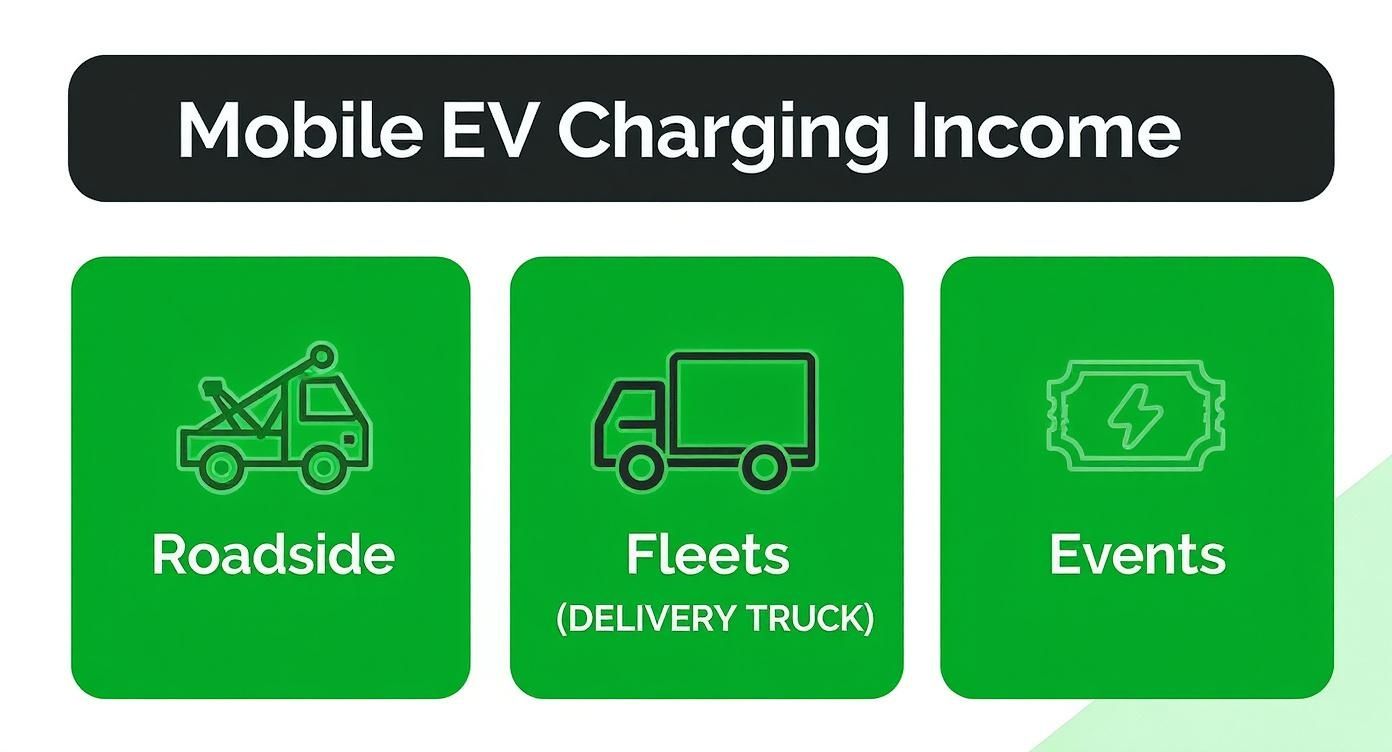
As you can see, the real earning potential comes from servicing those high-value needs like roadside assistance , fleet support and temporary events . In these scenarios, operators can charge a premium for the incredible convenience they offer, turning a vehicle into a profitable, mobile energy asset. This unique adaptability is what makes it such a powerful and growing part of the wider EV ecosystem.
Your Next Steps to a Successful Installation
Taking the plunge and installing a home EV charger is a big move towards cheaper, cleaner driving. Now that you've got a handle on the costs, the final stage is turning that plan into a reality.
This checklist will walk you through the process, making sure you feel confident from your initial checks right through to the final sign-off.
First things first, you need to get a clear picture of your home’s electrical setup. Take a look at your consumer unit (that's your fuse box) and make a note of its age and capacity. While you're at it, measure the distance from the consumer unit to where you want the charger, as this will be a key factor in your final quote.
Creating Your Action Plan
With a basic assessment of your property done, it’s time to bring in the experts. Getting this part right is crucial for a safe and reliable installation that will serve you well for years to come. A methodical approach here will help you find the best blend of value and expertise.
Here’s a simple action plan to follow:
- Gather Multiple Quotes: Get in touch with at least three different OZEV-approved installers. This gives you a clear comparison on price and lets you get a feel for their professionalism and knowledge.
- Verify Certifications: Make sure any electrician you consider is certified for EV chargepoint installation. You're looking for credentials from bodies like NICEIC or NAPIT , which guarantee they work to the highest UK safety standards.
- Review Charger Options: Chat with the installers about which charger model best fits your car and charging habits. They can give you the real-world pros and cons of tethered versus untethered units.
Choosing a qualified and certified electrician is the single most important decision you will make in this process. It’s a non-negotiable step that guarantees the safety of your home and the correct operation of your charger.
Finally, once you have your quotes lined up, you can look into how you'd like to pay. Many people find that spreading the cost makes the investment much more manageable. For more on this, check out our helpful guide on arranging finance for EV chargers.
Of course. Here is the rewritten section, crafted to match the human, expert tone of the provided examples.
Your Questions, Answered
Once you start digging into the details of EV charging, a few common questions always seem to pop up. Let's tackle them head-on with some straightforward answers.
Do I Need Planning Permission to Install an EV Charger in the UK?
For most homeowners, the answer is no. Installing a home EV charger typically falls under 'permitted development', which puts it in the same category as other minor home improvements. No paperwork needed.
However, you should always double-check if your property is a listed building or sits within a conservation area. In those cases, it’s best to have a quick chat with your local council before any work begins, just to be safe.
How Long Does a Typical Home EV Charger Installation Take?
A standard installation is surprisingly quick. If your chosen spot for the charger is close to your fuse box (or consumer unit), a qualified electrician can usually have it all done and dusted in two to four hours .
If the job is a bit more complex—perhaps needing a long cable run, some light groundwork or a few electrical upgrades—it might take up a full day. Your installer will give you a clear time estimate when they provide your quote.
What Is a Smart Charger and Why Do I Need One?
A smart charger is simply a charger that can connect to the internet. This little feature makes a huge difference, allowing you to schedule when your car charges. You can set it to top up during off-peak hours when electricity is cheapest and the grid is under less strain.
In fact, under UK government regulations, all new home and workplace chargers must be smart. It’s a simple way to help manage national energy demand and more importantly, trim down your electricity bills.
Think of it like setting a timer for your car's 'refuelling'. Instead of plugging in and charging at peak prices, you can use an app on your phone to tell it to wait for the cheaper overnight rates to kick in.
Can I Install an EV Charger Myself to Save Money?
Absolutely not. This is one job you can't DIY. Installing an EV charger involves working with high-voltage electricity and requires a qualified electrician who is certified for EV chargepoint installations.
Using a certified professional isn't just about safety; it ensures the work complies with UK wiring regulations ( BS 7671 ) and makes you eligible for any government grants that might be available. It's not worth the risk to cut corners here.
For businesses and drivers who need charging solutions beyond a fixed point, ZAPME offers pioneering mobile and portable EV charging. Discover our flexible Energy as a Service options at https://www.zapme.biz.