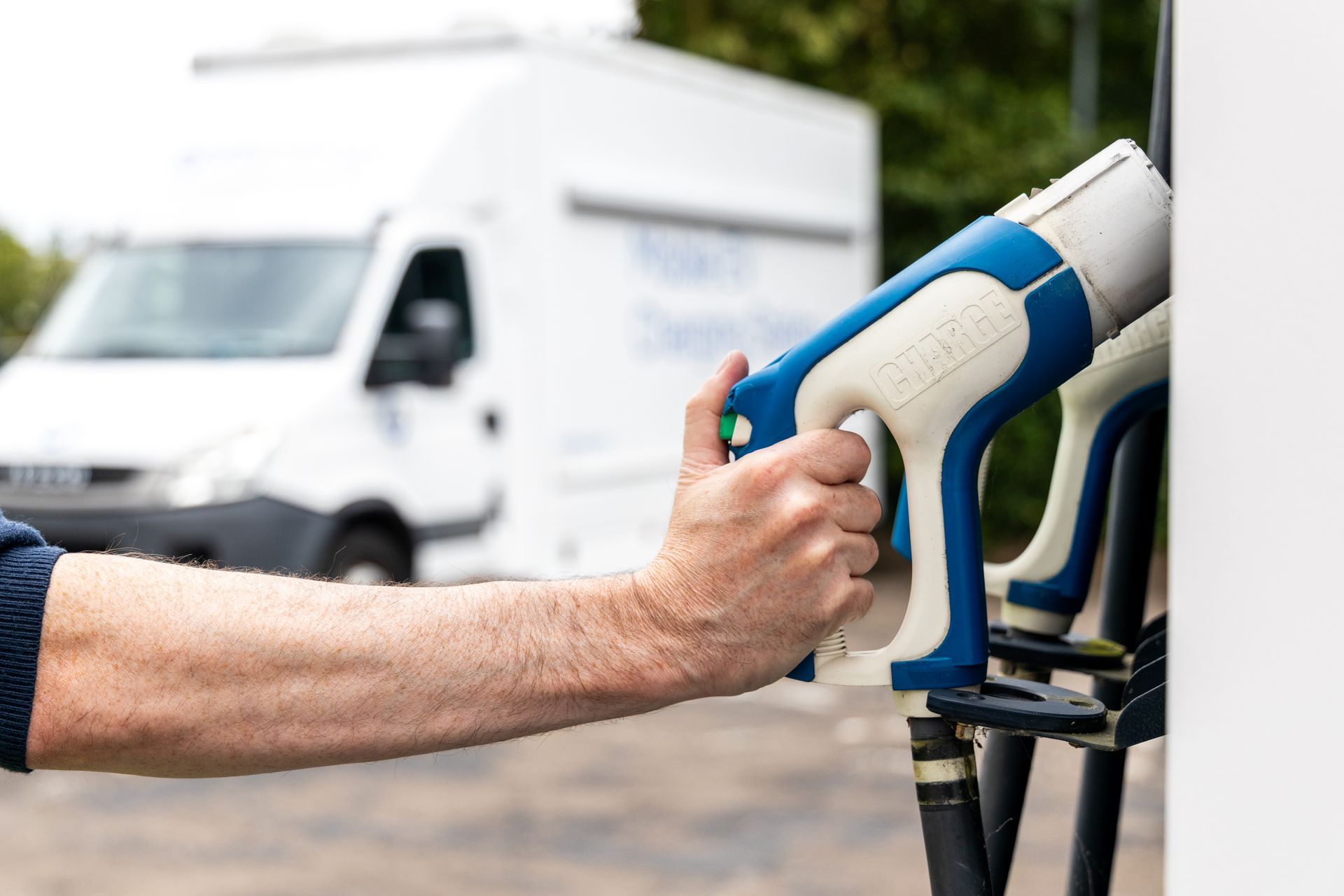


Fast Charger Electric Vehicle UK Guide
A fast charger for an electric vehicle is all about getting you back on the road in minutes, not hours. Think of it as the difference between filling a paddling pool with a garden hose versus a fire hose. This guide will break down what fast charging really means, from the tech that makes it possible to the massive business opportunities opening up right here in the UK.
The UK’s Growing Demand for Fast EV Charging
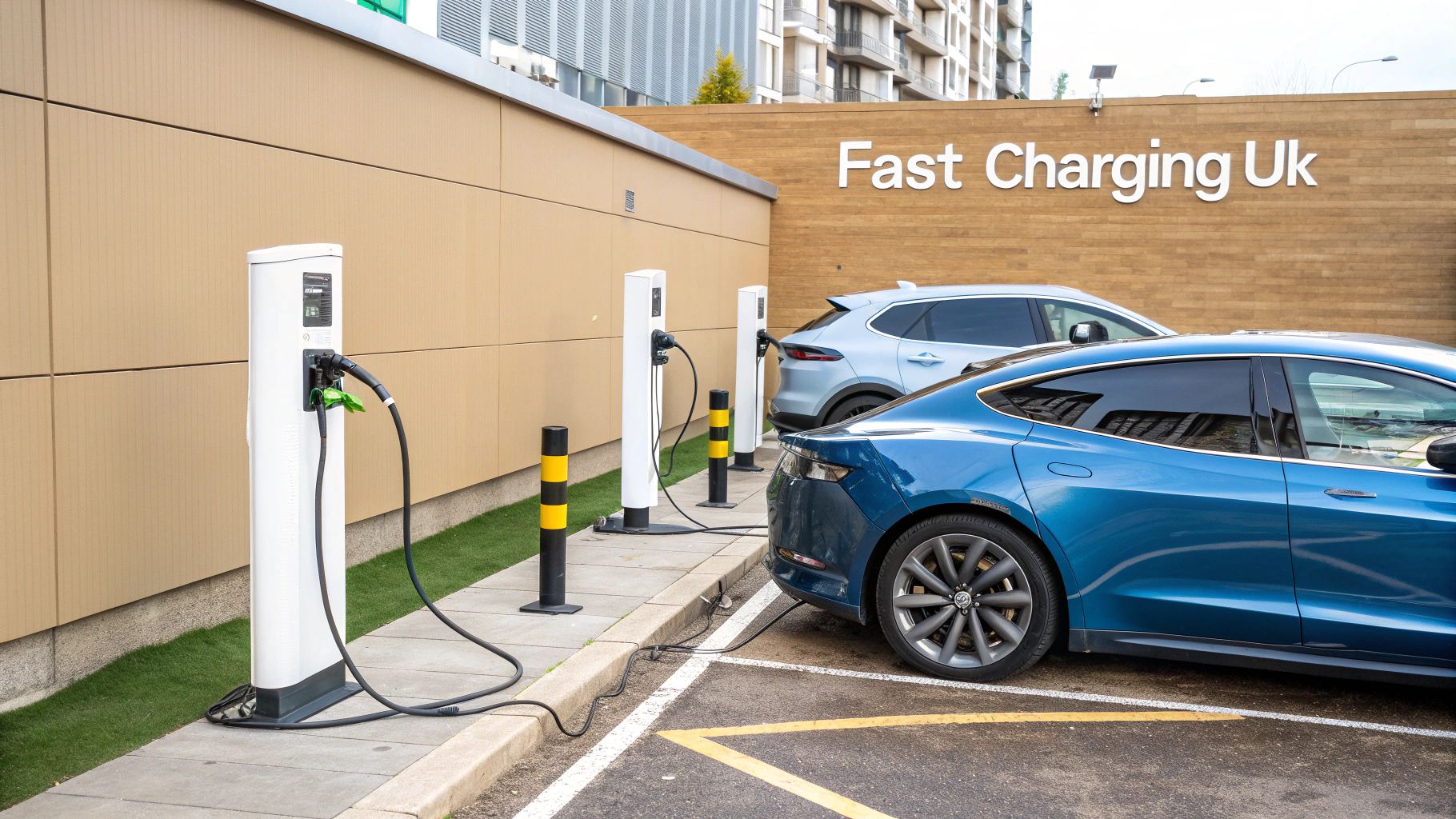
As electric vehicle adoption skyrockets across the UK, the conversation has moved on from ‘if’ we need EVs to ‘how’ we can power them efficiently. The hunger for convenient, rapid charging has never been greater and it is creating a dynamic and profitable new market.
The national infrastructure is scrambling to keep up. In the first half of 2025 alone, around 8,670 new public EV charging devices were installed. That’s a 27% year-on-year increase in the total number of chargers. You can dig into more data on the UK's EV charging expansion over at Willowleasing.com. This isn't just a statistic; it's a clear signal of public demand for accessible power.
Tapping into Mobile Charging Opportunities
While fixed charging stations are the backbone of the network, they have their limits—namely high installation costs and being stuck in one place. This is where mobile charging steps in as a clever, flexible and seriously profitable alternative. A mobile fast charger for an electric vehicle lets an operator take the power directly to the customer, wherever they are.
This on-demand service model opens up some powerful revenue streams for savvy entrepreneurs:
- Roadside Rescue: Offering emergency top-ups for drivers who have run out of juice miles from a station.
- Fleet Services: Providing scheduled charging for commercial fleets at their own depots, saving them the headache and cost of major grid upgrades.
- Event Power: Supplying temporary charging for festivals, concerts and corporate events where fixed points just do not exist.
A single mobile charging unit completing just a few call-outs a day could generate substantial annual revenue, with operators potentially earning tens of thousands of pounds per unit. It is an incredibly attractive and scalable investment for anyone looking to get into the EV market without the colossal overheads of fixed infrastructure.
The beauty of a mobile business is its agility. Operators can go where the demand is, turning frustrating charging gaps into a real commercial advantage.
Understanding AC vs DC Charging Technology
To really get what makes a fast EV charger so fast, we need to talk about the two types of electricity involved: Alternating Current (AC) and Direct Current (DC) . Both will charge your car but they do it in completely different ways and that is why the time it takes can vary so wildly.
Think of it like this: the national grid supplies AC power, which is like a river that constantly changes its flow direction. Your EV’s battery, however, can only store power as DC, which is a steady, one-way stream. This mismatch is the central challenge of EV charging.
When you use a typical AC charger, the car itself has to do all the heavy lifting. The AC power flows into the vehicle's onboard charger , a built-in bit of kit that converts the electricity from AC to DC before it can go into the battery. This onboard converter is the bottleneck; it has its limits and can only process so much power at once, making the whole thing relatively slow.
AC Charging: The Everyday Top-Up
AC charging is what you will almost always find at home or in workplace car parks. It is perfect for those times when you are not in a rush, like plugging in overnight or during a full day at the office.
- How it Works: The charger itself is a fairly simple box that safely delivers AC power from the mains to your car. From there, your vehicle's internal converter takes over.
- Typical Speeds: Power ratings for these chargers usually sit somewhere between 3kW and 22kW .
- Best Use Case: It is the ideal way to gradually top up your battery, ensuring you have a full "tank" for the next day without needing a high-powered, expensive setup at home.
This method is convenient and cheap for daily use but it is no help for drivers who need to get back on the road in a hurry. That is where DC charging completely changes the game.
DC Charging: The High-Speed Refuel
DC charging is the magic behind every genuine fast charger electric vehicle station. It takes a much more direct and powerful approach by completely bypassing the car's slow internal converter.
It is the difference between filling your water bottle with a small funnel versus a high-pressure fire hose. The big, complex job of converting power from AC to DC happens inside the charging unit itself, before the electricity ever reaches your car. This allows a massive amount of ready-to-use DC power to be pumped straight into the battery. This direct delivery is exactly why it is so much faster. You can learn more about this process in our comprehensive guide to an AC to DC battery charger.
Because all the hard work is done outside the vehicle, DC chargers can deliver power at incredible rates—often from 50kW to over 350kW . This can replenish 80% of a battery’s charge in as little as 20-30 minutes , making it absolutely essential for long journeys.
The difference really boils down to where the conversion happens.
| Feature | AC Charging | DC Fast Charging |
|---|---|---|
| Power Conversion | Inside the vehicle's onboard charger | Inside the external charging station |
| Typical Speed | Slow to Fast ( 3kW – 22kW ) | Rapid to Ultra-Rapid ( 50kW+ ) |
| Primary Use | Overnight, workplace, destination | Motorway services, public hubs, on-demand |
| Analogy | Filling a bottle with a small funnel | Filling a bottle with a fire hose |
Ultimately, getting your head around AC vs DC is key. AC is for when time is on your side but for real speed and on-the-go convenience, DC technology is the undisputed champion. It is what makes rapid refuelling a reality and turns long-distance EV travel from a chore into a seamless experience.
Decoding Charging Speeds and Power Ratings
When you're new to the world of EVs, the language around charging can feel a bit like alphabet soup. You will hear terms like kilowatts (kW) and phrases like ‘ultra-rapid’ thrown around but what do they actually mean when you pull up to a charge point? Getting to grips with these power ratings is the key to managing your time and making the most of your electric car.
A charger's power rating, measured in kilowatts, tells you how quickly it can push energy into your car's battery. Think of it like filling a bucket with a hose: a higher kW rating is like a wider, high-pressure fire hose, while a lower rating is more like a garden hose. Naturally, the fire hose gets the job done much, much faster. This is why a fast charger for an electric vehicle is all about its high kilowatt output.
This simple infographic breaks down the two main ways of getting power into your EV: the slower AC route you will find at home, and the much quicker DC fast charging option.
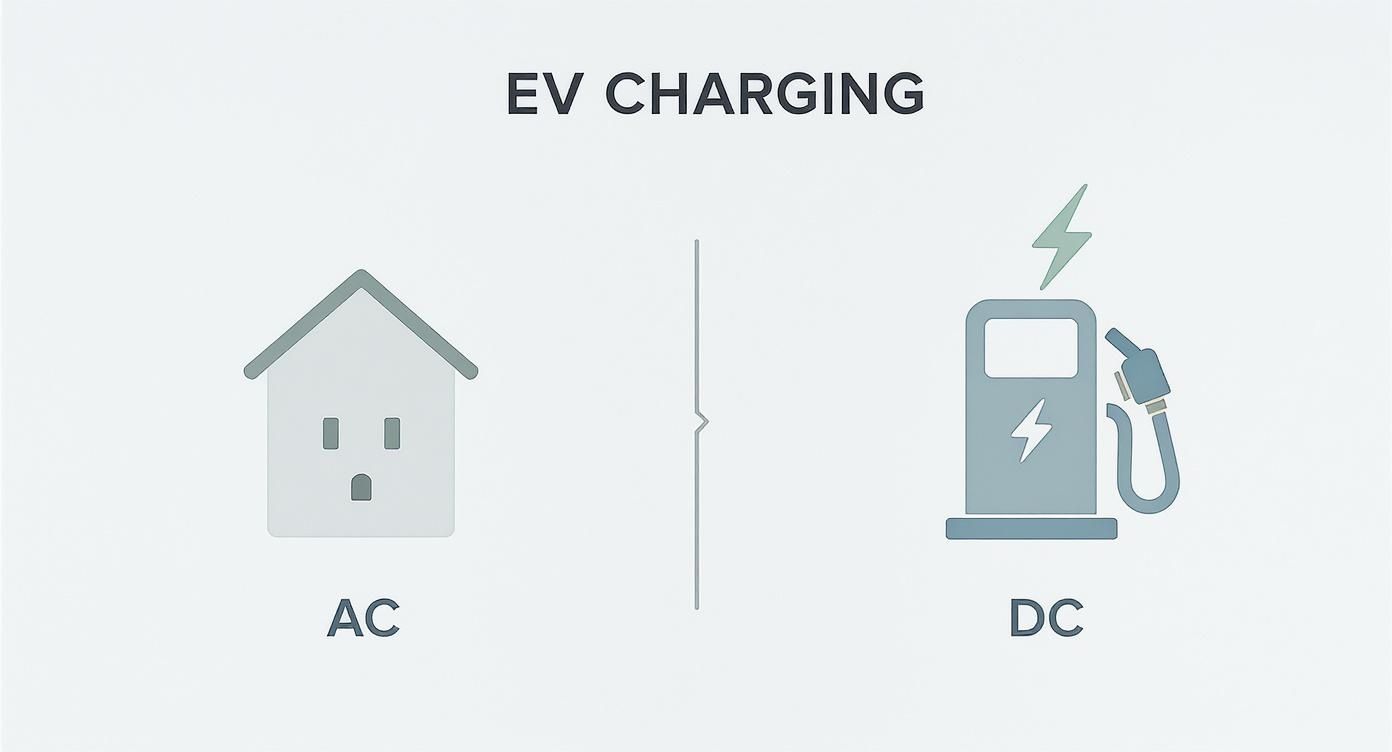
As you can see, AC power needs to be converted inside the car, which puts a cap on the speed. DC fast charging bypasses that internal converter, delivering power directly to the battery for a rapid top-up.
The Tiers of Charging Speed
To make things easier, the industry groups chargers into different speed tiers. Each one is built for a different job, from a slow overnight top-up at home to a lightning-fast pit stop on the motorway.
- Slow Charging (3-7kW AC): This is your typical home charging setup, often using a dedicated wall box or even a standard 3-pin plug in a pinch. It is perfect for plugging in overnight but a full charge can easily take over 12 hours.
- Fast Charging (7-22kW AC): You will find these dotted around public car parks, supermarkets and workplaces. They give you a decent speed boost over a home unit, usually topping up a battery in 3-6 hours.
- Rapid Charging (50-149kW DC): Now we are talking. This is where true DC fast charging kicks in. These are the chargers you rely on for long journeys, capable of adding around 100 miles of range in just 20-30 minutes.
- Ultra-Rapid Charging (150kW+ DC): The top tier. These incredibly powerful chargers are designed to get you back on your way in the shortest time possible, often taking a battery to 80% in under 20 minutes .
Why Your Car Will Not Always Charge at Maximum Speed
Here is a crucial point that catches out a lot of new EV drivers: plugging into a 150kW charger does not guarantee you will get 150kW of power. The actual speed is more of a negotiation between the charger and your car and a few real-world factors can throttle things back.
The charging speed you experience is only as fast as its weakest link. Your vehicle's own capabilities, its battery condition and even the weather all play a significant role in determining the final power output.
Knowing about these variables helps set realistic expectations. If you want to get into the nitty-gritty, our detailed guide explains how many kilowatts are needed to charge an electric car in the UK.
Here are the key things that can affect your speed:
- Vehicle’s Maximum Charging Rate: Every EV has a built-in limit on how much DC power it can handle. If your car’s max rate is 100kW, it does not matter if you plug it into a 350kW ultra-rapid charger – it will never draw more than 100kW.
- Battery State of Charge (SoC): Batteries charge fastest when they are emptier. Once the battery fills up past about 80% , the car’s management system deliberately slows the charging speed down to protect the battery’s long-term health.
- Battery Temperature: Batteries are a bit like us – they do not like being too hot or too cold. A chilly battery needs to warm up before it can accept a fast charge, so your initial speed on a cold day might be much lower than the charger's advertised rate.
Estimated EV Charging Times by Charger Power Rating
To put all this into perspective, the table below shows how these power ratings translate into real-world charging times for a typical 60kWh EV battery. It illustrates the approximate time needed to go from a 20% to an 80% charge, which is the most common and efficient way to use public fast chargers.
| Charger Type | Power Rating (kW) | Estimated Time (20-80%) |
|---|---|---|
| Slow (AC) | 3.6kW | Approx. 10 hours |
| Fast (AC) | 22kW | Approx. 1.5 - 2 hours |
| Rapid (DC) | 50kW | Approx. 40 - 50 minutes |
| Ultra-Rapid (DC) | 150kW | Approx. 15 - 20 minutes |
The difference is stark. The time saved by using a high-powered fast charger electric vehicle station is what makes long-distance EV travel practical and convenient. It is why a robust DC fast charging network is absolutely essential for modern drivers.
The Profitable World of Mobile EV Charging
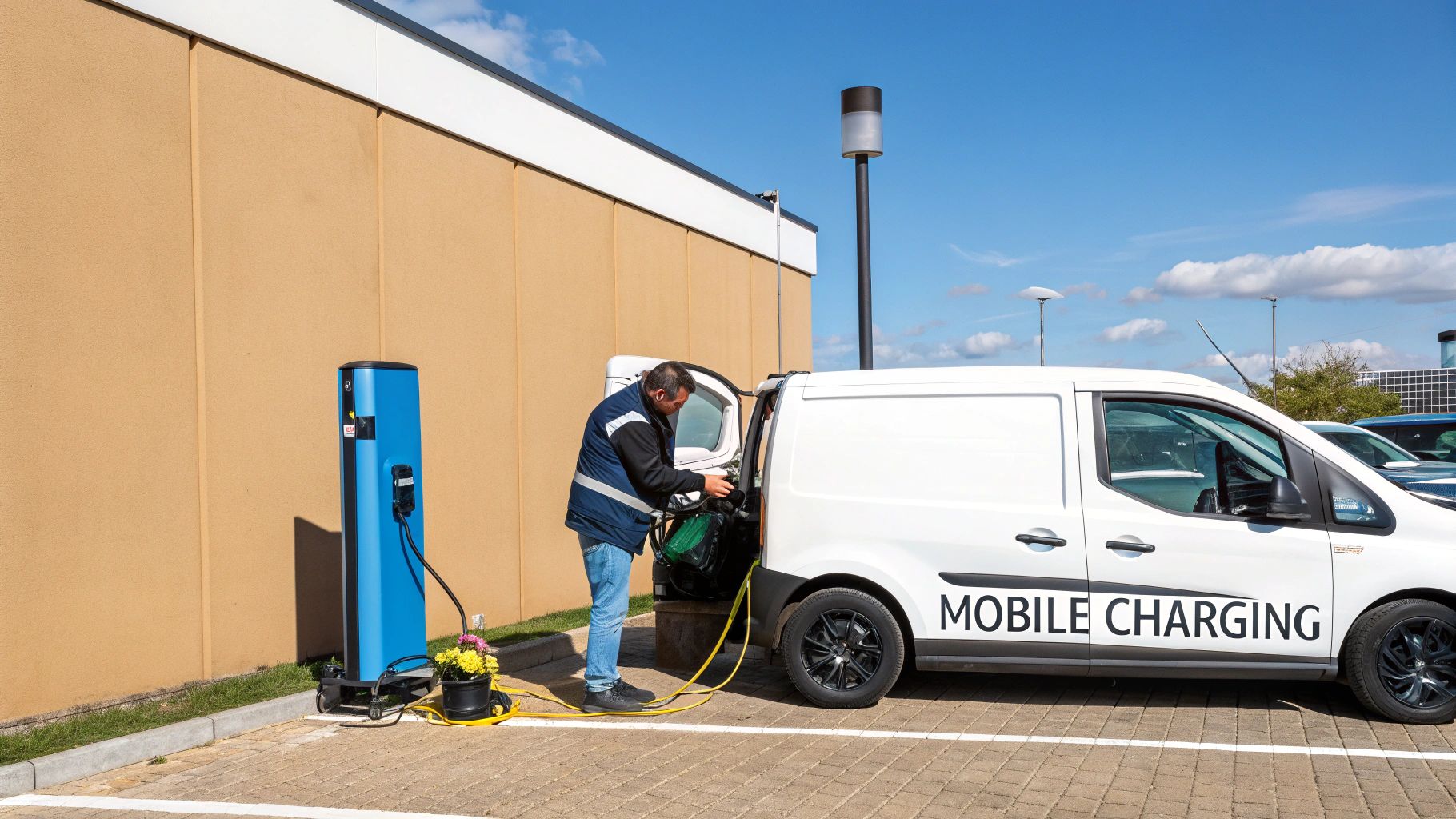
While the network of fixed charging stations is certainly growing, a far more agile and potentially lucrative opportunity is taking shape. Mobile charging flips the conventional model on its head. Instead of drivers hunting for a charger, the charger comes directly to them. This simple shift creates a powerful business case built on pure flexibility, speed and profitability.
Fixed installations are notoriously expensive and, well, fixed. They often involve eye-watering investments in grid upgrades, lengthy planning permissions and long-term site leases. Mobile charging units sidestep these hurdles entirely. Think of it as a charging station on wheels, perfectly placed to fill the crucial gaps in today's infrastructure and generate significant income for its operator.
This is not just about convenience; it is a direct response to very real market needs. It is for drivers stranded with a dead battery, commercial fleets needing reliable overnight top-ups at their depots and even large-scale events that need temporary power solutions. Each scenario is a distinct and profitable revenue stream waiting to be tapped.
Unlocking Multiple Revenue Streams
The financial appeal of running a mobile fast charger for an electric vehicle lies in its sheer diversity of income. Unlike a static station that just waits for passing trade, a mobile operator can actively chase and secure multiple lines of business. This creates a far more resilient and profitable enterprise from day one.
An operator's revenue is typically built from a few key sources. First, there is the direct sale of energy — charging customers a premium per-kWh rate that covers your electricity cost and generates a healthy margin. This is usually boosted by a call-out fee, much like a roadside assistance service, guaranteeing income for every job you attend.
But the real money is often in service contracts.
By establishing partnerships with local businesses, fleet operators or even event management companies, a mobile charging business can secure predictable, recurring revenue that forms the financial bedrock of the operation.
These contracts can be anything from providing daily top-ups for a local delivery fleet to being the official charging partner for a weekend festival. Each one offers serious earning potential.
Analysing the Profitability of Mobile Charging
Let's break down a realistic financial model to show just how profitable this can be. A single mobile charging unit, like one from the ZAPME range, quickly becomes a hard-working asset. The initial investment is a fraction of what is needed for a fixed rapid charging hub and its operational flexibility means the asset is always where the demand is highest.
Consider a simple scenario for a single operator:
- Emergency Call-Outs: Just two or three roadside assistance jobs a day can generate substantial income. With a combination of a call-out fee and a marked-up energy price, these jobs are highly profitable.
- Scheduled Fleet Charging: A contract to charge five fleet vehicles overnight provides a steady, predictable income stream. This service saves the fleet owner the immense cost of installing their own high-power charging infrastructure.
- Weekend Event Hire: Securing a contract for a single weekend event can bring in a significant lump sum, often equal to a full week's worth of regular call-outs.
When you combine these streams, the annual revenue from just one mobile unit can be impressive. A well-run operation completing a handful of jobs daily could easily generate tens of thousands of pounds in annual profit, making it a highly attractive route for entrepreneurs looking to get into the EV market.
The Strategic Advantage Over Fixed Infrastructure
The growth of fixed infrastructure is undeniable. For instance, charging hubs with six or more rapid chargers have shot up, with 136 new hubs added in the first half of 2025 alone, bringing the UK total to 673 . These sites are vital for long-distance travel but they also shine a spotlight on the limitations of a fixed-location model. You can explore more about this growth in charging infrastructure and its impact on drivers.
This expansion actually creates more opportunities for mobile solutions. The very existence of these hubs educates the public on the benefits of rapid charging, yet they cannot be everywhere. Mobile units are the perfect complement, reaching all the places fixed hubs cannot. They can service residential streets with no off-street parking, sprawling industrial estates and rural ‘charging deserts’.
Ultimately, the mobile charging model thrives on agility. Operators are not tied to a single location's success or failure. They can move with population shifts, follow seasonal demand (think coastal resorts in summer) and react instantly to new commercial opportunities. This makes a mobile fast charger electric vehicle business a truly scalable and future-proof investment in the UK's rapidly changing transport landscape.
Solving the UK's Charging Infrastructure Gaps
While the UK’s public charging network is growing, its expansion has been far from even. This has left noticeable gaps across the country – and they are not just minor inconveniences. These gaps are real roadblocks for millions of potential electric vehicle drivers and highlight a clear opportunity for more agile, on-demand charging solutions. The fixed infrastructure model, for all its benefits, simply cannot solve every problem.
Huge parts of the UK still suffer from being ‘charging deserts’. This is especially true in rural communities, where sparse populations make it hard to justify the huge investment needed for a fixed rapid charging hub. But it is just as big a problem in dense urban neighbourhoods, where rows of terraced houses leave residents with no off-street parking for overnight charging.
For these drivers, owning an EV remains a frustratingly out-of-reach prospect.
The Hurdles of Fixed Infrastructure
Beyond the geographical blind spots, the practicalities of installing fixed rapid chargers are riddled with logistical and financial headaches. An operator cannot just decide to install a fast charger electric vehicle station and get it done. The process is often agonisingly slow and incredibly expensive, thanks to several key obstacles.
- Securing Planning Permission: Getting the green light from local authorities can be a drawn-out affair, particularly in conservation areas or places of historical significance. Community objections and tangled regulations can easily add months, or even years, to a project's timeline.
- Managing Grid Upgrades: A bank of rapid chargers puts a colossal strain on the local electricity grid. In many areas, the existing infrastructure just cannot handle it. This means hugely expensive upgrades are needed, often costing tens or even hundreds of thousands of pounds.
- High Capital Expenditure: The cost of the hardware itself, combined with groundworks and connection fees, means that setting up even a modest charging hub is a multi-million-pound investment. That creates a massive barrier to entry for new operators trying to break into the market.
All these factors combine to make fixed infrastructure a slow and cumbersome solution to a problem that needs a fast, flexible answer.
Mobile Charging as the Strategic Solution
This is exactly where the strategic value of mobile charging shines. Nimble, grid-independent units are perfectly placed to fill these gaps, turning what was an infrastructure challenge into a compelling business opportunity. Instead of waiting years for the grid to catch up, a mobile operator can deliver power directly to where it is needed most, right now.
Mobile charging units are not just a stopgap; they are a vital and profitable component of a modern charging ecosystem. They provide an immediate solution to the UK's charging deserts and offer a service that fixed points simply cannot match.
The need for a more robust network is urgent. Projections suggest that by 2030 , the UK will need a massive increase in public fast charging points to support the surge in EV ownership following the government's ban on new petrol and diesel car sales. You can explore a detailed analysis of the UK's future charging needs from the ICCT. Mobile units will be absolutely essential to meeting this demand.
An operator with a mobile charger can service city residents who do not have driveways, support rural businesses or provide emergency power in any location. This flexibility does not just solve a critical problem for drivers; it creates a highly profitable business model. It neatly sidesteps the planning headaches and grid upgrade costs, allowing entrepreneurs to enter the market quickly and target underserved customers for maximum return.
So, You Want to Launch a Mobile Charging Business?
Jumping into the mobile EV charging market is a genuine opportunity to build something lasting and future-proof. The big switch to electric is not just an environmental trend; it is a new commercial landscape, wide open for entrepreneurs who can deliver power where and when it is needed most. This is your practical guide to getting started on the right foot.
Your first move is picking the right gear. The mobile charging unit is the absolute heart of your operation, so you have to choose a versatile and reliable fast charger for an electric vehicle . Think about systems like the ZAPME range—they offer different battery capacities and power outputs to match what you want to do, whether it is emergency roadside rescues or scheduled top-ups for a local business fleet.
Next, you have got to nail your pricing. This is not just about slapping a price on a kilowatt-hour. A smart, robust model will have several income streams working for you, maximising your profit and keeping the cash flowing.
Building Your Pricing Model
To build a business that sticks around, what you charge has to reflect the real value you are providing. You are not just selling electricity; you are selling convenience, speed and a fix for a major headache. Do not get dragged into a race to the bottom on energy costs.
A solid strategy should always include:
- A Call-Out Fee: This is non-negotiable. It covers your fuel, time and operational costs for every single job, making sure you are profitable from the moment you start your engine.
- Per-kWh Energy Rate: Charge a premium for the electricity you deliver. Your rate needs to be higher than a fixed public charger to account for the mobile, on-demand nature of your service.
- Subscription or Contract Rates: This is where you build stability. Offer discounted packages for regular clients like commercial fleets, apartment blocks or business parks. It is the key to predictable, recurring income.
Finding Your Customers and Growing Your Business
Okay, you have got the kit and you know what you will charge. Now, who are you selling to? Pinpoint your target market. Are you going after stranded drivers, local businesses with electric vans or even event organisers needing temporary power? A focused approach makes your marketing a hundred times more effective.
For a deeper dive into growing your customer base, check out these effective marketing strategies for small businesses.
The real secret here is to turn those infrastructure gaps we talked about earlier into your biggest business advantage. Position yourself as the go-to solution for 'charging deserts' and neighbourhoods full of homes without driveways. You will be tapping into a market that is not just underserved but genuinely grateful.
With the right strategy, a single mobile charging unit can become the foundation of a thriving business. For a more detailed walkthrough, our UK mobile EV charging service guide offers an in-depth look at building your venture from the ground up. This is your chance to get in on one of the UK's most exciting growth sectors.
Frequently Asked Questions
Still got a few questions buzzing around about fast EV charging? We get it. Here are some straightforward answers to the most common queries we hear from EV drivers and aspiring mobile charging operators alike.
How Much Money Can I Make with a Mobile EV Charger?
The earning potential for a mobile charging business is surprisingly strong and it does not just come from one place. You have got multiple revenue streams to tap into: charging a call-out fee for on-demand rescues, selling electricity at a healthy per-kWh rate and even landing lucrative contracts with local businesses that need to keep their fleets topped up.
Think about it. A single mobile unit, handling just a couple of jobs a day—perhaps a mix of emergency call-outs and scheduled fleet top-ups—can generate a very healthy annual income. The real magic is its flexibility. You go where the demand is, meaning your charger is always working for you, unlike a fixed station that just has to sit and wait for customers to show up.
What Is the Difference Between Rapid and Ultra-Rapid Charging?
Good question. Both ‘rapid’ and ‘ultra-rapid’ refer to the seriously quick DC charging but they describe different levels of power. Getting your head around the distinction is key to managing charging time expectations.
- Rapid Chargers are the workhorses, typically delivering between 50kW and 149kW . These will get most compatible EVs to 80% in around 40 minutes .
- Ultra-Rapid Chargers are the top-tier speed demons, offering 150kW or more—with some monsters hitting 350kW . These can slash charging times to under 20 minutes for an 80% top-up but only for cars that can handle that kind of pace.
Can Any EV Use Any Fast Charger?
Not quite. While most modern EVs in the UK use the standard CCS (Combined Charging System) plug for DC fast charging, it is not a free-for-all. Two things really matter: the physical plug and the car's own limits.
First, the car obviously needs the right connector to physically plug in. But more importantly, every single EV has a maximum charging speed it can accept. If a car's limit is 100kW , you can plug it into a 350kW ultra-rapid charger but it will never draw more than 100kW . The charging session always defaults to the slower of the two—either the car's maximum speed or the charger's.
Why Do Mobile Chargers Offer a Better Return on Investment?
This is where the business case gets really interesting. Mobile charging solutions often deliver a much better return on investment than digging up the ground to install fixed chargers and for a few solid reasons. The upfront cost is dramatically lower because you skip the eye-watering expense of grid upgrades, planning permission battles and major construction work.
A mobile charging business sidesteps the biggest financial and logistical headaches that come with fixed installations. This means you can get to market faster, start earning sooner and adapt to changing demand without being chained to an expensive, immovable lump of concrete and steel.
On top of that, a mobile unit’s ability to serve different needs—from roadside assistance to business fleets—creates a much more resilient and diverse business model. You can start maximising your asset's earning potential from the very first day.
Ready to turn the UK's charging gaps into your business opportunity? ZAPME offers a complete range of mobile EV charging solutions designed to get your venture on the road.