

EV Chargers at the Workplace: A Profit & Power Guide
Installing EV chargers at your workplace isn't just a nice-to-have perk anymore; it's quickly becoming a core business necessity. Done right, it can transform your car park from a simple cost centre into a valuable, revenue-generating asset. This guide will show you how to plan, deploy and monetise this essential infrastructure, with a close look at the powerful financial and operational perks of mobile charging.
Why Your Car Park Is an Untapped Asset
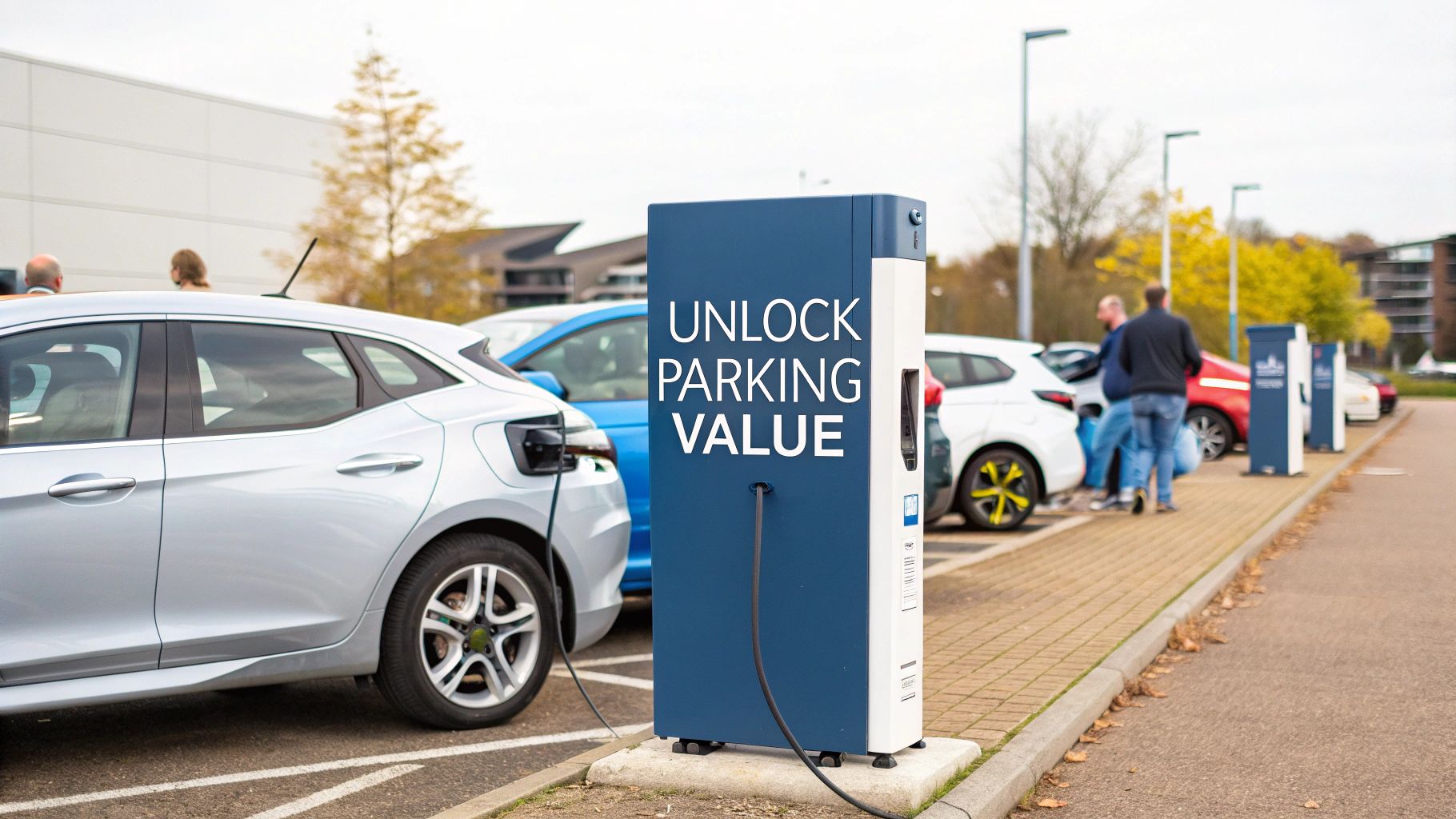
The corporate car park is evolving. As more of your employees, clients and even your own fleet vehicles switch to electric, the demand for reliable on-site charging is soaring. This shift is a massive opportunity for businesses to unlock new value from what has traditionally been a depreciating asset.
Instead of seeing charging infrastructure as just another expense, forward-thinking companies are realising it's a powerful tool for boosting employee satisfaction, enhancing their brand and generating direct profit. A recent survey really drove this home, noting that 42% of EV drivers see workplace charging as a key factor in their job satisfaction—placing it on par with other highly sought-after benefits.
The Financial Opportunity of Mobile Charging
The quickest way to start monetising your car park is with mobile EV chargers. Unlike fixed installations that demand extensive groundwork, planning permission and a significant capital spend, mobile units offer a simple plug-and-play solution. You can start generating revenue almost immediately.
Let's look at a simple model. Imagine an operator buys electricity at a commercial rate of 25p per kilowatt-hour (kWh) and sells it to users for 50p per kWh. A single mobile unit delivering an average of 50kWh a day could generate a net profit of over £12 daily . That translates to more than £250 per month from just one charger, creating a tangible income stream with minimal upfront cost.
This isn't just a theory; it's a reflection of a growing trend. The number of workplace chargers in the UK is projected to triple from around 50,640 units to approximately 169,150 units by 2030 as more businesses catch on. To get a deeper dive into these trends, explore the complete UK guide on ZAPME.
By embracing flexible charging solutions, you're not just meeting a critical need for your employees and visitors. You're creating a new profit centre that future-proofs your commercial property and enhances its overall value.
To further protect your investment, consider implementing robust physical deterrents like Electric Vehicle Security Bollards. Now, let's walk through the practical steps of planning and deploying your own profitable charging setup.
Getting to Grips with Your Site and Power Needs
Before you even think about installing EV chargers, you need a crystal-clear picture of your site's electrical capacity and day-to-day operational demands. A thorough site survey isn’t just a box-ticking exercise; it's the bedrock of a successful and profitable charging strategy. Rushing this stage is a classic mistake that often leads to expensive corrections and missed opportunities down the line.
First up, you need to evaluate your existing electrical infrastructure. This means going deeper than a quick glance at the fuse box. You have to understand your building's total power capacity and crucially, how much of that is already being eaten up during peak hours by everything else – your lighting, HVAC systems, machinery, you name it.
This process will tell you the maximum capacity of your grid connection and shine a light on any potential power bottlenecks. Without this data, you’re flying blind and risk overloading your system, which can lead to frustrating power outages and even damage your equipment.
Understanding Your Real Power Demands
Calculating the real-world charging needs of your fleet and staff is the next critical step. It’s not enough to just count the number of electric vehicles on site; you have to dig into their specific energy requirements.
A few key factors to consider:
- Vehicle Types: A big delivery van with a hefty battery is going to need a lot more energy than a small commuter car.
- Typical Dwell Times: How long are vehicles usually parked? An employee’s car might be on-site for a full eight hours, making slower, steadier charging perfectly fine. A visitor’s vehicle, on the other hand, might only be there for an hour and need a quicker top-up.
- Daily Energy Requirements: Think about the average daily mileage of your fleet vehicles. This will tell you the minimum kilowatt-hours (kWh) they need to be ready for the next day's work. If you need a quick refresher, we've got a simple guide on how to calculate a kilowatt-hour here.
Workplace charging has become a massive piece of the UK's EV infrastructure puzzle. Estimates from 2021 suggested there were already around 33,000 sockets installed at workplaces. Data shows that about 11-13% of all EV charging happens during working hours, supplementing the 65% that’s done at home. This really underscores the growing expectation for businesses to provide these facilities. You can learn more about these workplace charging findings here.
The Strategic Choice: Mobile vs. Fixed Chargers
Your power assessment will naturally lead you to a crucial decision: do you install fixed charging infrastructure or deploy mobile chargers? For many businesses, especially those with power limitations or tricky site logistics, mobile chargers offer a far more practical and intelligent solution.
Fixed chargers often demand expensive and disruptive groundwork. We're talking digging trenches, laying cables and sometimes even upgrading entire substations. This process can be painfully slow and is often a non-starter for businesses in leased properties or listed buildings.
Mobile chargers cleverly sidestep all of these issues. Because they aren’t permanent fixtures, they require zero groundwork and can be deployed instantly using existing, standard plug sockets. This gives you unmatched flexibility, particularly for sites where extensive electrical work just isn't on the cards.
A mobile-first approach lets you scale your EV charging provision based on actual demand. You can start small with just a few units and add more as your fleet grows or as more employees switch to electric, avoiding the huge upfront capital cost that comes with fixed infrastructure.
Bypassing Power Limitations with a Mobile Strategy
So, what happens if your site survey reveals that your grid connection is already stretched to its limit? This is a really common roadblock that would traditionally bring a fixed charger project to a screeching halt.
This is where the financial and operational genius of mobile charging truly shines. Instead of forking out tens of thousands for a grid upgrade, you can use mobile chargers to manage your power consumption intelligently. These mobile units can be charged up during off-peak hours when electricity is cheaper and the overall site demand is low.
They can then be wheeled out during the day to charge vehicles without putting any extra strain on your grid connection during peak times. This not only solves the power constraint issue but also dramatically cuts your operational costs, allowing you to maximise your profit margin when you sell that electricity on to users.
Choosing Your Chargers: Mobile vs Fixed
Once you've got a handle on your site's power capacity, you're faced with one of the biggest decisions of the entire project: what kind of charging tech to actually use. This isn't just about picking plugs and cables; it's a strategic move that dictates your project's cost, scalability and ultimately, its profitability. The conversation nearly always boils down to traditional, fixed charging points versus modern, mobile EV chargers.
Fixed chargers are what most people think of first but they come with some serious baggage. The installation is often expensive and hugely disruptive, involving digging trenches, laying armoured cables and sometimes even forcing costly grid upgrades. For any business renting its premises, operating from a listed building, or on a site where major groundwork is a non-starter, this can kill the project before it even begins.
Embracing Flexibility with Mobile Chargers
Mobile EV chargers offer a completely different way of thinking. They bring an agile, cost-effective solution to the table that neatly sidesteps the major headaches of fixed infrastructure. Because they aren't permanent fixtures, they can be deployed instantly using existing three-phase or even standard wall sockets, which means zero civil engineering work.
This built-in flexibility is a genuine game-changer. You can put chargers exactly where they’re needed on any given day, reacting to demand in real-time. If one corner of the car park is suddenly busier, you just wheel the chargers over. That’s a level of adaptability fixed infrastructure can never hope to match.
For a deeper dive into how these technologies compare in different situations, you can explore the future of stationary vs mobile EV charging solutions in our detailed breakdown.
The Financial Power of Going Mobile
The biggest draw for mobile charging—and the one that really gets people's attention—is its financial model. The initial capital outlay is so much lower compared to fixed units, making it a far less intimidating investment. This not only makes it easier to get funding signed off but also dramatically shortens the time it takes to see a return.
Even better, mobile chargers unlock a powerful revenue stream with minimal fuss. An operator can start monetising their car park almost immediately, turning what was once just a patch of tarmac into a profit centre. The maths is compelling and refreshingly simple.
Imagine buying your electricity at a commercial rate of 25p per kWh . You can then sell this on through a mobile charger at a competitive 50p per kWh . A single unit delivering 50kWh in a day brings in a clear profit of £12.50 after your electricity costs. Over a year, that one charger could generate over £3,000 in profit.
This model isn't just profitable; it's incredibly scalable. You can start with a single unit and just add more as demand grows, making sure your investment always tracks your revenue. That kind of organic growth is impossible with a fixed installation, where you’re often forced to over-speculate and over-spend from day one.
Choosing between mobile and fixed chargers often comes down to the specifics of your site, your budget and your long-term goals. Here’s a straightforward comparison to help clarify the decision.
Mobile vs Fixed EV Chargers: A Workplace Comparison
| Feature | Mobile Chargers | Fixed Chargers |
|---|---|---|
| Installation | Plug-and-play; no groundwork needed. Deployed in minutes. | Requires trenching, cabling and civil works. Takes weeks or months. |
| Upfront Cost | Significantly lower capital investment per unit. | High initial cost for hardware, labour and grid connection. |
| Flexibility | Can be moved anywhere on-site to meet changing demand. | Permanent, immovable installation. Location is fixed. |
| Scalability | Add units one by one as needed. Pay-as-you-grow model. | Difficult and expensive to add more chargers later. |
| Revenue Generation | Immediate. Start earning from day one. | Delayed until after lengthy installation and commissioning. |
| Site Suitability | Ideal for leased properties, listed buildings and temporary sites. | Only suitable for owned property where major works are permitted. |
| Grid Impact | Minimal. Can use existing sockets, avoiding grid upgrades. | Often requires costly and slow grid capacity upgrades. |
This table makes it clear: while fixed chargers have their place, mobile solutions offer an unmatched level of agility and financial accessibility for many businesses.
Making the Right Decision for Your Site
In the end, the choice between mobile and fixed can often be distilled down to one simple factor: your available power. This decision tree shows the clear path forward once your site assessment is complete.

The flowchart lays out a critical checkpoint. If your site has enough spare power for fixed chargers, that route is certainly on the table. If not, mobile chargers give you an immediate and effective solution without the need for expensive electrical upgrades.
When Mobile Chargers Are the Superior Choice
There are countless real-world scenarios where mobile chargers aren't just an alternative but are, without a doubt, the better option. Think about these common business situations:
- Leased Office Spaces: Most tenancy agreements forbid tenants from making major alterations to a property, making fixed chargers a non-starter.
- Listed Buildings: Strict heritage regulations prevent the kind of groundwork and structural changes required for permanent installations.
- Short-Term Needs: A business hosting a big event or running a temporary operational base needs a solution they can roll in and roll out just as easily.
- Capital Constraints: A mobile-first strategy allows businesses to get into the EV charging game with a fraction of the budget needed for fixed points.
In all these cases, a mobile strategy delivers the power and flexibility needed to offer essential workplace EV charging without being shackled to a costly, immovable asset. This ability to adapt and scale based on what's actually happening on the ground is the defining advantage of a modern, mobile-first approach.
Funding Your Project and Navigating Grants
Figuring out how to finance your workplace EV charging project might feel like a huge hurdle but there are several routes you can take to soften the initial financial hit. Getting a handle on the available support is the first step to building a solid business case and getting your chargers on the ground.
Thankfully, the UK government has specific schemes designed to speed up the rollout of EV infrastructure. The biggest one for businesses is the Workplace Charging Scheme (WCS).
The WCS is a straightforward, voucher-based system that helps cover the upfront costs of buying and installing charge points. It’s open to eligible businesses, charities and public sector organisations across the country.
Once your application is approved, you get a voucher that can be redeemed by any OZEV-authorised commercial installer, like ZAPME. This gives you an immediate discount on your installation bill, making that initial investment far easier to swallow.
Navigating the Workplace Charging Scheme
So, who qualifies? To be eligible for the WCS, you’ll need to be a registered business, charity or public sector body in the UK. The key requirement is that you have dedicated off-street parking for your staff or fleet – the scheme isn’t available for domestic properties.
The grant provides up to £350 per socket for a maximum of 40 sockets across all your sites. This means a single business could get up to £14,000 in funding, which can make a massive difference in getting a comprehensive charging solution in place.
The WCS has been instrumental in growing the UK's charging network. Managed by the Office for Zero Emission Vehicles (OZEV), it has already funded the installation of 63,777 EV charging sockets in workplace car parks, with the total grant value hitting an impressive £16.6 million .
The main takeaway here is that government support is real and designed to be easy to access. Not looking into schemes like the WCS is basically leaving money on the table—money that could get your project moving much faster.
Exploring Alternative Funding Routes
While grants are a fantastic starting point, they aren't your only option. Many businesses are now looking at alternative financing models that offer more flexibility and keep capital free for other core operations.
- Operational Leasing: This is essentially renting the charging hardware for a fixed monthly fee. It’s a great choice if you want to avoid a big upfront payment and prefer predictable, manageable operational costs.
- Asset Finance: This works a lot like a loan, secured against the value of the chargers themselves. It lets you spread the cost over several years, making even a large-scale deployment feel much more affordable.
- Private Financing: Some providers offer their own in-house financing packages, often bundled with installation and maintenance services for a complete, hassle-free solution.
When you're mapping out your budget, it pays to think long-term. Consider the financial benefits of add-ons like solar battery backup, which can help manage peak energy loads and make you more energy-resilient. Looking into the costs and incentives for solar battery backup can give you a better picture of how these long-term investments stack up.
The Financial Advantage of Mobile Chargers
This is where mobile chargers, like the ones we provide at ZAPME, really come into their own from a funding perspective. Their upfront cost is significantly lower than fixed infrastructure, which makes securing the budget a whole lot easier.
Because you don't need any expensive civil engineering works or grid upgrades, the total project cost is dramatically lower.
This smaller financial barrier often means you can fund a mobile charging rollout directly from your operational budget, completely bypassing the long, drawn-out capital expenditure approval process. It also shrinks your timeline from decision to deployment—and to generating revenue—from months down to just a few days.
Turning Your Chargers Into a Revenue Stream
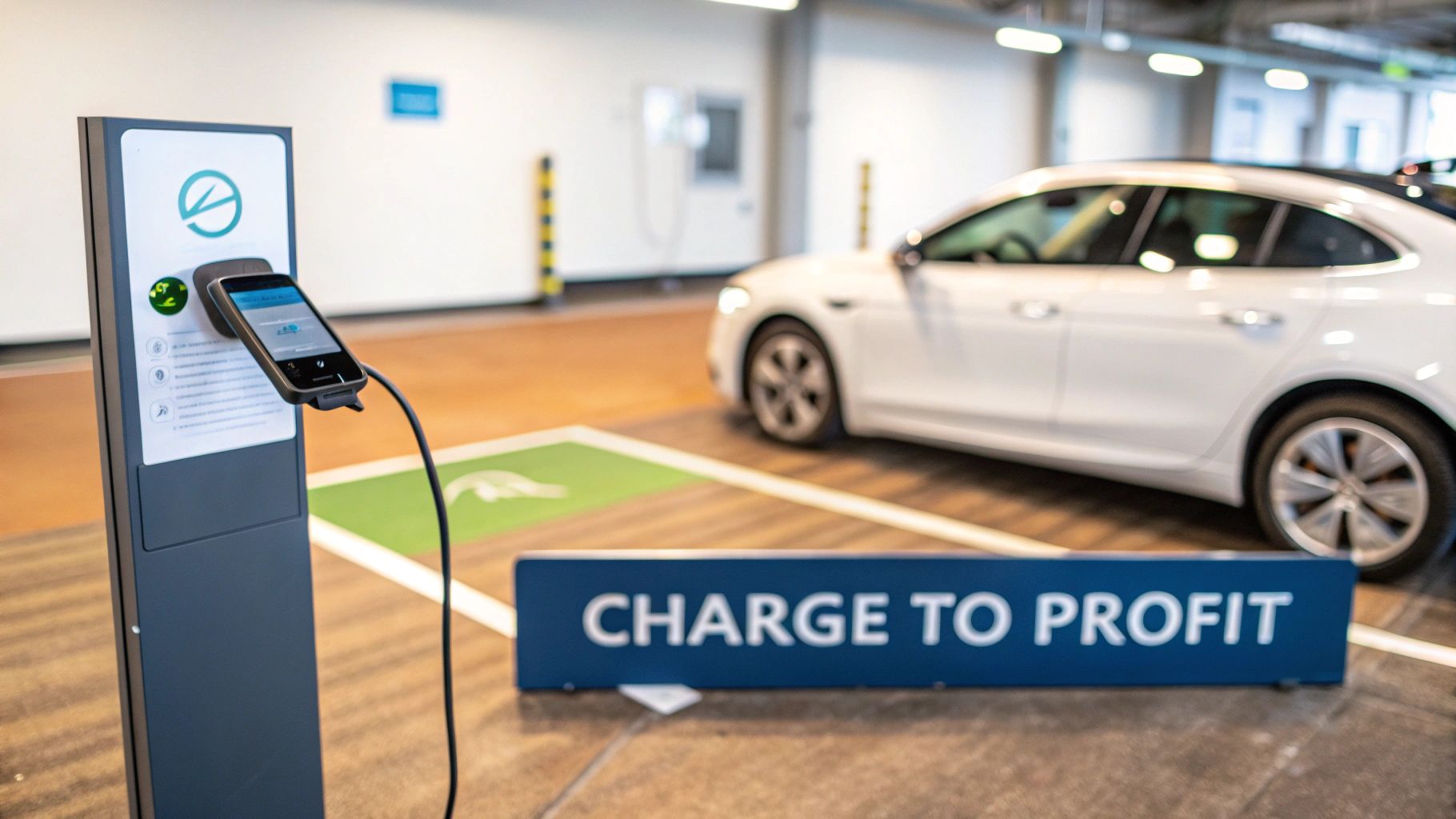
Putting EV chargers in your car park is one thing. Turning them into a genuine revenue stream is another. This is where smart operation comes in, transforming an essential service into a reliable source of income. Mobile chargers, in particular, offer a direct and simple path to monetisation without the heavy upfront costs and disruption of digging up your car park for fixed units.
By shifting your mindset from seeing charging as just a staff perk to treating it as a commercial service, you can turn your property into a profitable charging hub. The flexibility of mobile units means you can serve employees, visitors and your own fleet with a system that starts generating income from day one.
Building Your Billing Model
The foundation of a profitable charging service is a clear, fair billing model. Mobile chargers managed through a simple app make this surprisingly straightforward. You can easily set different tariffs for various user groups, creating a system that meets everyone’s needs while maximising your returns.
Here are a few proven approaches:
- Pay-As-You-Go for Staff and Visitors: This is the most direct model. Users pay per kilowatt-hour (kWh) they use. It’s transparent, easy to understand and ensures you cover your electricity costs while making a profit on every single charge.
- Integrated Fleet Billing: For your own company vehicles, you can track usage on a per-vehicle basis. This is a game-changer for precise cost allocation and managing your fleet’s operational budget.
- Subscription or Membership Tiers: Why not offer employees a monthly subscription for a set amount of charging at a slightly discounted rate? This creates a predictable, recurring revenue stream and builds loyalty.
The real beauty of a mobile solution is the ability to tweak these models on the fly. You can run promotions during quiet periods or set premium rates for high-demand visitor parking, all without needing complex hardware changes.
A Clear Financial Breakdown
The profit potential of mobile workplace EV charging is compelling. The calculation couldn't be simpler: you buy electricity at your commercial rate and you sell it for more. Let’s walk through a realistic scenario.
Imagine your business pays an average of 25p per kWh for its electricity. You decide to set a competitive charging rate of 50p per kWh for users—a price that’s often cheaper than public rapid chargers. This immediately creates a direct profit margin of 25p for every kWh sold.
A single mobile charger delivering just 50 kWh during a typical workday would generate:
- Daily Gross Revenue: 50 kWh x 50p = £25.00
- Daily Electricity Cost: 50 kWh x 25p = £12.50
- Daily Net Profit: £25.00 - £12.50 = £12.50
That might not sound like a huge number at first but it adds up fast. Over a standard working month, that one charger could generate over £250 in pure profit . A small fleet of just four mobile units could therefore produce a profit of over £1,000 per month .
To illustrate this, here’s a quick look at the potential monthly revenue from just one unit.
Potential Monthly Revenue From a Single Mobile Charger
| Metric | Example Value | Calculation Detail |
|---|---|---|
| Electricity Purchase Price | 25p / kWh | Your business's commercial rate. |
| Charging Sale Price | 50p / kWh | The rate you charge users. |
| Profit Margin | 25p / kWh | Sale price minus purchase price. |
| Daily Energy Delivered | 50 kWh | A conservative estimate for a single charger. |
| Daily Profit | £12.50 | 50 kWh x 25p profit margin. |
| Monthly Profit (22 days) | £275.00 | £12.50 x 22 working days. |
As you can see, the returns from even a single charger are significant, allowing you to quickly recoup your initial investment and establish a healthy new income stream.
This financial model shows just how quickly a mobile charger can pay for itself and start generating a significant return. The low upfront cost means your break-even point is reached much, much faster than with expensive fixed installations.
For a more detailed analysis, you can explore our complete guide on how workplace EV charging stations can become a profit source , which breaks these models down even further.
Managing Your New Charging Service
Of course, operating your chargers effectively is crucial for success. Modern mobile units are designed to be incredibly easy to use, both for you as the operator and for the driver. The entire service can be managed through a centralised app, giving you complete control over your charging ecosystem from your phone or desktop.
Key management tasks include:
- Scheduling and Reservations: An app-based system allows users to book a charging slot in advance. This prevents queues, ensures fair access for everyone and massively improves the user experience.
- Payment Management: All payments are handled securely through the app. This completely eliminates the need for cash handling or complicated invoicing, saving you a huge amount of admin time.
- Health and Safety Compliance: While mobile chargers bypass many of the complex installation regulations, you still need to ensure safe operation. This means regular visual checks of cables and connectors, plus clear user guidelines on safe handling and cable management to prevent trip hazards.
Case Study: A Logistics Company Turns a Problem into Profit
A mid-sized logistics company in the Midlands faced a classic dilemma. Their growing fleet of electric delivery vans needed daily charging but their leased warehouse had limited power capacity and the landlord refused permission for any major groundwork. A fixed installation was simply off the table.
They decided to bring in a fleet of six ZAPME mobile chargers. The units were charged overnight using cheap, off-peak electricity when the warehouse's power draw was minimal. During the day, these fully charged mobile units were used to top up the delivery vans, ensuring they were always ready for their routes without overloading the grid.
The company set an internal "charge-back" rate for its logistics division, slightly above their electricity cost. This not only covered their energy expenses but also generated a small profit, which they reinvested into adding more mobile units. On top of that, they started offering charging to staff at a competitive pay-as-you-go rate, turning their car park into a small but profitable public charging spot.
The result? Within six months, the project had completely paid for itself and was generating a net profit of over £1,500 per month . This real-world example shows how a mobile-first approach can solve complex logistical problems and create a valuable new revenue stream.
Your Workplace Charging Questions Answered
We get it. Thinking about installing EV chargers brings up a lot of questions. From costs and returns to safety and regulations, you need clear, practical answers before you commit. This final section dives into the most common queries we hear from business owners and fleet managers, especially when it comes to the simplicity and profitability of mobile charging.
How Much Money Can I Realistically Make from a Mobile Charger?
The profit you can make from workplace charging really comes down to two things: what you pay for your electricity and what you charge people to use it. A simple and effective approach is to buy electricity at your commercial rate and sell it on at a price that’s still competitive with public chargers.
Let’s run through a quick example. If your business buys electricity at 25p per kWh and you set the user price at 50p per kWh , you’ve created a direct profit margin on every charge.
A single mobile unit delivering just 50kWh in a day—that’s only a couple of top-ups for modern EVs—could generate over £12 in profit daily .
That adds up fast. Over a typical working month, that one charger could bring in more than £250 in profit after covering your electricity costs. As you add more units or as usage climbs, that figure scales up. Suddenly, an underused car park becomes a new revenue stream, all without the huge upfront investment fixed chargers demand.
The real beauty of a mobile charger is how quickly it becomes profitable. Without the eye-watering costs of digging up your car park or upgrading your grid connection, you hit your break-even point much faster. You can then reinvest and scale your charging based on actual demand, not guesswork.
What Are the Main Health and Safety Considerations?
Health and safety are non-negotiable when you’re providing any kind of charging service. With mobile chargers, the focus is less on complex installation rules and more on good, practical, day-to-day management.
Here’s what you need to have covered:
- Smart Cable Management: This is the big one. You absolutely must have a clear process to stop cables from becoming a trip hazard. Using high-visibility cable ramps or marking out designated charging bays are simple but highly effective fixes.
- Unit Stability: Make sure the mobile unit is placed on level ground where it can’t be easily knocked over. Modern units are built to be stable but a bit of common sense in where you place them goes a long way.
- Certified Equipment: Always, always use professionally certified equipment that meets UK electrical safety standards. This is your guarantee that the unit has been properly tested and is safe to operate.
- Socket Inspection: While mobile chargers don't need permanent wiring, the sockets they plug into must be up to the job. It's crucial to have these sockets professionally checked to ensure they can handle the continuous load safely.
A clear, simple usage policy for all staff and visitors is also a key part of your safety strategy. It just makes sure everyone knows how to use the equipment properly and safely.
Do I Need Planning Permission?
This is one of the biggest headaches that mobile charging completely eliminates. For most fixed EV charger installations in England, you usually fall under permitted development rights, so you might not need full planning permission. However, there are always conditions and if your building is listed or in a conservation area, you’ll almost certainly need to get consent.
Mobile chargers sidestep this entire issue.
Because they aren’t permanent structures and require zero groundwork, they generally do not require any planning permission . This simplifies the whole process enormously, slashing administrative delays and getting you up and running in days, not months.
How Do Mobile Chargers Integrate with Fleet Management?
Modern mobile charging solutions are smart bits of kit. They’re built to connect with the fleet management software and telematics systems you’re already using, usually through something called an API. This connection opens up a stream of data that is gold dust for any fleet operator.
This integration lets fleet managers:
- Track Energy Use Accurately: See exactly how much energy each vehicle is drawing. This allows for precise cost-per-mile calculations and helps you understand your true running costs.
- Automate Expense Reporting: Automatically assign charging costs to the right vehicle or department. No more manual spreadsheets or guesswork.
- Optimise Charging Schedules: Use the data to schedule charging during off-peak hours when electricity is cheapest, directly cutting your operational costs.
This flow of information is essential for managing a mixed fleet and for building a rock-solid business case that shows the real-world savings of going electric.
Ready to turn your car park into a profitable, future-proof asset? The team at ZAPME can provide a mobile charging solution that fits your exact needs, with flexible funding options to get you started straight away. Find out more at ZAPME.