

Does Fast Charging Damage Batteries? The Definitive Guide
For most modern EV drivers in the UK, the answer is a reassuring no. While the science behind rapid charging does involve putting the battery under more stress, your car's sophisticated Battery Management System (BMS) acts as a powerful safeguard. Think of it as a dedicated minder for your battery, constantly adjusting the charging speed to prevent any potential damage. This advanced technology not only protects your vehicle but also opens up significant commercial opportunities for businesses.
Unpacking the Fast Charging Myth
The idea that fast charging ruins your battery is one of the most stubborn worries for both new and long-time electric vehicle owners. It's a concern rooted in the early days of battery technology but the technology inside today’s EVs is a world away from that, engineered from the ground up to handle the demands of a rapid top-up. This reliability creates a booming market for mobile charging solutions. Operators of mobile chargers can tap into a growing customer base, providing a vital service that supports the EV transition while generating substantial revenue.
This isn't just a theory; it's backed by a mountain of real-world data. A major 2023 study from the European Battery Alliance dug into over 160,000 charging sessions from more than 13,000 EVs across the UK, covering popular models from Tesla, Nissan and Hyundai.
The results were crystal clear. The study showed that Teslas which were frequently fast-charged experienced no statistically significant difference in battery range degradation compared to those charged mostly at home. After five or six years on the road, the average battery capacity loss was around 10-12% , no matter how they were charged. You can explore the full findings on EV charging habits to see the data for yourself.
Key Factors at a Glance
So, if it's not simply about speed, what really influences your battery’s health? The answer is all about how your vehicle manages the charging process. Several clever factors work together behind the scenes to protect your battery's longevity every time you plug in.
To make this easier to understand, we've put together a quick summary of the main elements that make fast charging a safe and reliable option for keeping you on the road.
Fast Charging Impact at a Glance
| Factor | Impact on Battery Health | Why It Matters |
|---|---|---|
| Battery Management System (BMS) | High Protection | This is your car's brain, constantly monitoring temperature and voltage to prevent overheating and stress. |
| Charging Curve | High Protection | The BMS automatically slows charging speed after 80% to protect the battery when it's nearly full. |
| Ambient Temperature | Moderate Influence | Extreme cold or heat can affect charging efficiency but the BMS adapts to keep the battery safe. |
| Battery State of Charge (SoC) | Moderate Influence | Repeatedly charging from very low to 100% can cause more stress than smaller, more frequent top-ups. |
As you can see, modern EVs are designed with built-in protections that do the heavy lifting for you. It's less about avoiding fast chargers entirely and more about understanding how your car is working to keep its battery in top condition.
How Your Electric Car's Battery Actually Works
To really get to grips with how different charging speeds affect your car, it helps to peek inside the battery itself. Thinking about how an EV battery works doesn’t have to be complicated. Just picture it as a busy nightclub with two rooms: the anode and the cathode .
The clubbers are millions of tiny particles called lithium-ions . When you plug your car in, it’s like a bouncer herding all the lithium-ions from the cathode room over to the anode room, packing them in tightly. This is your battery storing energy.
Then, when you hit the road, the bouncer opens the doors and the ions are free to flow back to their original room, the cathode. It’s this constant rush of lithium-ions from one side to the other that creates the electrical current powering your motor. This back-and-forth dance is what allows your battery to be charged and discharged, time and time again.
The Natural Process of Battery Ageing
Just like a favourite pair of trainers eventually wears out, every battery degrades over time. It's a completely natural and unavoidable part of its life. Each time you charge up and drive off, tiny, irreversible changes are happening to the battery's internal chemistry.
This gradual wear and tear is what we call battery degradation . Over many years and thousands of miles, these tiny changes add up, slowly reducing the total amount of energy the battery can hold. So, a battery that gave you a fresh 300 miles of range might only manage 270 miles after several years of faithful service.
The key isn't to try and stop this process entirely—that’s impossible. The goal is to manage it effectively, slowing it down through smart habits and understanding what puts unnecessary stress on the battery's internal components.
Understanding Your Battery's Components
This internal setup is precisely why getting your head around fast charging is so important. Shoving the lithium-ions (our clubbers) from one room to the other too aggressively can cause microscopic traffic jams, creating extra heat and stress inside. But as we've seen, your car is expertly designed to manage this flow. For a deeper dive into how these crucial power sources are built, you might find our guide to battery packs for car charging in the UK especially useful.
The main components all work together to keep this process smooth and safe:
- Anode (-) The 'storage' room where lithium-ions gather up when you're charging.
- Cathode (+) The 'starting' room where the ions hang out when the battery is discharged.
- Separator A physical barrier that stops the anode and cathode from touching (which would be very bad!) but lets the lithium-ions pass through.
- Electrolyte A chemical liquid that acts as the 'dance floor', allowing the ions to travel between the two rooms.
Having this basic picture in your mind helps build a clear model of what’s happening under your feet every time you drive or plug in. It demystifies the whole thing, turning abstract worries about battery damage into a much more practical understanding of energy flow and management.
The Science of Fast Charging and Battery Stress
To understand why fast charging isn't the battery-killer it’s often made out to be, we need to look at the two main stresses it can introduce: heat and a process called lithium plating . Don't worry, the science is more straightforward than it sounds.
A great way to picture this is to think of your EV's battery as a multi-storey car park. When you use a slow AC charger at home, it's like cars arriving one by one. They have plenty of time to find an empty spot without any fuss, generating very little heat or chaos.
Fast charging, on the other hand, is like a sudden rush hour. A huge number of cars (lithium-ions) all try to get into the car park at once. This sudden surge inevitably generates more heat and can cause microscopic traffic jams. If the ions can't find a parking space fast enough, they can form small metallic deposits on the surface—this is what’s known as lithium plating .
This infographic illustrates the fundamental flow of ions between the anode and cathode during charging and discharging.
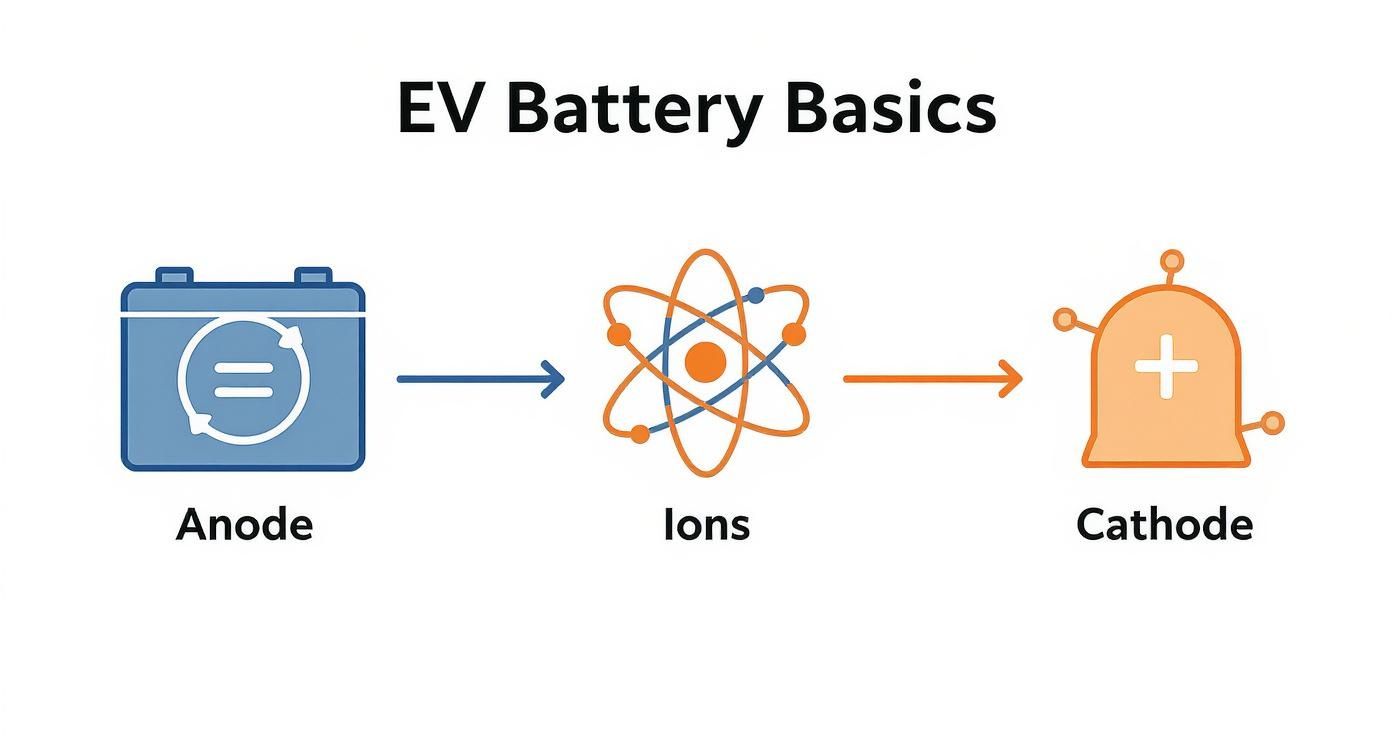
This constant, controlled movement is the key to a healthy battery and managing the speed of this flow is what prevents stress.
What Laboratory Tests Reveal
It’s true that under extreme, uncontrolled conditions, fast charging can cause damage. Laboratory studies in the UK have shown that charging rates above 1C —a rate that fully charges a battery in one hour—can speed up degradation in certain batteries. For example, some tests on NMC (Nickel Manganese Cobalt) batteries, which are common in UK EVs, showed that charging at very high speeds caused noticeable capacity loss after just 300 cycles .
But these are forced, artificial scenarios.
The crucial difference is that these lab tests are designed to push batteries to their breaking point. Your car's onboard computer, which we'll explore next, is specifically designed to never allow these damaging conditions to occur at a public charging station.
Real World vs Lab Conditions
The science is clear: excessive heat and uncontrolled high-speed charging are not good for batteries. But this is precisely where your vehicle's engineering comes into play. Public DC fast chargers, which convert power before it enters your car, work hand-in-hand with your vehicle’s systems to manage this entire process safely. Our guide on understanding an AC to DC battery charger explains more about how this technology works.
In the real world, your car communicates constantly with the charger. It dictates exactly how much power it can safely accept based on its temperature, current charge level and overall health. So, while a charger might be capable of delivering 150kW , your car will only take what it knows is safe.
This intelligent management is the reason why the car park analogy of traffic jams and chaos doesn't happen when you plug in on the motorway. Your car's internal traffic warden is always on duty, ensuring every ion parks safely and efficiently, no matter how busy it gets.
Your Car's Secret Weapon: The Battery Management System
If fast charging generates all this extra heat and stress, how can it possibly be safe for your battery? The answer lies with the unsung hero of your electric vehicle: the Battery Management System , or BMS.
This clever bit of kit is the main reason why the old fear of fast charging damaging batteries just isn’t a major worry for modern EV drivers.
Think of the BMS as the vigilant conductor of your battery's orchestra. It’s a sophisticated network of sensors and microprocessors keeping a close eye on every single cell inside the battery pack. Its entire job is to make sure the whole system performs harmoniously and safely, especially during the intense process of a rapid charge.
The BMS is constantly monitoring two crucial factors: temperature and voltage . It checks each individual cell, ensuring none get too hot or are pushed beyond their safe voltage limits. The moment it detects a cell straying from its happy place, it steps in.
The Art of the Charging Curve
You can actually see this intervention in action in what's known as the 'charging curve'. Plug into a fast charger and you'll notice the power delivery starts high but then gradually drops off. That’s not a fault with the charger; it’s your car’s BMS taking control to protect its own longevity.
This process is deliberately managed in stages:
- The Bulk Phase: From a low state of charge up to around 80% , the BMS lets the battery soak up power at its maximum safe rate. This is where you get that incredibly quick top-up.
- The Absorption Phase: As soon as the battery hits roughly 80% , the BMS slows the charging speed right down. Why? Because the cells’ internal resistance increases as they fill up. Forcing too much power in at this stage would generate a ton of heat and stress.
This automatic slowdown is the single most important defence your car has against battery damage from fast charging. It’s a bit like pouring a glass of water; you can go fast at the start but you naturally slow down as you get near the top to avoid making a mess.
The BMS ensures your battery only ever accepts the amount of power it can safely handle at any given moment. It’s the reason why a charger's maximum output is far less important than your car's ability to intelligently manage the energy it receives.
Once you understand how this secret weapon works, the whole conversation changes. You can stop worrying about whether fast chargers will harm your battery and instead appreciate how your vehicle is precisely engineered to handle it smartly, every single time you plug in. This built-in intelligence is what makes modern EVs so resilient.
Practical Tips for a Healthy EV Battery in the UK
Knowing the science is one thing but putting it into practice is what really protects your investment. While your car’s Battery Management System (BMS) does the heavy lifting, a few smart habits can help you get the absolute most out of your EV's battery life here in the UK.
The goal isn't to avoid rapid chargers altogether—they're an essential tool for modern EV ownership. It’s more about striking a balance that puts battery health first for your daily driving, while still giving you that quick top-up convenience when you’re on a long journey.
This balanced approach means you’re not causing unnecessary stress day-to-day, saving the high-speed sessions for when they really count.
Embrace the 20-80% Rule for Daily Driving
For your regular commute or trips around town, one of the best habits you can get into is the '20-80% rule'. It’s simple: try to keep your battery’s state of charge between 20% and 80% as much as possible.
Lithium-ion batteries are happiest when they aren’t completely full or totally empty. Constantly charging to 100% or running the battery flat puts extra strain on the internal chemistry, which can speed up degradation over time. By setting a charging limit of 80% in your car's settings, you create a buffer that significantly cuts down this stress.
Make Slower Overnight Charging Your Default
Think of your charging options like your diet. A rapid charge is like a convenient takeaway—perfect when you’re in a hurry but not something you'd want every single day. For the long-term health of your battery, slow and steady really does win the race.
Plugging into a standard 7kW home wallbox overnight is the gentlest way to replenish your battery. This slower, controlled charge generates far less heat and allows the lithium ions to settle into the anode gracefully. Making this your default method ensures your battery starts each day in the best possible condition.
Adopting a routine of slower home charging for daily use and reserving rapid charging for long-distance travel is the most effective strategy for maximising your EV battery’s lifespan and performance over many years.
To put this into perspective, let's compare a few common charging scenarios and see how they stack up for long-term battery health.
Charging Habits Comparison for Optimal Battery Health
| Charging Scenario | Typical Use Case | Long-Term Impact | Recommendation |
|---|---|---|---|
| Nightly 7kW Home Charging | Daily commute, local trips | Minimal Stress . Low heat, gentle on cells. | Ideal . The best daily routine for battery longevity. |
| Occasional 150kW+ Rapid Charging | Motorway service stops, long journeys | Moderate Stress . High heat and current but infrequent use is fine. | Use as needed . Perfect for extending range on the go. |
| Frequent Rapid Charging | Primary charging method for drivers without home charging | High Stress . Regular high heat and current can accelerate degradation. | Minimise if possible . Mix with slower public AC charging when you can. |
| Charging to 100% Daily | Trying to get maximum range every day | Increased Stress . Pushes cells to their upper voltage limit regularly. | Avoid . Set a charge limit of 80-90% for daily use. |
As you can see, it's not about completely avoiding one type of charging but rather about creating a healthy balance that works for your lifestyle.
Work With the UK Climate, Not Against It
The British weather also plays a part, particularly on those frosty winter mornings. Cold temperatures can temporarily reduce a battery’s efficiency and its ability to accept a high-speed charge.
Plugging a very cold battery into a powerful rapid charger can put it under unnecessary strain as the BMS works hard to warm it up first. A simple fix is to precondition your battery. Most modern EVs let you warm the battery using mains power before you set off.
Doing this for 15-20 minutes on a cold day before you drive to a rapid charger makes a huge difference. The battery will be at its optimal operating temperature, ready to accept a fast charge much more efficiently and with far less stress on its cells.
Your Fast-Charging Questions, Answered
Even when you understand the science, it's normal to have a few practical questions about day-to-day charging. Let's tackle some of the most common queries we hear from UK drivers, helping you put all this knowledge into practice.
The main thing to remember is that for most modern EVs, the car’s own technology does the heavy lifting to protect the battery. Your job is just to build a few good habits.
Is It Bad to Use Rapid Chargers All The Time?
While your EV can certainly handle it, a bit of balance is always the best bet for long-term battery health. Think of it like your diet—a takeaway is great when you’re in a rush but home-cooked meals are better for you day-to-day. For your regular commute, a slower overnight charge at home is much gentler.
Using rapid chargers for long journeys or when you’re short on time is exactly what they’re for. Thanks to your car’s Battery Management System (BMS), it won’t cause any significant harm. A healthy mix of slow and fast charging is the ideal strategy.
Does the Charger's Speed Really Matter?
Yes but your car is always in the driver's seat. A 150kW charger has the potential to be much faster than a 50kW one but your vehicle will only ever draw the amount of power it decides is safe for its current temperature and state of charge.
Plugging into a more powerful unit doesn't force-feed your car. Its internal safeguards work no matter the charger's advertised output, so you don't need to worry about picking one that’s ‘too powerful’. If you want to get your head around the technical terms, you can find clear explanations in our comprehensive EV charging glossary.
Your EV actively communicates with the charging station, dictating the terms of the energy transfer. It effectively tells the charger, "Give me this much power, at this speed," ensuring the process is always optimised for battery safety and longevity.
Should I Be More Concerned With an Older EV?
If you have an older electric car—usually one made before 2017—it’s smart to be a little more cautious. These vehicles often have less advanced battery chemistries and management systems, which can make them more susceptible to the stress of frequent high-speed charging.
In this case, using rapid chargers more sparingly is a sensible way to help preserve the battery's health. It's always a good idea to check your car’s handbook for any specific guidance the manufacturer provides. For newer cars, this is much less of a concern.
At ZAPME , we understand that charging needs to be convenient and reliable, wherever you are. Our mobile EV charging solutions are designed to provide rapid power on demand, giving you the freedom to top up without being tied to a fixed location. For a mobile charging operator, this translates into a lucrative business model, serving customers at events, fleet depots or roadsides. Discover how our Energy as a Service model can support you or your fleet at https://www.zapme.biz.