

Your Guide to the Modern EV Charging Unit
At its heart, an EV charging unit is a smart fuel pump for electricity. But it is much more than just a fancy plug. This bit of kit intelligently manages the flow of power from the grid to your car's battery, ensuring every charge is safe, efficient and optimised for your vehicle.
What Exactly Is a Modern EV Charging Unit?
Think of it as the crucial middleman between the national grid and your EV. Its main job is to take raw electrical energy and convert it into a form your car's battery can actually use and store. This is not as simple as plugging in a kettle; it is a sophisticated conversation between the charger and the car, managing charging speeds, monitoring battery temperature and keeping everything safe. Without this smart technology, mass EV adoption would stall.
These units are now a common sight everywhere from home garages and office car parks to motorway services and supermarket car parks. They represent a fundamental shift in how we think about topping up our vehicles. The old model of a weekly trip to the petrol station is being replaced by a more flexible network where power is available wherever we park for a while.
Fixed Versus Mobile Charging Flexibility
The most common type you will see is the fixed EV charging unit —the ones bolted to the ground or a wall. They are the backbone of our public charging network. But there is a highly flexible and interesting alternative gaining real traction: the mobile EV charging unit. This portable solution brings the charge directly to the car, opening up a world of new service opportunities.
Mobile chargers are not tied down to one spot, which means they can be deployed wherever there is a need. This adaptability is a game-changer in the fast-growing EV market. While the UK’s infrastructure is expanding rapidly—the network saw a 27% year-on-year increase in public chargers in the first half of the year alone—gaps still exist. This is a particular problem for the 40% of UK EV drivers who do not have access to off-street parking. You can explore more data on the UK's charging infrastructure growth to see the full picture.
A mobile EV charging unit transforms charging from a fixed destination you have to drive to into an on-demand service that comes to you. This simple change unlocks huge commercial opportunities for operators who can now reach customers anywhere.
The Business Case for Mobile Charging
For an operator, the advantages of a mobile EV charger are clear and immediate. It completely sidesteps the need for costly groundwork, lengthy planning permissions and complex grid connection agreements that come with fixed installations. An operator can get a business up and running almost overnight, generating revenue from day one by offering services like:
- Emergency roadside assistance for EVs with a flat battery.
- On-site charging for commercial fleets like delivery vans or taxis.
- Temporary power at festivals, conferences and other big events.
This level of flexibility allows savvy entrepreneurs to build a profitable business around convenience. It turns a vehicle-mounted EV charging unit into a high-value, low-overhead asset in a market that is only going to get bigger. Operators can earn substantial revenue, with the potential to make over £600 in a single day by combining services like emergency call-outs, fleet contracts and event partnerships.
Decoding the Different Types of EV Chargers
Getting your head around EV chargers is much easier once you realise they are not all created equal. The main difference comes down to the type of electricity they deliver. Think of it like a water hose: some give you a steady trickle while others blast out a powerful jet, but they all ultimately fill the same tank.
The national grid supplies Alternating Current (AC) , which is what powers our homes. Your EV’s battery, however, can only store Direct Current (DC) . To solve this, every electric car has a small onboard converter that changes the AC from the wall into the DC the battery needs. This little detail is the key to understanding why some chargers are faster than others.
AC vs DC Charging: The Garden Hose and the Fire Hose
An AC charger is your garden hose. It sends AC power straight to your car and lets the vehicle's own converter do the heavy lifting of turning it into DC. Because that internal converter has to be small and light, the process is slower. This makes AC charging perfect for a steady, overnight top-up at home or during a long park-up at the office or a shopping centre.
A DC charger , on the other hand, is a high-pressure fire hose. These units are much bigger because they house a powerful converter inside them. This means they convert the grid's AC power into DC before it even gets to your car. By bypassing the vehicle’s small internal converter, DC chargers can pump high-power electricity directly into the battery, making for a seriously fast charge.
This diagram shows how the charging unit acts as the essential bridge between the grid's power and your vehicle's battery.
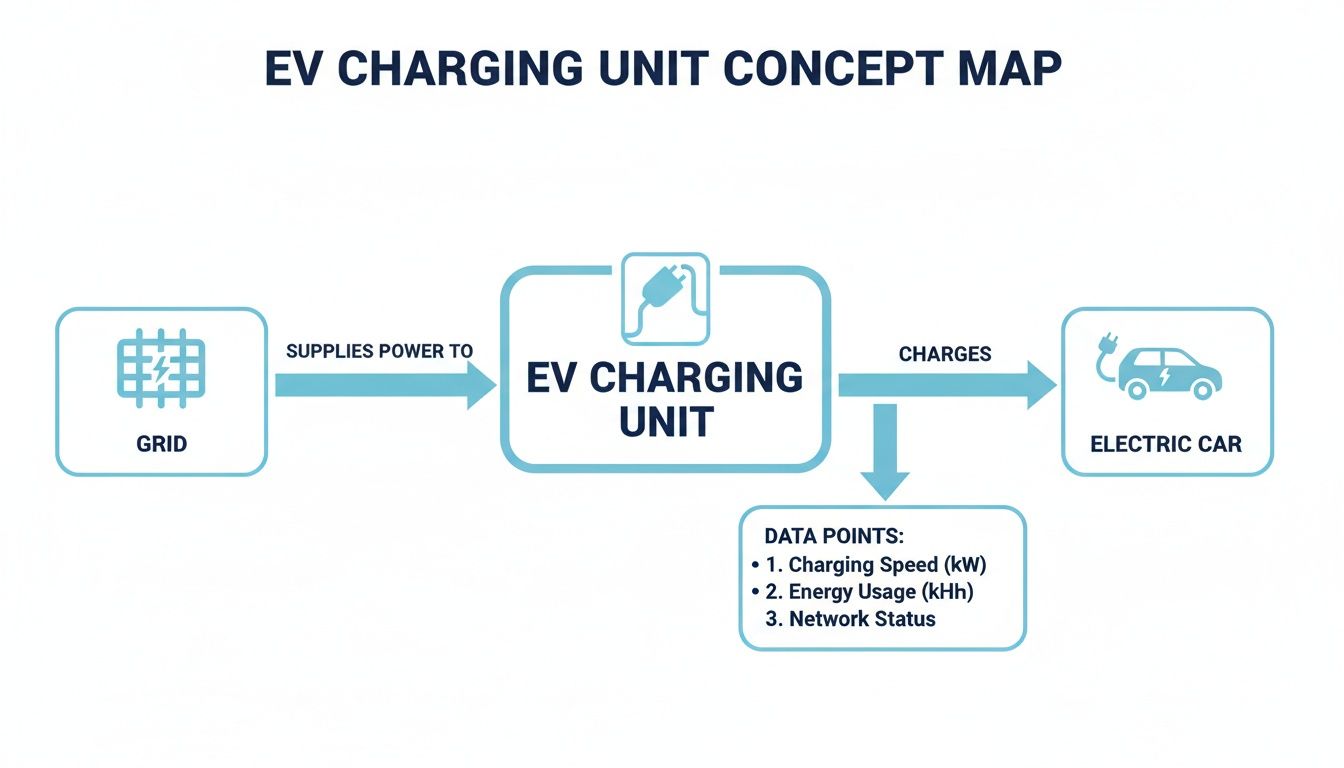
Without this link, the power from the grid would be incompatible with your EV's battery.
Charging Speeds from Slow to Ultra-Rapid
The power an EV charger delivers dictates its speed, which is usually broken down into different 'levels'. Each level has a specific role to play in the charging ecosystem.
To make things clearer, here is a quick rundown of how the different charger types stack up against each other.
A Quick Comparison of EV Charger Types
This table compares the key characteristics of different EV charging levels to help you quickly understand their differences.
| Charger Type | Typical Power Output | Charging Speed (Miles of Range per Hour) | Common Location |
|---|---|---|---|
| Level 1 (Slow) | 1-2 kW | 2-5 miles | Standard 3-pin home socket |
| Level 2 (Fast) | 7-22 kW | 20-60 miles | Home wallboxes, workplace, public car parks |
| Level 3 (Rapid) | 50-150 kW | 100-200+ miles | Motorway services, public charging hubs |
| Ultra-Rapid | 150-350+ kW | 200-400+ miles | Major transport routes, dedicated charging hubs |
As you can see, there is a charger for every occasion, from a slow trickle to a rapid fill-up.
This mix is exactly what we see across the UK's public network. By October, the UK had 86,021 public charging devices. While 20% of these were powerful 50kW+ rapid chargers for quick top-ups, the majority ( 56% ) were slower units designed for destination charging, showing there is a clear need for every speed.
Fixed Units vs Agile Mobile Chargers
Finally, chargers come in two main flavours: fixed or mobile. A fixed EV charging unit is exactly what it sounds like—permanently installed, bolted to the ground or a wall and hardwired into the grid. These are the workhorses of the public network.
In contrast, a mobile EV charging unit is a self-contained, portable system that brings the power directly to the vehicle. This flexibility opens up huge commercial potential for operators. Instead of waiting for customers to come to you, you can provide on-demand charging for roadside recovery, service business fleets at their depots or offer a premium charging amenity at events.
Mobile charging completely removes the geographical handcuffs of fixed infrastructure, effectively turning a vehicle into a profitable, roving power source. While different chargers use various connectors, you can learn all about them in your guide to every EV charger plug in the UK.
The Untapped Profit in Mobile EV Charging
The real opportunity in the electric vehicle market is not just about selling cars; it is about selling the energy that powers them. While fixed charging points are essential, the truly agile and potentially lucrative business model lies with the mobile EV charging unit. This approach moves beyond the limitations of static infrastructure and into the world of on-demand service, creating a blueprint for a profitable, low-overhead business.
Imagine being able to deploy a high-value service exactly where demand is highest, without the crippling upfront costs of groundwork, planning permissions or grid connections. A mobile unit is a business-in-a-box, ready to generate revenue from the moment it hits the road. You can take the power directly to the customer, whether they are a stranded motorist, a busy commercial fleet or attendees at a weekend festival.
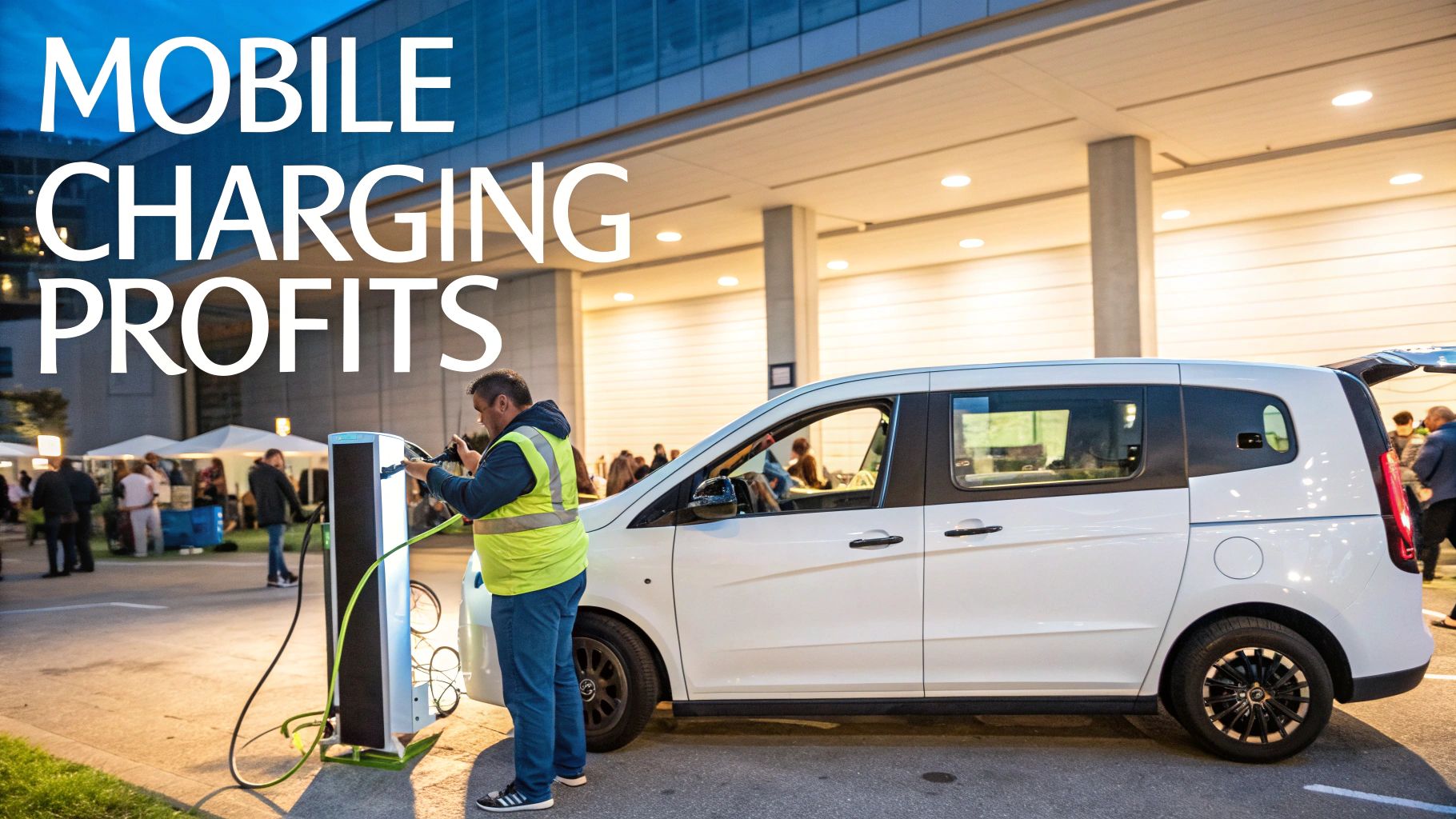
This flexibility is a huge advantage. Instead of waiting for customers to find your fixed location, you can strategically position your service in charging ‘deserts’ or respond to sudden surges in demand. This model transforms a simple charger into a dynamic and highly responsive asset.
Diverse Revenue Streams for Mobile Operators
A mobile EV charging unit opens up multiple avenues for generating income. Operators are not limited to a single pricing model; they can adapt their offering to suit different situations and customers. This versatility is key to maximising daily earnings and building a resilient business.
The most common revenue streams include:
- Emergency Roadside Assistance: This is a premium service. Stranded EV drivers with a flat battery are willing to pay a significant call-out fee on top of the cost of the electricity just to get them moving again.
- Per-kWh Energy Sales: The straightforward model of selling electricity at a set price per kilowatt-hour. Mobile operators can adjust their pricing based on location and demand, charging more at a remote event than in a city centre.
- Service Level Agreements (SLAs) with Fleets: Businesses with electric vans or taxis need reliable charging to minimise vehicle downtime. A contract to provide scheduled on-site charging at their depot can provide a steady, predictable income.
- Event and Venue Partnerships: Festivals, outdoor concerts and corporate events are perfect opportunities. Organisers will often pay for a mobile EV charging unit to be on-site as a premium amenity for attendees and staff.
By combining these streams, an operator can build a multi-faceted business that captures revenue from various market segments. A single unit could service a stranded motorist in the morning, top up a delivery fleet in the afternoon and power an event in the evening.
A Realistic Daily Earning Scenario
Let's break down what a single operator could realistically earn in a day. This hypothetical scenario shows just how powerful the combination of different revenue opportunities can be.
By strategically targeting different customer needs throughout the day, a single mobile EV charging unit can generate substantial revenue, far surpassing what a single, underused fixed charger might make.
Consider this potential daily schedule for an operator in a busy urban area:
- Morning (7 AM - 9 AM): Two emergency call-outs for stranded commuters. At an average of £100 per call-out fee plus energy costs, that’s an immediate £200 .
- Midday (11 AM - 2 PM): A pre-booked fleet charging session for a local delivery company, topping up three vans. This could be a contract worth £150 for the session.
- Afternoon (3 PM - 5 PM): Responding to on-demand requests through an app, completing two top-up charges for drivers in areas with no available public chargers. These might generate £40-£50 each , adding another £90 .
- Evening (6 PM onwards): Providing charging at a local food festival. The operator might charge a flat fee to the organiser and also sell energy to attendees, potentially earning another £200-£300 over several hours.
In this single day, the operator has generated over £640 in revenue. Even after accounting for the cost of electricity and vehicle running costs, the profit margin is significant. The key is the ability to be in the right place at the right time—a luxury that fixed infrastructure simply cannot offer.
For a deeper dive into the numbers, our guide explains how you can profit with a portable charging station for electric cars. This flexibility ensures the asset is always working and earning, turning downtime into an opportunity to find the next customer.
Essential Checks Before Deploying a Charging Unit
Putting an EV charging unit into service—whether it is fixed in the ground or mounted on a vehicle—is a lot more involved than just plugging it in. It demands careful planning to make sure everything is safe, compliant and ultimately, profitable. Before you even think about launching a charging service, you need to get the essential groundwork right. This is what separates a smooth, successful operation from a costly headache.
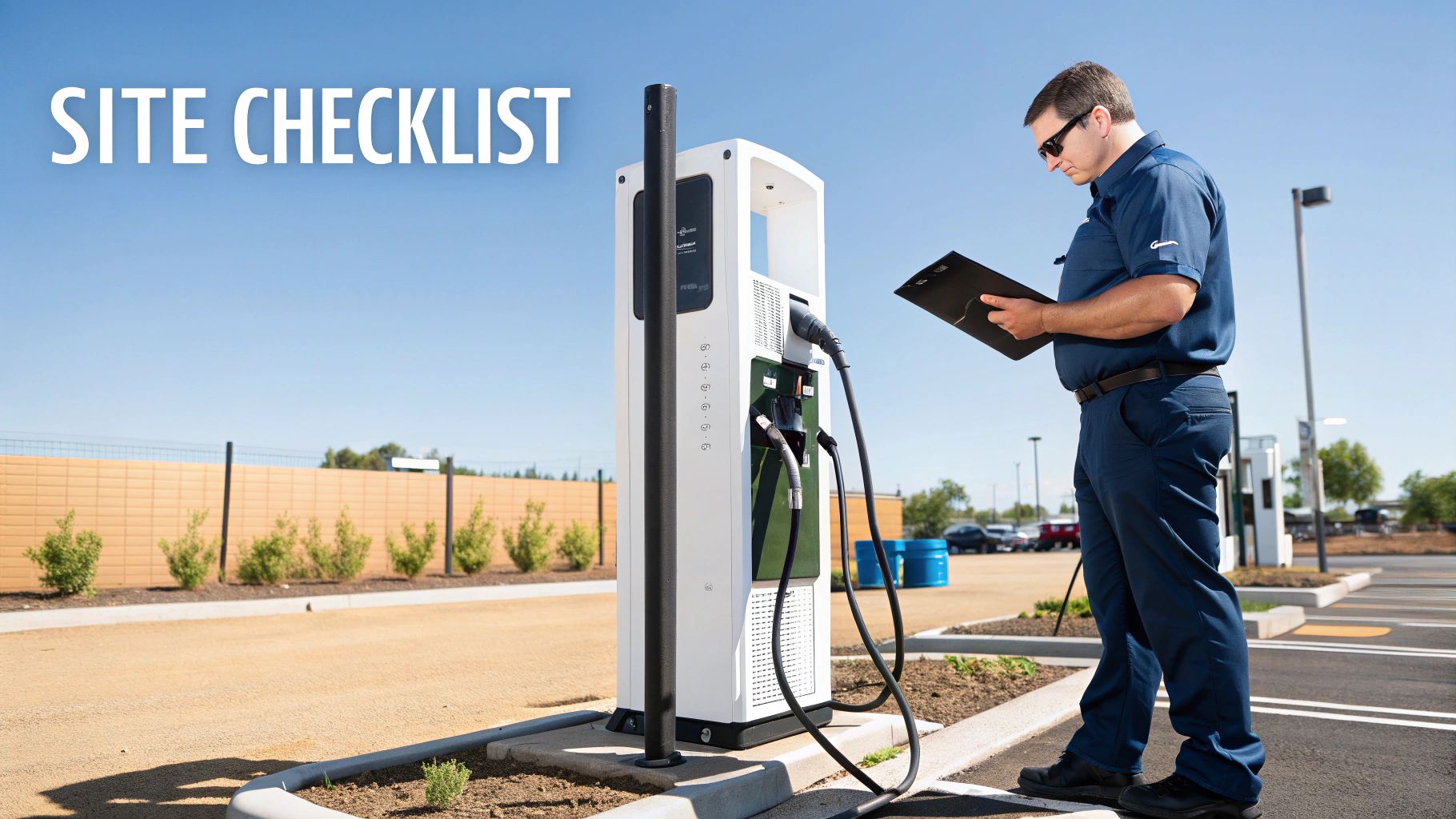
For traditional fixed units, the road to deployment can be long and winding. The biggest hurdle right out of the gate is figuring out the local grid capacity. You simply cannot install a powerful rapid charger if the electrical infrastructure in the area cannot handle the load, which often means lengthy back-and-forth discussions with your local Distribution Network Operator (DNO).
On top of that, you will almost certainly need to secure planning permissions from the local council. This can be a drawn-out process, bogged down by paperwork and potential objections from the community. All these steps add up, often stretching installation times to months before a single EV can plug in. In sharp contrast, a mobile EV charging unit lets you sidestep these hurdles entirely, offering a service that is ready to go almost immediately.
Understanding Connectors and Compatibility
An EV charging unit is completely useless if it cannot connect to the cars it is meant to serve. Thankfully, the UK and European markets have largely standardised on a couple of key connector types. Getting to know them is vital for any operator who wants to serve the widest possible audience.
The two dominant standards you will come across are:
- Type 2 Connector: This is the universal standard for AC charging across the UK and Europe. From a Renault Zoe to a Tesla, almost every electric car can use a Type 2 plug for slower, everyday top-ups, making it an absolute must-have.
- CCS (Combined Charging System): This is the go-to for DC rapid charging. Think of it as a Type 2 connector with two extra-large pins underneath to handle the high-power direct current. It is the most common rapid charging plug you will find on modern EVs.
Ensuring your EV charging unit is equipped with both Type 2 and CCS connectors is not just a technical detail—it is a commercial necessity. It guarantees you can serve virtually every EV on the road today, maximising your potential customer base and revenue.
Navigating UK Safety Standards and Regulations
Operating an EV charging unit in the UK means sticking to a strict set of safety standards and regulations designed to protect the public and the electrical grid. Compliance is not optional; failing to meet these rules can lead to serious legal and financial trouble. Before deploying any charger, it is crucial to understand the specific local rules and best practices, as outlined in this guide on EV charger installation requirements.
The key regulations fall under the IET Wiring Regulations (BS 7671) and specific government legislation like The Electric Vehicles (Smart Charge Points) Regulations. These cover everything from electrical safety and surge protection to ensuring the charger communicates properly with the grid to prevent overloads. With approximately 931,323 total chargers in the UK as of August—including 68,273 public and 809,181 home chargers—you can see the sheer scale of the infrastructure these regulations govern.
For any aspiring operator, getting a firm grip on these obligations is fundamental. It means you can launch a safe, reliable and fully compliant service with confidence from day one.
How ZAPME Delivers Charging as a Service
Trying to enter the EV charging market can feel like navigating a minefield. You are faced with high upfront costs, tricky grid connection negotiations and painfully long waits for planning permission. These hurdles often stop a charging business before it even gets off the ground, sinking capital into fixed chargers that might not even be in the right place to meet demand. It is a slow and expensive way to operate.
ZAPME cuts through these problems with our Energy-as-a-Service (EAAS) model. Instead of buying and installing a fixed charger, our partners get access to a fleet of mobile units. This approach completely sidesteps the need for groundwork or grid upgrades, allowing entrepreneurs and established businesses to launch a charging service almost overnight.
This model shifts your focus from owning hardware to delivering a flexible, on-demand service. It means you can start generating revenue from day one, without the crippling capital investment that holds so many back.
Launch Your Business with Zero Capital Investment
The biggest advantage of the ZAPME EAAS model is that it removes the huge financial barrier to entry. Starting a charging business the old way means spending tens of thousands of pounds on hardware, civil engineering and electrical work before you can earn a single penny. Our model turns this on its head.
With ZAPME, there is zero capital investment needed to get started. We provide the mobile EV charging unit; you provide the service. This allows you to build a profitable operation based on your operational skill, not the depth of your pockets. You can focus your resources on marketing and winning contracts, not on servicing debt for a static piece of equipment.
For a complete breakdown of this model, you can learn more about how ZAPME’s approach to recharging electric vehicles offers new opportunities.
Scalability That Matches Your Ambition
Your business should not be limited by fixed infrastructure. A key benefit of our EAAS approach is its built-in scalability. You can start with a single mobile EV charging unit and expand your fleet as your customer base and contracts grow. This organic growth model ensures your capacity always matches demand, without the risk of over-investing.
The ZAPME EAAS model allows your charging fleet to grow dynamically with your business. You can add more units as you secure more contracts, ensuring your service scales in direct response to your success, not ahead of it.
This kind of agility is simply impossible with fixed charging points. Adding another static charger is a major project, but adding another ZAPME unit to your fleet is a straightforward process. This flexibility lets you react quickly to new market opportunities.
Putting the EAAS Model into Action
The practical applications of ZAPME's mobile EAAS model are vast, turning common charging challenges into profitable services. Just imagine these real-world scenarios where a mobile EV charging unit excels:
- On-Demand Fleet Power: A last-mile delivery company in London needs its electric vans charged overnight at a depot with limited grid capacity. A ZAPME operator provides a scheduled nightly charging service, ensuring the fleet is ready for the morning shift without the company having to invest in costly infrastructure upgrades.
- Premium Event Amenity: A weekend music festival is held in a remote rural location, miles from any public chargers. An operator can partner with the organisers to offer on-site EV charging for attendees, artists and staff, providing a high-value service and generating substantial revenue from a captive audience.
- Emergency Roadside Recovery: A motorist's EV runs out of power on a smart motorway. Instead of needing a flatbed truck, a ZAPME unit can be dispatched to provide a quick 10-15 minute rapid charge, getting the driver back on their way faster and more efficiently.
In each case, the operator is deploying a flexible asset precisely where it is needed most. This is how a mobile EV charging unit becomes a powerful and profitable business tool.
Your Questions About EV Charging Answered
As we have explored the world of the modern EV charging unit, a few common questions always seem to pop up. This final section is all about giving you clear, straightforward answers to those lingering queries, helping you solidify your understanding of both the technology and the business opportunities it presents.
We will look at the practical side of things for everyone from EV drivers to aspiring mobile charging operators.
How Much Money Can an Operator Realistically Make?
The income potential of a mobile EV charging unit is substantial and it all comes down to an operator's ability to be flexible. Unlike a fixed charger that only earns money when someone plugs in at its single location, a mobile unit generates revenue by going exactly where the demand is. An operator’s earnings are a direct result of their strategy and the mix of services they offer.
A typical day could easily combine several different revenue streams. For example, an operator might earn £150-£200 from two emergency roadside call-outs in the morning, another £150 from a pre-booked fleet charging session midday and a further £200-£300 by providing services at a local evening event. This combination could see a single unit generating over £500 per day .
The key is diversification. By offering a mix of high-margin emergency services and steady, contract-based work, an operator can build a robust and profitable business model. The freedom to adjust pricing based on location and urgency further boosts that earning potential.
Is Mobile EV Charging a Scalable Business?
Absolutely. In fact, you could argue that mobile charging is far more scalable than a traditional fixed infrastructure business. The old model requires a huge capital outlay for each new location, involving land acquisition, grid upgrades and lengthy installation processes. This makes expansion incredibly slow and expensive.
A mobile charging business scales much more organically. You can begin with a single EV charging unit and grow your fleet as your customer base expands. This approach offers several clear advantages:
- Low Initial Risk: You can test the market and build a client list with a minimal upfront investment before committing to further expansion.
- Responsive Growth: You add new units directly in response to secured contracts or proven demand, ensuring each new asset is profitable from the word go.
- Geographical Flexibility: Scaling can mean expanding into new territories or simply increasing service density in your current area, all without being tied to physical plots of land.
This model allows your business to grow in direct proportion to its success, making it a far more agile way to capture a share of the expanding EV market.
With mobile charging, your business growth is driven by customer demand, not by complex infrastructure projects. You can add capacity exactly when and where it's needed, creating a truly scalable and responsive service.
What Are the Biggest Advantages of Mobile Charging Over Fixed Units?
While fixed chargers are the backbone of the national network, mobile units offer unique advantages that address critical market gaps and create entirely new business opportunities. The main benefit is the complete removal of geographical constraints. A mobile EV charging unit is not a destination; it is a service that comes directly to the customer.
This fundamental difference creates several key benefits for an operator:
- Speed to Market: A mobile charging business can be up and running almost immediately, bypassing the months of planning, permissions and construction required for fixed installations.
- Lower Upfront Costs: Mobile solutions avoid the enormous expenses associated with groundwork, cabling and grid connection fees, drastically reducing the barrier to entry.
- Targeted Service Delivery: Operators can go directly to where the need is greatest, from business parks with inadequate charging to remote event locations or the side of a motorway.
- Operational Agility: You can adapt your service locations daily based on real-time demand, events or even traffic patterns, ensuring your asset is always positioned for maximum use.
Ultimately, mobile charging provides a layer of convenience and on-demand service that fixed infrastructure simply cannot match. It transforms the EV charging unit from a static piece of hardware into a dynamic, revenue-generating tool. This allows operators to build a business around solving immediate problems for EV drivers and fleet managers—a service for which customers are more than willing to pay a premium.
Ready to sidestep the costs and delays of fixed infrastructure? ZAPME offers a direct path to launching your own mobile charging business. Explore our Energy-as-a-Service model and discover how you can start generating revenue from day one. Find out more about ZAPME's mobile charging solutions.