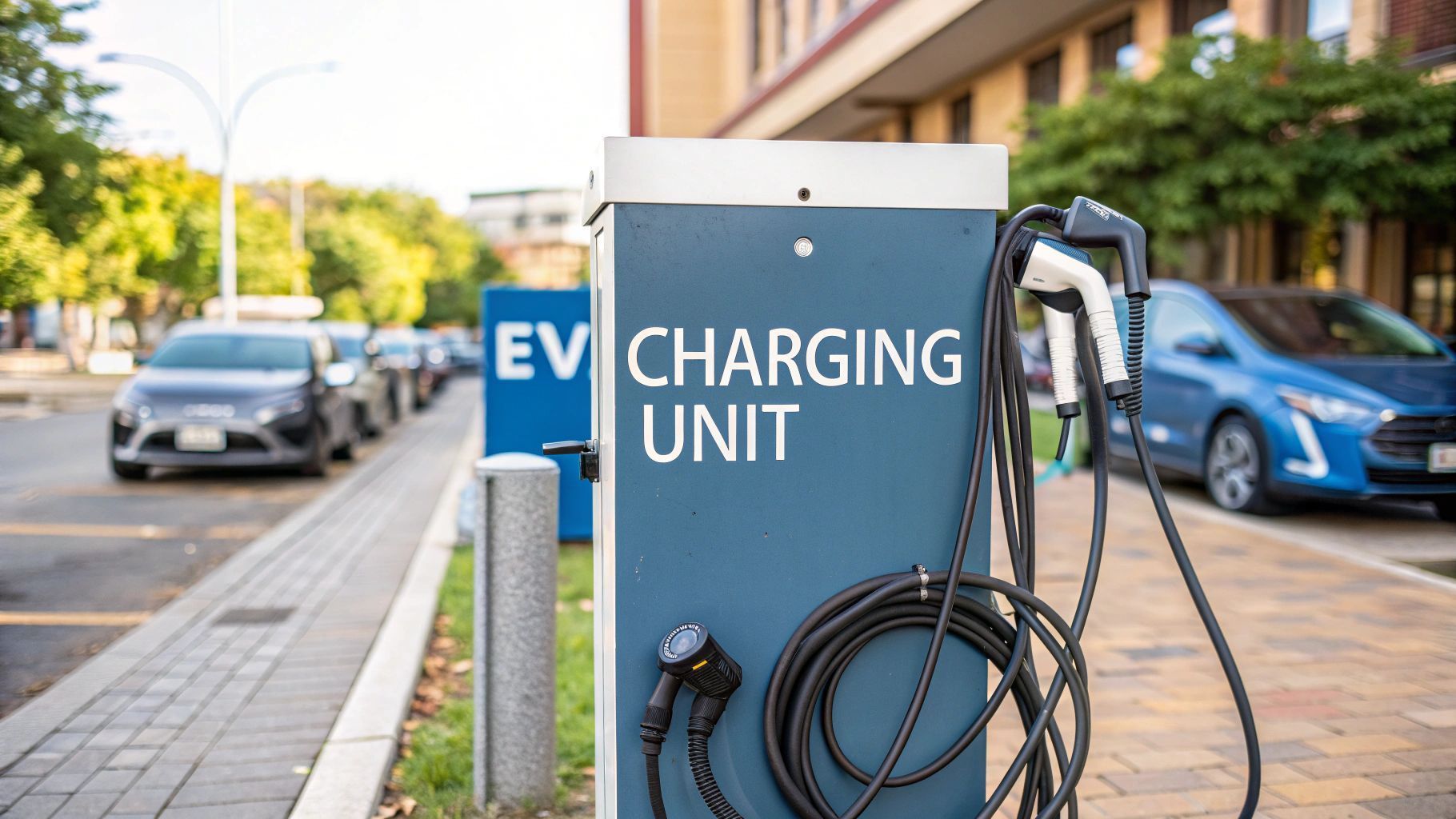


The Ultimate Guide to the UK EV Charger Socket
Diving into the world of electric vehicles can feel like learning a new language and the EV charger socket is a key part of that conversation. Think of it as the crucial handshake between your car and its power source—not so different from a household plug meeting its wall socket. Getting to grips with this is the first step for any driver or business owner wanting to navigate the UK’s charging landscape with confidence.
Your Guide to EV Charger Sockets
Jumping into electric vehicles means getting familiar with a few new bits of tech. For anyone just starting out, the sheer amount of information can seem like a lot but the basics are actually quite straightforward once you break them down. At its simplest, you’re dealing with three parts: the charger itself, the cable carrying the power, and the socket on your car.
Just like you can’t plug a UK appliance into a European wall socket without an adaptor, EV chargers have specific connectors that have to match the vehicle’s inlet. This guide will walk you through everything you need to know, from the standard socket types you’ll find across the UK to the practical choice between a tethered charger (with a built-in cable) or a more flexible socket-only unit for your home or business. Nailing these fundamentals is essential.
Why Mobile Charging Is a Game Changer
While fixed charging points are popping up more and more, they aren’t always where you need them to be. This is where mobile charging really shines. A mobile EV charger, like one of our ZAPME units, is essentially a powerful, portable battery on wheels that brings the power directly to the vehicle. This clever approach completely sidesteps the hefty costs and planning headaches that come with installing permanent infrastructure.
For an operator, this flexibility unlocks serious earning potential. Imagine being able to offer charging services at festivals, busy retail parks, or even in roadside assistance scenarios. Because you’re providing a premium, on-demand service, you can command higher prices per kilowatt-hour (kWh).
An operator of a mobile charger can generate significant income. For example, charging just above the average rate for public rapid chargers and delivering 200 kWh of energy per day could generate over £4,000 per month . This demonstrates a scalable business model with a much lower initial investment than fixed charging stations.
This mobile approach also lets you target "charging deserts"—areas with high demand but not enough infrastructure—turning a major headache for drivers into a profitable opportunity for you. As you read on, you'll gain the knowledge to make smart decisions, whether you’re a driver looking for convenience or an entrepreneur spotting a gap in the market. To get up to speed on all the terminology, check out our complete EV charging glossary for clear definitions.
UK Socket and Connector Types Explained
Getting to grips with the UK’s electric vehicle charging network is much simpler once you understand the handful of connectors you'll come across. Not all chargers are the same and knowing which EV charger socket your car uses is the first step to a hassle-free journey. Think of it like phone chargers – different brands used to have different plugs and EVs are similar, although things are becoming much more standardised now.
In the UK and across Europe, the go-to standard for AC charging is the Type 2 connector . You’ll sometimes hear it called a Mennekes plug. This is the one you’ll use for everyday charging at home, the office, or at destinations like supermarkets. This versatile seven-pin connector is your key to the vast majority of the UK’s charging infrastructure, handling everything from a slow overnight top-up to a faster 22kW charge.
To put it simply, the power flows from the charger, through the cable, and into the socket on your car.
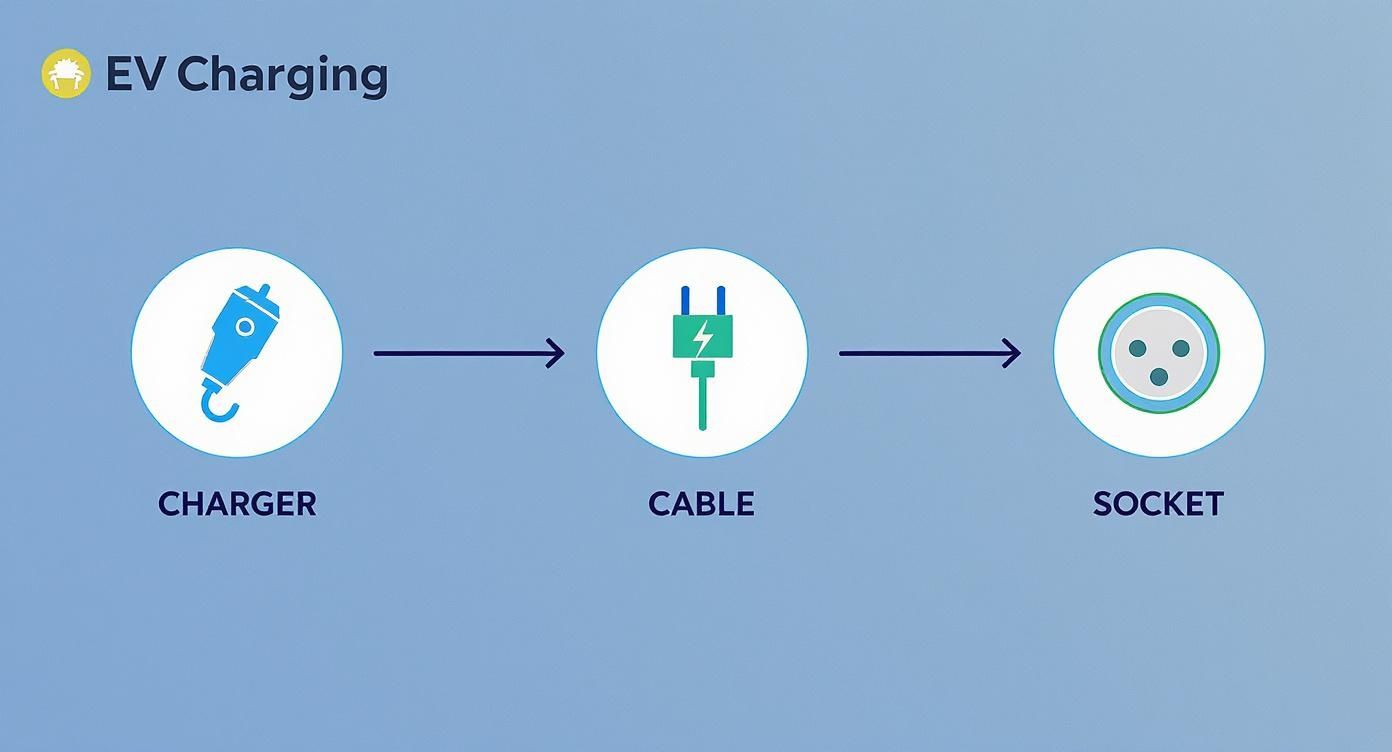
As you can see, your car's socket is the final, crucial piece of the puzzle.
Rapid Charging with CCS Connectors
When you're on a long trip and need to get back on the road quickly, you’ll be looking for a rapid DC charger. These use a different, more powerful connection: the Combined Charging System (CCS) connector. This is now the dominant standard for rapid charging in the UK and is fitted to most modern electric vehicles.
The design is quite clever. A CCS connector is essentially a Type 2 socket with two large DC power pins added underneath. This ‘combo’ setup means your car can use the very same port for both everyday AC charging and those ultra-fast DC boosts at motorway services. It’s an elegant solution that offers brilliant compatibility without cluttering the car with multiple sockets.
This dual-purpose design is a big reason why the UK’s charging network is expanding so efficiently. The growth we've seen is nothing short of remarkable.
Government statistics show that by November 2025, the UK had 87,168 public electric vehicle charging points across 44,326 locations . This includes 116,016 individual charging units and 121,364 connectors ready for drivers to use.
This massive expansion, driven by government initiatives and soaring driver demand, highlights just how accessible public charging is becoming for everyone.
UK EV Charger Socket and Connector Compatibility
To make things even clearer, here’s a quick table summarising the main connectors you’ll find in the UK, what they’re used for, and the kind of power they deliver.
| Connector Type | Charging Type | Typical Power | Common Use Case |
|---|---|---|---|
| Type 2 | AC (Fast) | 3.6kW - 22kW | Home, workplace and public destination chargers (supermarkets, car parks). |
| CCS (Combo 2) | DC (Rapid) | 50kW - 350kW | Motorway services and dedicated public charging hubs for quick top-ups. |
| CHAdeMO | DC (Rapid) | Up to 50kW | Older Japanese models (e.g., Nissan Leaf) and some imported vehicles. |
| Type 1 | AC (Fast) | 3.6kW - 7.4kW | Older or imported models from North America and Asia. Increasingly rare. |
Understanding these two main types— Type 2 for AC and CCS for DC—will cover almost every charging scenario you're likely to face with a modern EV in the UK.
Compatibility and Common Scenarios
Most new electric cars sold today come with a CCS port as standard, meaning you’re all set for both slow home top-ups and rapid motorway charges right out of the box.
Here’s a simple way to remember where you'll find each type:
- Type 2 Sockets: These are on most home chargers, workplace units and public 'fast' chargers you find in places like shopping centres and gyms.
- CCS Connectors: These are physically attached to the rapid and ultra-rapid charging units found at motorway services and dedicated charging hubs.
While these two standards cover the vast majority of vehicles on the road, some older or imported models might use different connectors like CHAdeMO or Type 1 . If that’s the case for your car, having the right cable or adaptor is vital. For a deeper dive into making different chargers work for you, check out our guide on how to find the best electric car charger adapter in the UK.
Ultimately, getting familiar with your vehicle's specific socket is the key to charging with confidence wherever you go.
Tethered vs Socketed Chargers: The Right Choice for You
When you decide to install an EV charger at your home or business, one of the first questions you’ll face is whether to go for a tethered or a socketed unit. Each has its own clear advantages and the right choice really boils down to what you prioritise most: day-to-day convenience or long-term flexibility.
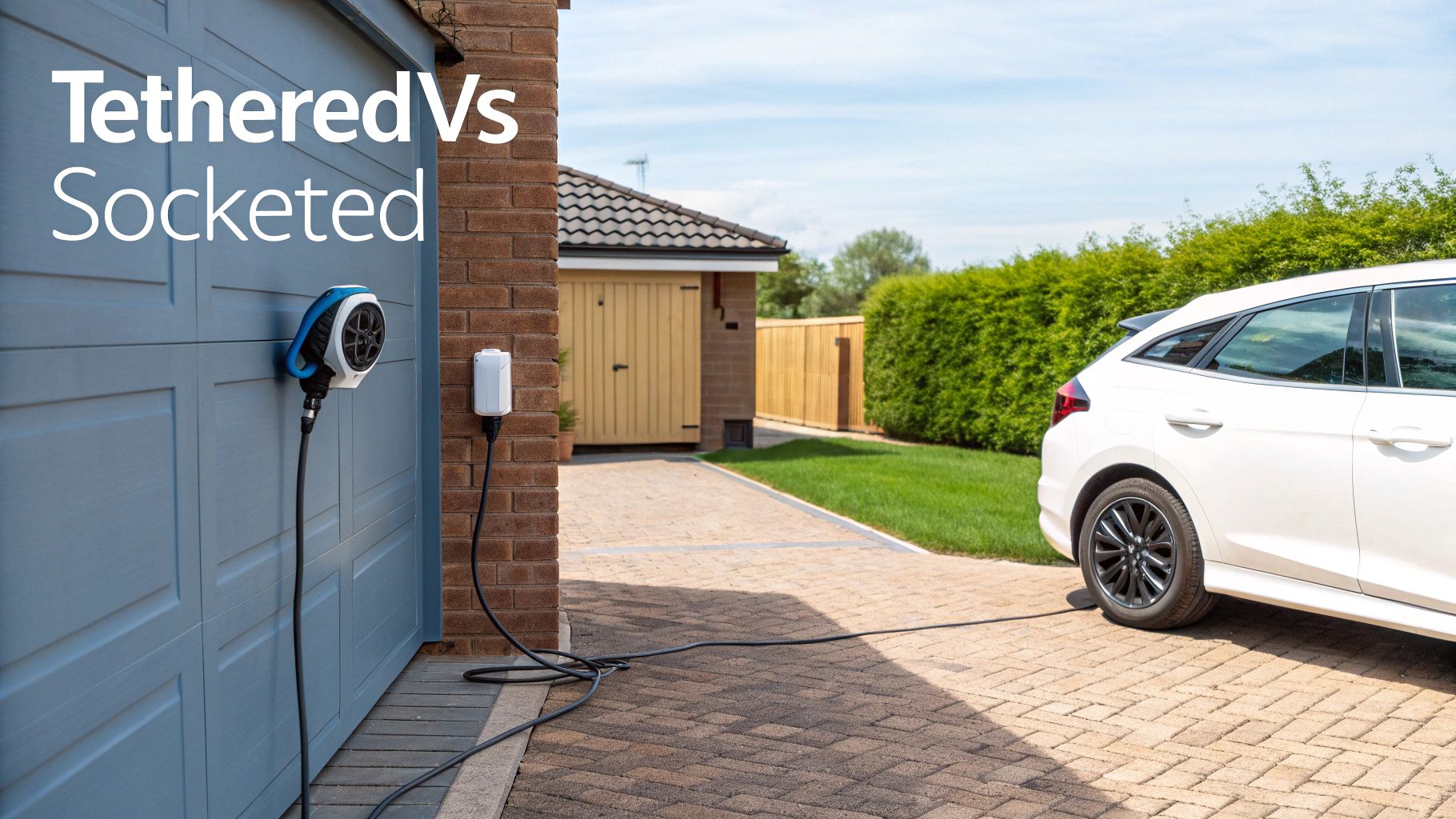
To put it simply, a tethered charger comes with its cable permanently attached. A socketed unit, on the other hand, is just an EV charger socket that you plug your own separate cable into.
A tethered charger is the definition of plug-and-play. You just park up, grab the attached cable, and plug it straight into your car. There's no faffing around getting a cable out of your boot—a real bonus on a rainy British day—making the whole process that bit quicker and easier for daily use.
For businesses, this grab-and-go convenience can be a huge perk for employees. Studies have consistently shown that access to workplace charging boosts job satisfaction. In fact, a 2025 survey found that 98% of EV drivers without workplace charging said they would be very interested in having it, highlighting its value as a highly desired benefit.
The Case for Socketed Chargers
A socketed charger offers a much cleaner, more minimalist look and, crucially, far greater flexibility. Without a permanent cable dangling from it, the unit itself is more discreet on your wall. But more importantly, it’s future-proof.
While the Type 2 socket is the standard here in the UK for now, what if connector technology changes down the line? With a socketed unit, you’d only need to buy a new cable, not replace the entire wall box.
This versatility is also great for visitors. If a guest turns up with a different type of EV (maybe an older model with a Type 1 connector), they can simply use their own cable to charge from your socket. This makes it a much more accommodating choice for commercial properties or even just households with a mix of different electric cars.
A key advantage of a socketed charger is its adaptability. You are not tied to a single cable length or connector type, giving you the freedom to change vehicles in the future and making your charge point universally accessible to anyone with the right cable.
This adaptability is particularly useful in fleet or commercial settings, where you might have all sorts of different vehicles needing a top-up over the years.
Comparing Your Options
So, how do you choose? It really is a straight trade-off between convenience and flexibility. Here’s a quick rundown to help you figure out what works best for your situation.
- Convenience: The tethered charger wins hands down. It's the quickest and easiest way to start charging the moment you park.
- Aesthetics: A socketed unit generally looks tidier. There’s no coiled cable permanently on display, giving a cleaner finish.
- Flexibility: The socketed charger is the clear winner here. It allows you to use different cable lengths and can adapt to any future changes in connector standards.
- Durability: With a tethered unit, the cable is always out in the elements and at risk of damage. A socketed charger means you can keep your cable safely tucked away in the car, which could extend its life.
- Cost: The initial purchase price is often pretty similar. However, think long-term. If a tethered cable gets damaged, you might be looking at a costly repair or even a whole new unit. With a socketed charger, you just buy a new cable.
Ultimately, the choice is a personal one. If you value speed and simplicity for your daily commute above all else, a tethered unit is an excellent, hassle-free option. But if you prefer a neater look, want to future-proof your investment, and need the flexibility to charge different vehicles, then a socketed EV charger socket is the smarter, more strategic choice.
How to Build a Business with Mobile EV Charging
Imagine a charging station that comes directly to your customers. That’s the simple but powerful idea behind mobile EV charging, a business model that’s quickly gaining ground. Instead of sinking huge sums into planning permissions, groundwork and grid connections for a fixed site, a mobile service uses powerful, portable chargers to deliver energy wherever it’s needed most.
These power banks on wheels, like our ZAPME vehicle-mounted units, completely sidestep the enormous costs and long lead times tied to installing permanent infrastructure. For an operator, this means a much lower initial investment and the freedom to be incredibly agile.
Tapping into On-Demand Charging
The real magic of a mobile charging business is its flexibility. An operator can deploy chargers with pinpoint accuracy, targeting places where demand suddenly spikes but permanent infrastructure just isn't there. This opens up a whole host of profitable opportunities.
Think about these high-demand scenarios:
- Events and Festivals: Large gatherings attract thousands of EV drivers who will all be looking to recharge. A mobile unit can provide a premium, on-site service.
- Busy Retail Parks: On peak shopping days, fixed chargers are often all taken. A mobile service can handle the overflow and keep customers happy.
- Fleet Depots: Commercial fleets transitioning to electric often need extra charging capacity without wanting to commit to major electrical upgrades.
- Roadside Assistance: A flat EV battery is the new running out of petrol. Mobile charging offers a vital emergency service for stranded drivers.
This ability to go where the demand is makes the model so effective. You aren’t waiting for customers to find you; you’re actively meeting them right where they are.
Calculating Your Earning Potential
So, how much can an operator actually make? The profitability of a mobile service is built on providing a premium, convenient solution that people are willing to pay a little extra for. Let’s break down a realistic financial projection.
The average cost at a public DC rapid charger in the UK is currently around 65p per kilowatt-hour (kWh). As a mobile operator offering an on-demand service, you can reasonably set a higher price point.
By pricing your service at 75p per kWh and delivering just 200 kWh of energy per day—that’s enough to fully charge four or five typical family EVs—you could generate £150 in daily revenue . Operating consistently, this could bring in over £4,500 per month from energy sales alone.
And that calculation only scratches the surface. The real profitability comes from building multiple revenue streams on top of just selling the energy.
Building a Scalable Business Model
A truly successful mobile charging business diversifies its income. Your pricing strategy can be structured to maximise earnings from different types of customers and situations, creating a robust and scalable operation.
Here are a few key income streams to consider:
- Convenience Fees: Adding a flat call-out fee or a tiered service charge based on location or time of day captures the value of your on-demand model. This works especially well for emergency roadside assistance.
- Service Contracts: Establish recurring revenue by securing contracts with businesses. You could offer regular on-site charging for commercial fleets, taxi services, or delivery companies, billing them monthly for a guaranteed service level.
- Event Partnerships: Instead of just turning up, partner directly with event organisers. You can negotiate a deal to be the exclusive charging provider, often for a fixed fee or a share of the revenue, guaranteeing a captive audience.
This multi-faceted approach transforms a simple service into a fully-fledged business. The low setup cost compared to fixed infrastructure means your return on investment can be achieved much faster, allowing you to scale your operation by adding more mobile units as your customer base grows. To explore this business model in more detail, our complete UK mobile EV charging service guide offers a deeper look into strategy and operations.
Understanding Charging Speeds and Power Levels
How quickly you can get back on the road comes down to one thing: the power flowing from an EV charger socket . Getting your head around the different charging speeds is the key to managing your time and your wallet, whether you're plugging in overnight or grabbing a quick boost on the motorway.
The concept itself is simple. More power equals faster charging.
Think of it like filling a bathtub. A small tap will get the job done eventually but a high-pressure fire hose will fill it in a fraction of the time. It’s exactly the same principle for your EV. The power output of a charger is measured in kilowatts (kW) and this number dictates how quickly it can top up your car's battery.
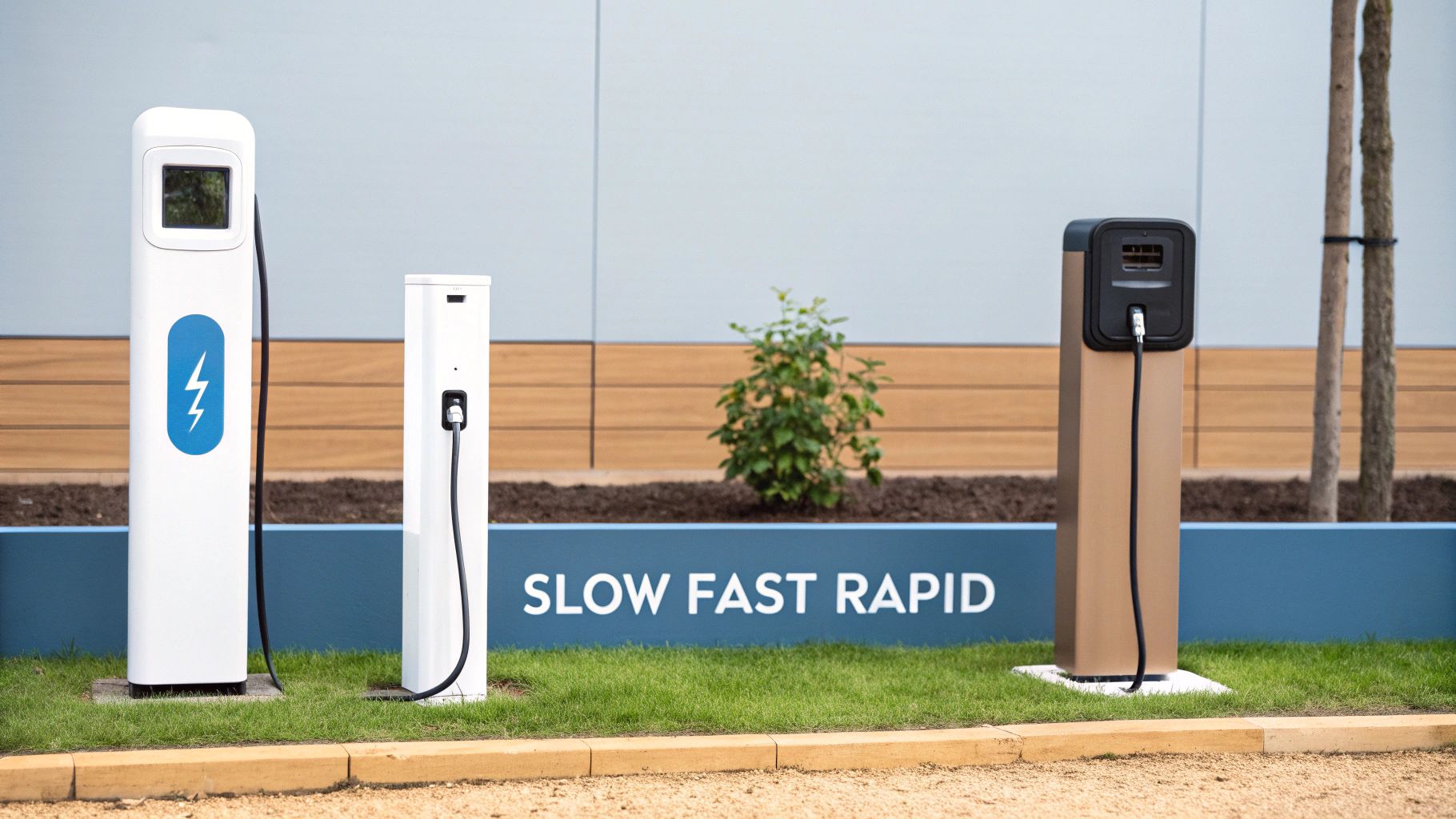
Here in the UK, the charging world is split into three main tiers. Each one is designed for a different purpose and found in different places.
The Three Tiers of EV Charging Speed
Knowing these levels helps you plan your stops properly. You wouldn't rely on a slow charger on a long motorway trip, just as you wouldn't need an ultra-rapid charger for a simple overnight top-up at home.
-
Slow Charging (Up to 3kW): This is your most basic option, often using a standard three-pin plug. It’s incredibly slow, adding just a handful of miles per hour, but it can be a useful backup when you're in a pinch.
-
Fast Charging (7kW to 22kW): This is the sweet spot for most home, workplace and destination chargers. A 7kW unit is perfect for overnight charging, easily taking most EVs from empty to full in about 8-10 hours . Step up to a 22kW charger and you can cut that time down to roughly 3-4 hours .
-
Rapid and Ultra-Rapid Charging (50kW+): These are the powerhouses you find at motorway services. A 50kW rapid charger can add around 100 miles of range in just 35 minutes . The newer ultra-rapid units ( 150kW and above) can do the same in as little as 10-15 minutes , completely changing the game for long-distance travel.
The UK's public charging network is growing at a phenomenal rate to keep up. As of June 2025, there were 82,369 public EV charging devices spread across more than 40,000 locations . The real story is in the speed, with a 58% surge in ultra-rapid chargers in early 2025, proving just how much demand there is for faster solutions. You can explore more data on the UK's charging infrastructure expansion to see the full picture.
How Power Levels Affect Charging Time
Here’s a crucial point: the charger isn't the only thing that determines your speed. Your car's onboard charger has its own maximum AC charging rate, typically 7kW or 11kW . If you plug a car with a 7kW limit into a 22kW fast charger, it won't magically charge faster. It will simply pull power at its maximum 7kW rate.
A common misconception is that a more powerful charger always means a faster charge. The final speed is a negotiation between the charger's output and the car's maximum intake. The charging rate will always be limited by the lower of the two values.
This is why knowing your car’s specs is just as important as checking the charger’s power level. The same logic applies to DC rapid charging, just with much bigger numbers. A car might have a maximum DC charging rate of 100kW . If you plug it into a 350kW ultra-rapid charger, it will still only ever charge at its 100kW peak. Understanding these details helps you manage your expectations and pick the most suitable—and cost-effective—charger for every journey.
Safety, Compliance and Smart Charging for Businesses
Fitting an EV charger socket isn't a weekend DIY job. This is a task for a qualified professional, full stop. Getting your installation right and ensuring it's compliant with UK regulations is absolutely essential for protecting your property, your vehicles and everyone who uses them.
A certified electrician handles the critical details you can't see but that are vital for safety. They'll install proper earth-fault protection to prevent electric shocks and implement load management . Think of load management as an intelligent traffic controller for your building's electricity. It constantly watches your total power usage and adjusts the charger's output so you never overload the system and trip the main fuse. For any home or business, this professional oversight is the bedrock of a reliable and secure charging setup.
Smart Charging: More Than Just Power
For businesses, the advantages of a professionally installed smart charging system go far beyond basic safety. These systems unlock a world of control and cost-saving opportunities, turning a simple charger into a powerful operational tool.
It all comes down to the software. Imagine being able to see exactly how much energy each vehicle is using, who’s plugging in, and when. Smart charging gives you the power to monitor usage in real-time and even handle billing automatically, whether for employees or customers. This gets rid of administrative headaches and gives you clean, clear data for your operational and sustainability reports.
The real game-changer for businesses is scheduling. Smart systems let you automatically charge your fleet during off-peak hours. By drawing power overnight when electricity tariffs are at their lowest, you can slash your energy costs and turn a major expense into a manageable one.
Making the Financials Work
When you combine proper planning with a smart system, you get a tangible return on your investment. The ability to control when and how your fleet charges has a direct impact on your bottom line. You can set priorities to ensure mission-critical vehicles are always ready to roll, all while managing the electrical load to avoid getting hit with expensive peak-rate energy.
This level of control is particularly crucial for any business running a fleet of electric vehicles. A well-managed charging setup doesn't just lower your running costs—it boosts efficiency and guarantees your vehicles are available when you need them. It’s the difference between simply supplying power and strategically managing an energy asset. Ultimately, a professional installation paired with smart technology is the only way to build a safe, efficient and financially sound charging solution.
Answering Your Questions About EV Charger Sockets
Diving into the world of EV charging can throw up a few questions. Let's tackle some of the most common queries about charger sockets and what they mean for your vehicle or business.
Do I Need a Specific EV Charger Socket for My Car in the UK?
For AC charging at home or at most public chargers, your car will almost certainly use a Type 2 socket. It’s the official standard for the UK and Europe, so you'll find it’s widely compatible.
When you need a rapid charge on the motorway, modern EVs use the CCS (Combined Charging System) connector. This is essentially a Type 2 socket with two extra DC pins underneath. While it's always smart to double-check your car's handbook, Type 2 and CCS are the standards you’ll encounter with nearly all new cars.
Can I Use an Adaptor If a Charger Socket Does Not Match My Car?
Adaptors are out there but they’re generally not a good idea for regular use. They can be unreliable and introduce potential safety risks. For instance, you might find a cable to connect a Type 1 car to a Type 2 charger but you can't simply adapt a standard EV to use a rapid charger it was never built for.
The safest and most straightforward approach is to use charging stations that are designed for your car’s port. With a socketed charger, you just need the right cable for your car, which usually comes with the vehicle anyway.
As a rule of thumb, always stick with equipment designed specifically for your vehicle's EV charger socket . Relying on adaptors adds needless complexity and creates weak points that can affect both your charging speed and safety.
How Much Money Can I Realistically Make from a Mobile EV Charger?
Your revenue really comes down to your business model and pricing strategy. Because you're offering a premium, on-demand service, you can charge a higher rate.
Let's say you charge 75p per kWh (while public rapid chargers are averaging around 65p). If you deliver 200 kWh of energy per day, that works out to £150 daily. Keep that up and you could be looking at over £4,000 per month .
You can boost that potential even further through:
- Event partnerships , becoming the exclusive on-site charging provider.
- Fleet service contracts , which bring in guaranteed, recurring revenue.
- Targeting 'charging deserts' —areas with high EV ownership but few fixed chargers. You turn a driver's problem into your profit.
This model lets you build a profitable business with far lower setup costs than installing fixed infrastructure.
Ready to explore the future of flexible and profitable energy delivery? ZAPME offers pioneering vehicle-mounted mobile EV chargers that bring the power directly to where it's needed most. Discover our range of solutions and build your on-demand charging business today.
Learn more at https://www.zapme.biz.