

Your Guide to Every Nissan Leaf Charging Type
Getting to grips with every Nissan Leaf charging type might seem a bit daunting at first but it’s far simpler than you’d think. There are really just three main ways to power up your Leaf and a good way to picture them is like filling a bottle.
You’ve got a slow trickle from a small tap (a standard home plug), a steady flow from a kitchen tap (a dedicated home wallbox) or a powerful jet from a firehose (a public rapid charger). Understanding these options is the key to making your life with an EV completely seamless.
An Overview of Nissan Leaf Charging Options
Powering your Nissan Leaf efficiently all comes down to understanding the basic differences between its charging methods. Each one serves a different purpose, from convenient overnight top-ups at home to quick boosts on a long motorway journey. The real distinction is simply speed and location, which directly shapes how you plan your day-to-day driving.
The hierarchy of charging speeds is pretty straightforward. The slowest method is using a standard 3-pin plug at home, followed by a much quicker charge from a dedicated wallbox installation. For the fastest top-up, you’ll need to find a public rapid charger.
This infographic breaks down the main charging options for the Nissan Leaf by their typical power output.
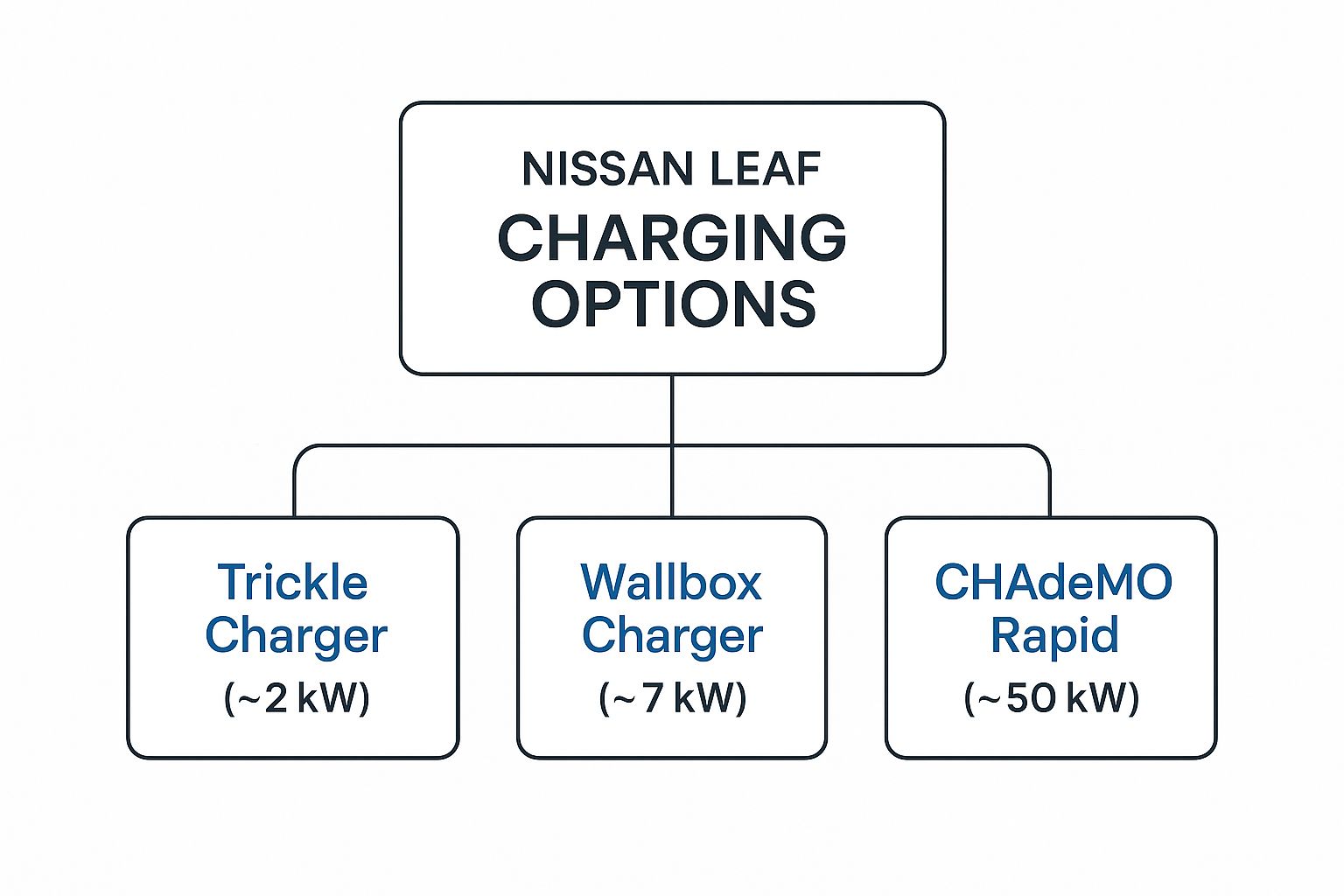
As you can see, there’s a massive leap in power from a basic trickle charge to a CHAdeMO rapid charge. It really highlights the specialised role each method plays in an EV owner's life.
Nissan Leaf Charging Types at a Glance
To make it even clearer, here’s a quick summary table comparing the different charging methods you'll come across for your Leaf.
| Charging Level | Connector Type | Common Location | Typical Power | Approx. Charge Time (40kWh) |
|---|---|---|---|---|
| Level 1 (Trickle) | 3-Pin Plug | Home, workplace | 2.3kW | 15 - 20 hours |
| Level 2 (AC) | Type 2 | Home wallbox, public | 7kW - 22kW | 6 - 8 hours |
| Level 3 (DC Rapid) | CHAdeMO | Motorway services, public hubs | 50kW+ | 40 - 60 minutes (to 80%) |
This table shows just how much faster a dedicated charger is compared to a standard plug, making it easy to see why most owners opt for a proper home installation.
Everyday Charging Habits in the UK
Here in the UK, most Nissan Leaf drivers rely heavily on home charging for their daily needs. This usually involves either a slow overnight trickle charge or, more commonly, a much more efficient Level 2 wallbox.
Public CHAdeMO rapid chargers are typically saved for those longer trips where getting back on the road quickly is the top priority. It's also interesting to see how drivers have adapted to the car’s system, often manually managing their charge times to strike a balance between battery health and convenience.
Your choice of charging method will ultimately come down to your daily mileage, access to charging points and how often you travel long distances. A solid grasp of EV charging compatibility ensures you’re always prepared for the road ahead.
Mastering Home Charging for Daily Driving
For most Nissan Leaf owners, charging quickly becomes a simple overnight habit – a lot like plugging in your phone. The most basic way to do this is with the standard 3-pin ‘trickle charger’ that comes with the car. It uses a regular household socket, which is handy but it’s really best for emergencies or a small top-up. A full charge could take up to 20 hours , so it isn't a practical daily solution.
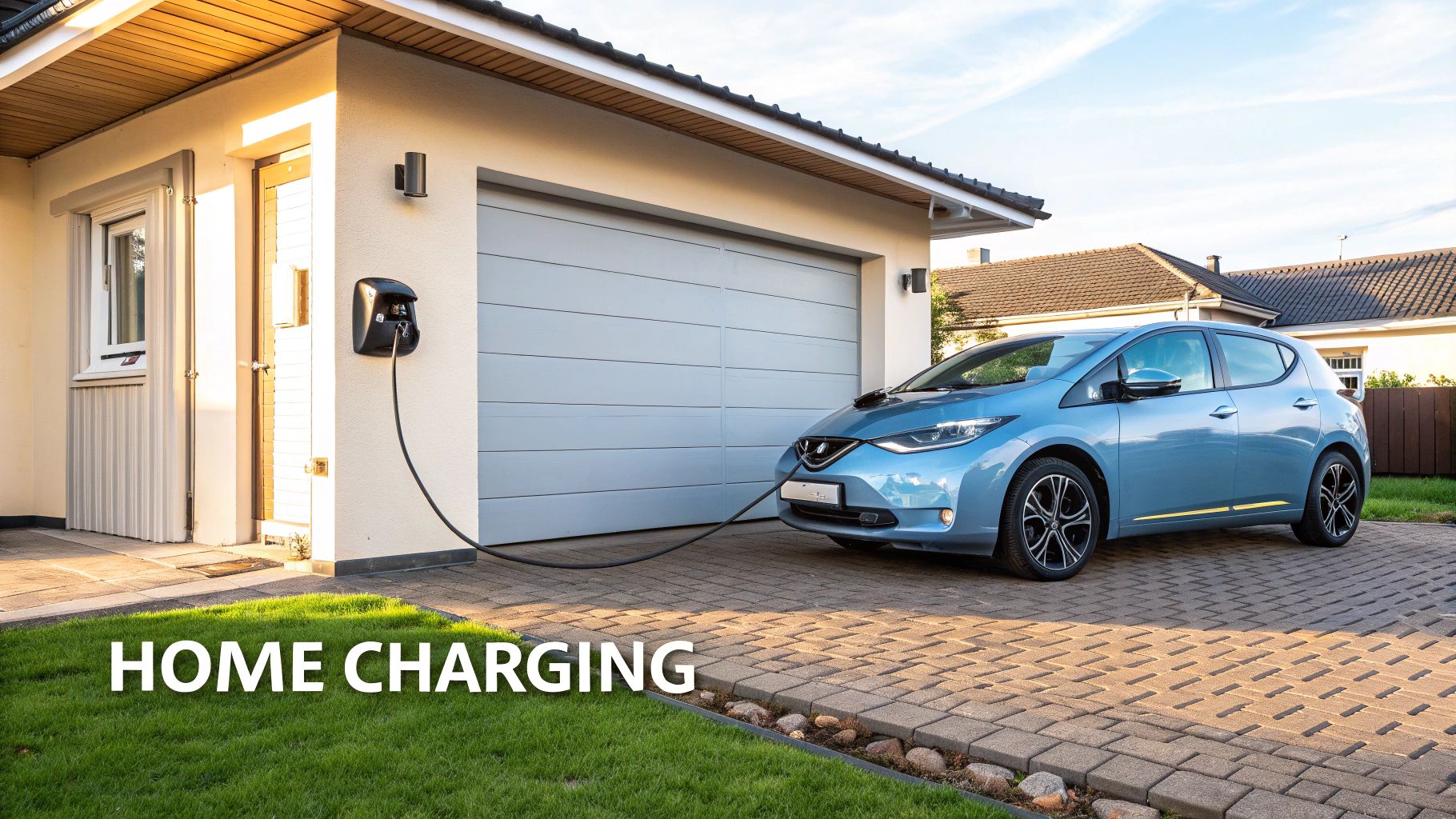
The real turning point for convenient daily driving is a dedicated home wallbox. Think of it as upgrading from a slow drip to a steady, powerful flow of electricity. This Level 2 AC charger completely changes the game by slashing charging times and making your Leaf a seamless part of your daily life.
The Wallbox Advantage
Getting a wallbox installed transforms your charging experience. It’s the difference between waiting all day for your car to be ready and waking up to a full battery every single morning, no matter how low it was when you plugged in.
Here’s why it’s the go-to choice for Leaf drivers:
- Speed and Efficiency: A standard 7kW wallbox can fully charge a 40kWh Leaf in around 6-8 hours . This is perfect for an overnight charge, ensuring you’re ready to go by morning.
- Enhanced Safety: Unlike a regular socket, a wallbox is purpose-built for the high, continuous power an EV needs. It comes with built-in safety features to protect both your car’s battery and your home’s wiring.
- Cost Savings: Many modern wallboxes are ‘smart’, meaning you can schedule charging to start during off-peak hours when electricity is cheapest. Those savings on your energy bills really add up over time.
To truly unlock the convenience and safety of daily EV driving, exploring professional EV charger installations is a vital step. While there's an initial investment, government grants can often reduce the cost and the long-term savings and daily ease of use make it well worth it.
Rapid Charging On The Road With CHAdeMO
When it comes to longer journeys in your Leaf, rapid DC charging is the answer. The key to unlocking this speed is the CHAdeMO connector.
Think of it this way: if home charging is like filling a paddling pool with a garden hose, DC rapid charging is like calling in the fire brigade. It completely bypasses your Leaf’s slower onboard converter and pumps high-voltage DC power straight into the battery. The result? A massive reduction in charging time.
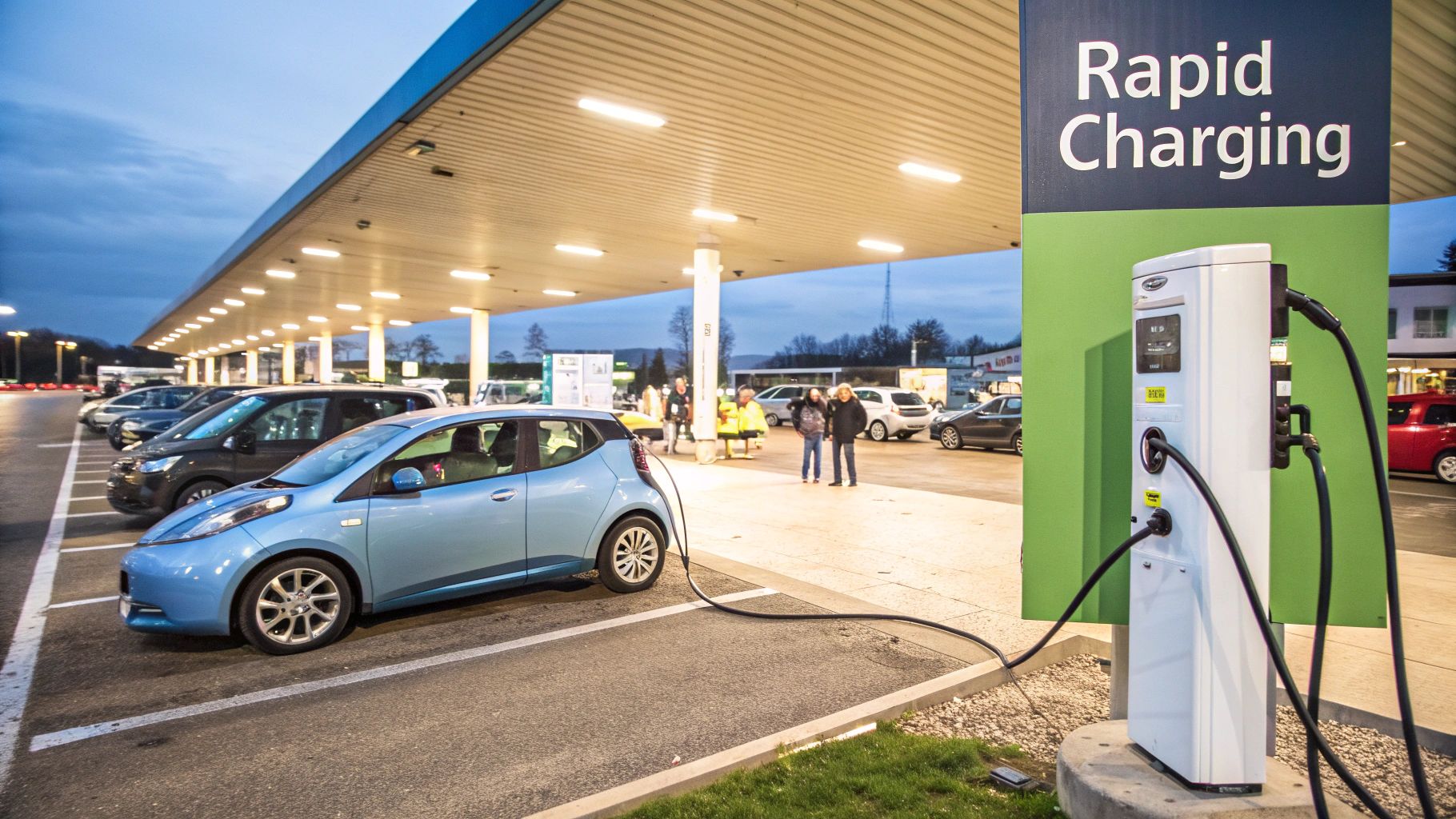
This Nissan Leaf charging type is particularly important here in the UK. We have a huge CHAdeMO infrastructure network, built up over the last decade to support early EVs like the Leaf. Many of the UK’s 16,698+ rapid chargers support the standard, so you’re rarely far from a compatible plug.
While newer EV brands are shifting towards the CCS connector, the Leaf’s loyalty to CHAdeMO has shaped where rapid chargers are located across the country, making it one of the best-supported EVs on UK roads.
Finding And Using CHAdeMO Chargers
Finding a compatible rapid charger couldn’t be easier. Apps like Zapmap or PlugShare let you filter your map to show only CHAdeMO connectors, pointing you straight to your next top-up. When you arrive, just plug in and follow the simple on-screen instructions to get the power flowing.
A crucial point to remember is that charging speed isn't constant. Your Leaf will charge at its fastest rate until the battery reaches around 80% , after which the speed slows down significantly to protect the battery's health. For this reason, most drivers aim for an 80% charge and then continue their journey. You can check out our guide on every EV charger connector for a deeper dive.
The Mobile Charging Opportunity
An exciting development in this space is the rise of mobile charging, which presents a fantastic business opportunity for savvy entrepreneurs. Imagine running a mobile charging van fitted with a CHAdeMO unit, providing a roadside rescue service for stranded EVs or offering convenient top-ups for business fleets at their depots. The advantage is that you are not tied to one location; you can go wherever the demand is, from busy city centres to remote tourist spots, maximising your earning potential.
This business model turns a driver's inconvenience into your profitable venture. By charging a call-out fee plus a per-kWh rate, a single mobile unit could service multiple clients daily and generate a significant income. It is a highly scalable business that meets a real and growing need in the UK's expanding EV market.
Navigating The UK's Public Charging Network
Taking your Nissan Leaf on a longer journey across the UK is far less daunting than it once was, thanks to a public charging network that's growing at an incredible pace. You’ll find compatible chargers on motorways, at major supermarkets and dotted throughout city centres, making range anxiety a thing of the past. For Leaf owners, the key is the widespread availability of the CHAdeMO rapid charging connector.
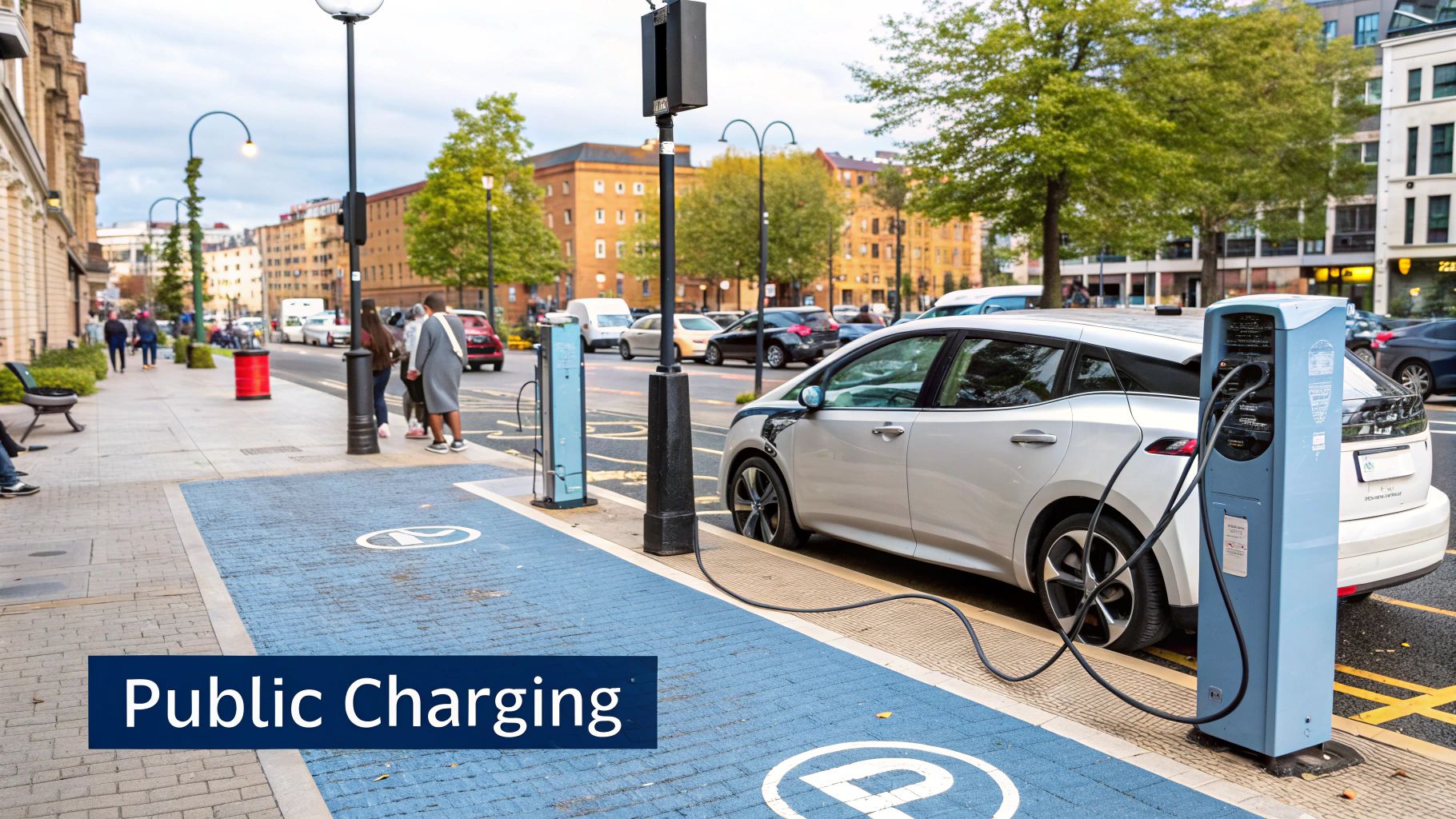
This extensive infrastructure means you are rarely far from a quick top-up. The growth has been remarkable, with the UK now hosting around 74,611 public charging points as of early 2025. That's a massive 410% increase from just 16,505 points back in January 2020. Crucially, a huge portion of these are rapid chargers perfectly suited to the Nissan Leaf, helping drivers get back on the road in no time.
Real-World Charging Speeds
Most CHAdeMO rapid chargers you’ll encounter on your travels deliver power at 50kW . This speed is the real sweet spot for most Leaf models, offering a practical balance between charging time and long-term battery care. It provides a significant boost without putting excessive strain on the battery system, making it an ideal choice for those mid-journey stops.
When using a 50kW charger, you can typically expect to achieve a 10-80% charge in around 40-60 minutes, depending on your battery size and its starting temperature. This makes a coffee or lunch break the perfect opportunity for a substantial top-up.
Charging Times for Nissan Leaf Models (10-80%)
To give you a clearer picture, here’s a quick breakdown of what to expect when you plug in. These times are estimates for a 10-80% charge, which is the most common rapid charging scenario on a long trip.
| Charger Power | 40kWh Leaf Battery | 62kWh Leaf e+ Battery |
|---|---|---|
| 50kW | ~ 40-50 minutes | ~ 60 minutes |
| 100kW | ~ 40-50 minutes | ~ 60 minutes |
As you can see, even if you plug into an ultra-rapid 100kW or 150kW charger, your Leaf’s charging speed is limited by its own hardware to around 50kW . The good news is that the sheer number of reliable 50kW units means you can travel with complete confidence. For a more detailed breakdown, you can explore our guide to the UK's public EV charging networks in 2025.
The Mobile Charging Business Opportunity
Beyond the world of fixed charging points, an innovative and profitable market is taking shape: mobile EV charging. Think of it as power on demand, delivered directly to drivers wherever they find themselves. The great advantage is that you can provide roadside recovery or convenient top-ups for business fleets right in their own depots, going wherever the demand is highest.
For a savvy entrepreneur, this represents a major business opportunity in the UK's rapidly growing electric vehicle landscape. The model isn't just about driver convenience; it's a lucrative venture for operators. A single van fitted with a mobile charging unit can service multiple clients throughout the day, creating a steady and reliable stream of income.
Building a Profitable Financial Model
The financial model behind a mobile charging service is refreshingly straightforward and highly effective. Revenue typically comes from two main sources: a fixed call-out fee for the service and a variable per-kWh rate for the energy you supply. This dual approach ensures every single job is profitable, no matter how much charge is actually delivered.
For instance, you might charge a £50 call-out fee and then bill the electricity at 70p per kWh . If a stranded Nissan Leaf driver needs 20kWh to get to the next service station, their total bill would come to £64 . Servicing just five clients a day with similar needs could generate over £300 in daily revenue, making for a very compelling business case. With such figures, a mobile charging operator stands to make an annual revenue well in excess of £75,000 from a single vehicle, even when accounting for vehicle running costs, electricity and vehicle-free days.
The core advantage is flexibility. You aren't tied to a single location. Instead, you can go where the demand is highest, whether that’s a busy city centre, a commercial estate or a popular tourist route. This adaptability is what maximises your earning potential.
Analysing the Investment and Return
Getting started in mobile charging does require an initial investment in a suitable van and the mobile charging unit itself. These units come in various capacities and can support multiple charging standards, including the CHAdeMO connector that’s essential for the Nissan Leaf. While the upfront cost is significant, the potential return on investment is strong.
An operator can quickly calculate their break-even point by offsetting this initial outlay against projected daily earnings. With low operational overheads beyond the vehicle and electricity costs, profitability can be achieved surprisingly quickly. This business model directly tackles the problem of ‘charging deserts’ and provides a vital service that will only grow in demand as more drivers make the switch to electric.
Your Nissan Leaf Charging Questions Answered
Even when you've got a handle on the different charging options for your Nissan Leaf, a few real-world questions always pop up. Let's tackle some of the most common queries from Leaf drivers.
Can I Use a Tesla Charger for My Nissan Leaf?
Generally, no – you can’t just pull up to a Tesla Supercharger. In the UK, Tesla’s rapid charging network uses the CCS connector, which simply won’t fit into your Leaf’s CHAdeMO port. They're physically different plugs.
However, you might spot Tesla 'Destination' chargers at places like hotels or shopping centres. These are slower AC chargers and often use a standard Type 2 connector, which your Leaf can use. Just don't expect Supercharger speeds.
Does Rapid Charging Damage the Battery?
Consistently using rapid DC chargers can contribute to faster battery degradation over the long run. The main culprit is the extra heat it generates inside the battery pack.
Your Leaf’s battery management system is smart enough to protect itself but for the best long-term battery health, it’s wise to stick with AC charging for your daily needs. Think of rapid charging as a tool for long motorway journeys or when you’re caught short, not your everyday go-to. A balanced approach is the best way to preserve your battery’s lifespan.
'Rapidgate' was an issue that affected earlier 40kWh Leaf models. After a few back-to-back rapid charges, the battery would get too hot and charging speeds would plummet. The newer 62kWh 'e+' models have much better thermal management, making this far less of a problem.
Which Public Charging Networks Should I Use in the UK?
When driving a Leaf, you’ll want to prioritise networks with strong CHAdeMO support. Keep an eye out for these key providers:
- Instavolt: Known for its reliability and widespread presence.
- Gridserve Electric Highway: You’ll find these across the UK’s motorway service stations.
- Shell Recharge: Often conveniently located at their petrol station forecourts.
Many regional networks and local council chargers also offer CHAdeMO . The easiest way to find a compatible charger is to use an app like Zapmap or PlugShare. They let you filter by connector type and even show you if a charger is currently available.
For businesses and entrepreneurs looking to capitalise on the growing EV market, ZAPME offers pioneering mobile charging solutions. Explore our range of portable rapid chargers and learn how you can build a profitable mobile EV charging business at https://www.zapme.biz.