

Your Guide to EV Chargers Workplace Solutions
Installing EV chargers at your workplace used to be a nice-to-have, a simple perk for a handful of staff. Those days are gone. It's now a core business decision.
As the UK barrels towards an electric future, providing reliable charging isn't just about keeping up—it's about staying competitive. It's what top talent expects, it's what your employees need and it’s a non-negotiable part of showing you’re serious about sustainability. The real question isn't if you should offer charging but how you get it right.
Why Workplace EV Charging Has Become a Necessity
The shift to electric vehicles isn’t some far-off concept; it's happening on our roads right now. With the government’s 2035 deadline to end new petrol and diesel car sales looming, your employees and fleet managers are making the switch. This is creating a huge, immediate demand for charging facilities right where people spend most of their day: at work.
For any business, ignoring this is simply not an option. Recent data makes it crystal clear—access to charging is a major factor in job satisfaction. A 2024 survey showed that a massive 42% of EV drivers see workplace charging as a key perk, ranking it right up there with benefits like flexible hours. This turns EV chargers at your workplace into a powerful tool for attracting and keeping the best people in a tough market.
It’s Far More Than Just an Employee Perk
The impact goes well beyond making your team happy. Putting charging points on-site sends a clear signal about your company’s values. It’s a tangible, visible commitment to your corporate sustainability goals and that matters more than ever to customers, investors and the local community. It's a simple move that can seriously boost your green credentials.
Think about the real-world advantages:
- Attract Top Talent: Job seekers who own an EV, or are planning to, will actively filter for employers who support their choice. It's a deal-breaker.
- Improve Morale: Your current staff feel seen and valued when you invest in facilities that make their lives easier and back their sustainable lifestyle choices.
- Future-Proof Your Business: The need for EV charging is only going in one direction. Acting now puts you ahead of the game and prepares your site for what's coming next in transport.
The reality is that for many employees, especially those in flats or rented accommodation without off-street parking, the workplace is the only practical and reliable place to charge. By offering this, you're not just providing a convenience—you're enabling the transition to electric mobility for your entire team.
The Critical Choice: Mobile vs Fixed
Once you know you need charging, the next hurdle is picking the right hardware. Traditionally, that meant installing fixed, wall-mounted or ground-mounted units. This route often comes with huge upfront costs, disruptive groundworks to lay cables and a permanent commitment to specific parking bays.
But there’s a smarter, more flexible alternative gaining ground: mobile charging solutions. These portable units get around the need for expensive, messy installation and can be deployed exactly where they're needed most. This guide will walk you through how a clever strategy using mobile chargers can give you all the benefits of workplace charging but without the high costs and rigidness of fixed infrastructure. It’s about making a smarter investment for your business.
Planning Your Workplace Charging Capacity
Before you even think about installing hardware, you need a solid, realistic plan. Getting a handle on your site's potential and forecasting future demand is hands-down the most critical part of rolling out EV chargers at work. If you get this wrong, you're looking at wasted investment or a system that’s already obsolete the day you switch it on.
The first practical step is a proper site survey. This isn't just about finding a bit of empty space in the car park; it's about pinpointing the most strategic locations. You need to think about visibility, accessibility and how close you are to your main electrical intake. Grab your facilities manager and walk the site, putting yourself in an EV driver's shoes. Where’s the most logical place to park for several hours?
Understanding Power (kW) vs Energy (kWh)
It’s easy to get lost in the technical jargon but for workplace charging, you really only need to get your head around two key terms: kW (kilowatt) and kWh (kilowatt-hour) .
Think of kW as the speed of the charger—it’s the rate electricity flows into the car's battery. A higher kW number means a faster charge.
On the other hand, kWh is the amount of energy delivered. It’s like the volume of fuel you pump into a tank. A typical EV might need 20-40 kWh to cover a day's commute and a few errands. In a workplace setting, where cars are parked for eight hours, a standard 7kW charger is often more than enough to deliver that amount of energy comfortably.
This simple infographic shows the journey from seeing the first EVs in your car park to gaining a real business advantage by providing charging.
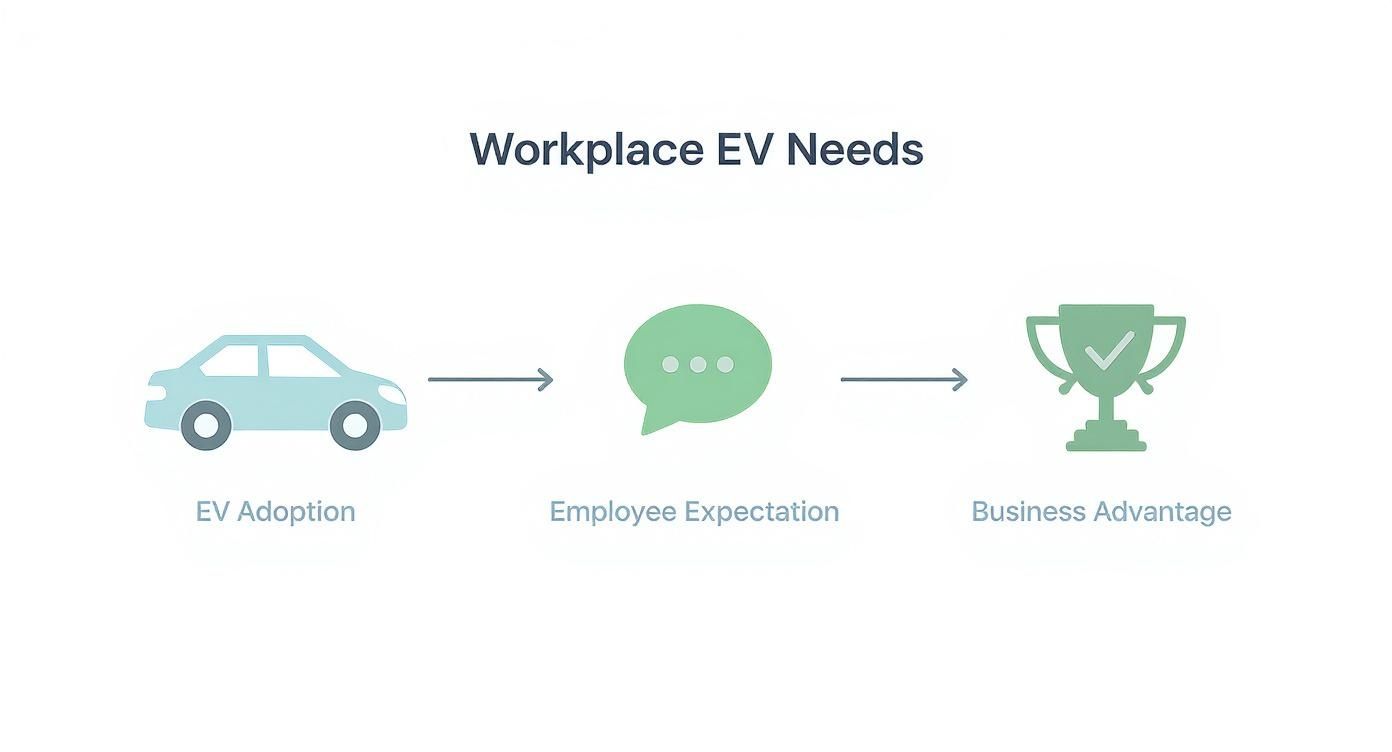
As you can see, the process moves from simply accommodating the growing number of electric vehicles to actively meeting employee expectations, which ultimately gives your business a competitive edge.
Estimating Your Current and Future Demand
Gauging demand is part science, part art. You need to account for your current EV drivers and, crucially, all the people who will make the switch in the next few years. Kicking things off with a simple employee survey is a great way to get a baseline number.
To build a realistic estimate, consider these factors:
- Current EV Drivers: How many employees and fleet vehicles are already electric? Get a hard number.
- Future Uptake: Ask staff about their plans to switch to an EV in the next one to three years. National trends suggest this number will grow much faster than you think.
- Fleet Electrification: What are the company's own plans for its fleet? Fleet vehicles usually have very predictable charging patterns.
- Visitor Needs: Will you offer charging to clients or visitors? This can be a fantastic perk that showcases your company’s forward-thinking attitude.
This data helps you decide whether to start small and scale up or make a more significant investment from the outset. The UK government has pushed this transition hard through various schemes. The Workplace Charging Scheme (WCS), for example, helped fund 21,417 charging sockets across thousands of businesses by late 2021. You can explore the full research about the UK's workplace charging growth to get a feel for the landscape.
The most crucial takeaway here is to plan for growth. Installing infrastructure for two chargers when you might need ten in three years is a classic false economy. Your plan has to be scalable.
Engage the Experts Early
Finally, and this is non-negotiable: involve your facilities manager and a qualified electrical contractor right from the start. They are the only ones who can tell you the reality of your site’s electrical capacity. They’ll determine if your current grid connection can handle the extra load or if you're facing costly and time-consuming upgrades.
This assessment is absolutely vital. It will directly influence your choice of EV chargers. A site with limited spare capacity, for instance, could be a perfect candidate for mobile chargers. These can be charged up overnight from standard sockets and then deployed during the day, completely avoiding any strain on the grid during peak hours.
Getting an expert consultation in early will save you an incredible amount of time, money and headaches down the line.
Mobile Flexibility vs Fixed Infrastructure
When you’re looking to bring EV charging to your workplace, it really boils down to one major decision: do you invest in permanent, fixed infrastructure or do you opt for the clever adaptability of mobile units?
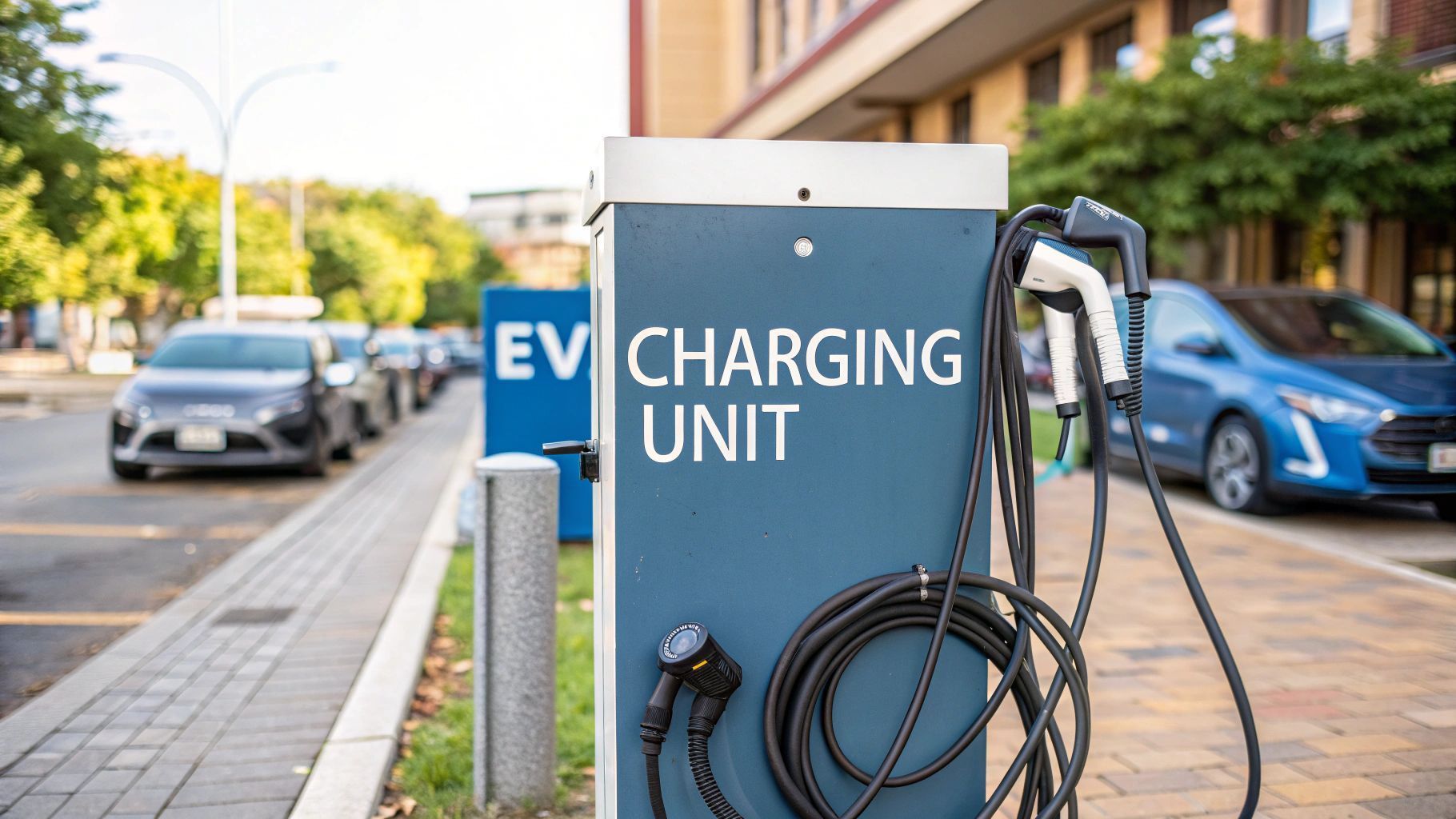
We’re all familiar with the traditional wall-mounted chargers but they come with some serious drawbacks. For many businesses, they’re a surprisingly risky and expensive choice.
Fixed installations are, by their very nature, permanent. They demand disruptive and often costly civil engineering works—think digging trenches, laying armoured cables and hooking everything directly into your electrical distribution boards. This isn't just an upheaval in your car park; it locks you into a specific layout for good. If your parking needs change or you relocate, those expensive chargers get left behind.
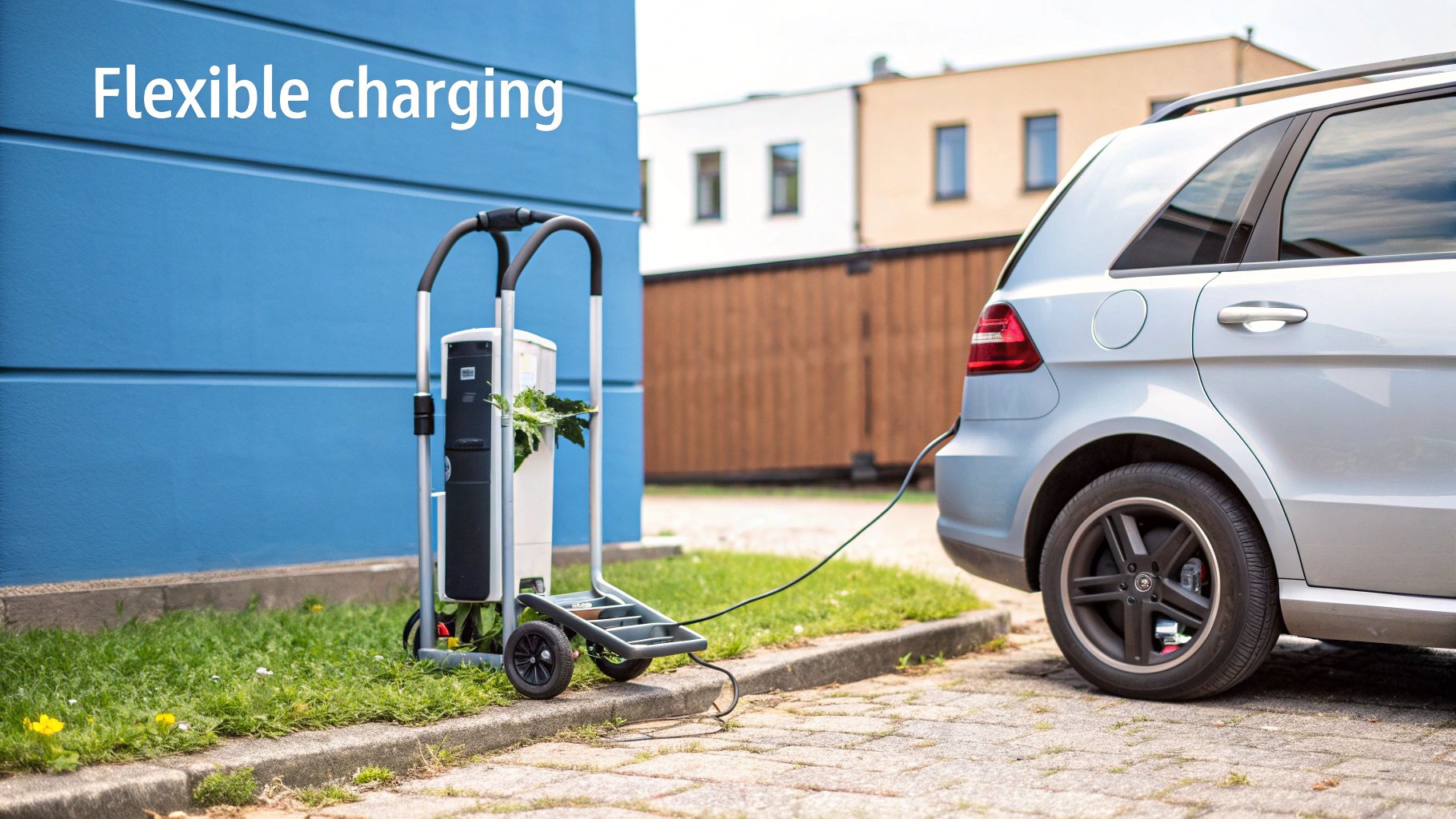
This is where the genius of mobile charging becomes crystal clear. A mobile unit, like the ones we've developed at ZAPME, requires zero installation . You simply charge it up from a standard socket and wheel it to wherever it’s needed.
This approach completely sidesteps the hefty upfront costs and long-term rigidity of fixed hardware. It’s a lower-risk, higher-return path to offering brilliant workplace charging.
The True Cost of Fixed EV Chargers
Let's be honest, the sticker price of a fixed charger is just the tip of the iceberg. The real expense is hidden in the installation.
For a standard commercial setup, you could easily be looking at thousands of pounds per unit once you factor in the labour, potential electrical upgrades and all the necessary groundworks. You’re not just buying a charger; you're funding a mini construction project for every single bay you want to electrify.
Worse still, that investment is static. A fixed charger will only ever serve one parking space. If an internal combustion engine car parks there, or the EV driver doesn't need a top-up, that expensive asset is sitting idle, generating zero value. It's a wildly inefficient use of capital, especially for businesses just beginning their EV journey.
Mobile chargers completely rewrite this equation. With no installation costs, the initial outlay is transparent and predictable. You can start small with a single unit and scale up your charging provision as demand grows, all without any further disruptive works.
Mobile Chargers vs Fixed Chargers: A Workplace Comparison
To make the choice clearer, here's a side-by-side look at how mobile and fixed solutions stack up in a typical business environment.
| Feature | Mobile Chargers | Traditional Fixed Chargers |
|---|---|---|
| Upfront Cost | Lower initial investment; no installation or civil works required. | High; includes hardware, labour, groundworks and potential grid upgrades. |
| Deployment Speed | Immediate. Can be used straight out of the box after an initial charge. | Slow. Can take weeks or months for planning, approvals and construction. |
| Flexibility | Extremely high. Can be moved to any vehicle in any parking space. | None. Permanently fixed to a single bay. |
| Scalability | Simple and non-disruptive. Just add more units as demand grows. | Complex and expensive, requiring more disruptive installation work. |
| Asset Utilisation | High. Can be moved to serve multiple vehicles, maximising its use. | Low. Only serves one bay; often sits idle if the bay is empty or occupied. |
| Revenue Potential | High. Creates a direct profit margin on every kWh sold. | Lower. Often treated as a cost centre or amenity, with complex billing. |
| Relocation | Easy. Can be moved to new premises if your business relocates. | Impossible. The investment is tied to the property and cannot be moved. |
As you can see, the flexibility of mobile units not only reduces risk but opens up opportunities that are simply not possible with fixed hardware.
Unlocking Revenue with Mobile Charging
This is one of the most powerful arguments for mobile EV chargers at work: they can be a direct revenue generator. While fixed units are often chalked up as a cost centre, a fleet of mobile chargers can quickly become a profitable part of your operation.
The business model couldn’t be simpler.
As the operator, you buy electricity at your standard commercial rate—let's say around 25p per kWh . You can then set your own charging price for users (employees, visitors or even the public) at a competitive market rate, for example, 45p per kWh .
This instantly creates a 20p profit margin on every single kilowatt-hour you deliver.
Let’s run the numbers. A typical EV needing a 40kWh top-up would generate £8 in pure profit for your business from a single charging session. If you use that one mobile unit just five times a week, that's over £2,000 in profit annually .
You’re earning this income from an asset that required no costly installation and can be deployed anywhere on your site to ensure it’s always being used. For a more detailed breakdown, you can explore the future of EV charging and the debate between stationary vs mobile solutions.
Scenarios Where Mobile Chargers Excel
The sheer flexibility of mobile units means they solve practical, everyday problems that fixed chargers just can't touch. This adaptability makes them the superior choice in so many common workplace situations.
Think about these real-world examples:
- Serving Visitors and Clients: A client arrives in their EV and needs a top-up. Instead of sending them to a specific (and possibly occupied) charging bay, you can bring the charger right to their car, wherever they’ve parked. It’s a premium service.
- Managing Fleet Vehicles: Your company's pool cars or delivery vans return to the depot. The mobile units can be wheeled from vehicle to vehicle, ensuring they are all fully charged and ready for the next day without needing a dedicated charging bay for every single van.
- Monetising Shared Car Parks: If your office is in a multi-tenant building, a mobile charger can be offered as a paid service to employees from neighbouring businesses. You’ve just created an additional revenue stream from a shared asset.
- Events and Temporary Demand: Hosting a conference? You can instantly scale up your charging capacity for the day to cater for the influx of EV drivers, without making any permanent changes to your infrastructure.
This ability to take the charge to the car , rather than forcing the car to find the charge, is what truly sets mobile solutions apart. It transforms EV charging from a rigid piece of infrastructure into a dynamic, flexible and profitable service.
Funding Your Project and Unlocking Revenue
Putting EV chargers in at your workplace is more than just an operational upgrade—it’s a financial decision. The good news is, there are government incentives designed to soften the initial investment, plus clear pathways to turn your chargers into a genuine source of revenue. The trick is to stop seeing this as a cost and start seeing it as the creation of a new, profitable asset.
In the UK, the main support mechanism to know about is the Workplace Charging Scheme (WCS). This government grant is a significant helping hand for businesses looking to get started, providing direct financial support that makes the business case much more compelling right from day one.
Understanding the Workplace Charging Scheme
Administered by the Office for Zero Emission Vehicles (OZEV), the WCS offers a voucher that can cover up to 75% of the purchase and installation costs . This is capped at a maximum of £350 per socket .
Your business can claim for up to 40 sockets in total across all its sites. Do the maths and that works out to a potential £14,000 in grant funding. This dramatically lowers the financial barrier to entry, making EV charging a far more manageable and attractive proposition if you’re worried about the initial capital outlay.
It's important to remember that the WCS grant is specifically for fixed installation chargers. While this is great for businesses committed to a permanent setup, it doesn't apply to mobile charging units. But since mobile chargers have no installation costs, their upfront investment is already significantly lower, making them a very attractive alternative even without the grant.
Turning Chargers into Profit Centres
Beyond just providing a facility, the real financial opportunity is in monetising your EV chargers. This is where mobile chargers, in particular, really come into their own, transforming a workplace amenity into a direct and controllable revenue stream. The model is simple and highly effective.
As the operator, you buy electricity at your standard commercial rate. You then set your own retail price for users, creating an instant profit margin on every kilowatt-hour (kWh) sold. It’s not uncommon for businesses to add markups of 100% or more over their own electricity costs, quickly turning parking spaces into revenue generators.
Modelling Your Potential Income
Let’s put some real-world numbers on this. Say your business electricity tariff is 25p per kWh . You decide to offer charging to employees and visitors at a competitive rate of 45p per kWh . Straight away, you’re making a healthy 20p profit on every single kWh delivered.
Think about a typical scenario:
- An employee needs a 40kWh top-up to get them home and run a few errands.
- At your rate, that single charging session generates £8 in pure profit for your business (£18 revenue minus your £10 electricity cost).
- If just one mobile unit is used for five of these charges a week, that single charger brings in £40 in weekly profit .
That translates to over £2,000 in annual profit from one mobile unit that required no disruptive or expensive installation. With a small fleet of these chargers, you can see how the figures scale up rapidly. To explore different ways to pay for your hardware, our guide on financing options for EV chargers provides a detailed overview.
Creative Revenue Streams Beyond Your Staff
The flexibility of mobile chargers unlocks other income opportunities that are simply impossible with fixed units. Because they aren’t tied to a specific bay—or even your own premises—you can get creative to maximise your returns.
One great strategy is to lease a mobile charger to a neighbouring business. If a nearby office lacks its own charging facilities, you can offer them a unit on a daily or weekly rental. This creates an entirely separate, reliable income stream from an asset you already own, accelerating your return on investment even further. When looking at funding, it's also worth understanding the costs and incentives for solar battery backup systems , as this can add another layer of value and resilience to your charging setup.
By thinking beyond the traditional model of a static, fixed charger, it becomes clear that providing EV charging isn’t just about meeting a need. It’s a strategic commercial opportunity waiting to be seized.
Deployment, Operation and Safety
This is where the rubber meets the road. Moving your EV charging plan from paper to a live, functioning service is the most critical part of the journey. It’s the point where your strategy has to stand up to the realities of daily operations, user management and health and safety. The good news? With mobile chargers, this transition is refreshingly straightforward and skips the disruption that often comes with fixed installations.
The whole process is simple by design. Once your mobile charging units arrive, they just need an initial top-up from any standard 13A socket . Forget about calling in electricians, digging trenches or shutting down sections of your car park. It’s as easy as wheeling a charger to a vehicle, plugging it in and letting your team manage their session through a simple smartphone app.

This elegant simplicity means you can get your service up and running almost immediately, offering a valuable perk to your team and visitors from day one.
Best Practices for Daily Operations
To keep your charging service running like a well-oiled machine, it helps to establish clear operational guidelines right from the start. Thankfully, managing user access and billing is almost entirely automated through a dedicated app, which lifts the administrative burden from your facilities or HR teams. You simply set your price per kWh and the system handles all the payment processing and deposits the revenue straight into your business account.
Integrating this with your company fleet is just as seamless. You can easily create schedules to make sure company vehicles are always charged and ready for the day ahead. This might look like a simple rota where a facilities team member connects the chargers to fleet cars at the end of the day, prioritising them for a full charge using cheaper off-peak electricity overnight. For a deeper dive into the whole process, take a look at our complete guide on commercial EV charging installation.
The convenience this offers is a huge reason for the growing satisfaction among UK drivers. In fact, surveys show that 84% of UK BEV users found public charging (which includes workplaces) more convenient in the six months leading up to 2025. A positive, hassle-free experience is key to encouraging EV adoption and simple, app-based systems at work are playing a massive part in that.
Prioritising Health and Safety
While mobile chargers are built for ease of use, a sharp focus on health and safety is non-negotiable. Running a safe charging environment protects your employees, your visitors and your business. The two main areas to concentrate on are cable management and equipment maintenance.
To prevent trip hazards, it’s crucial to make sure charging cables are never left trailing across walkways. When a charger is in use, position it to keep the cable run as short as possible and use high-visibility cable protectors where needed. When the units aren't in use, they should be returned to a designated, secure storage area with all cables tidied away.
Adhering to UK safety regulations is not just about compliance; it's about building trust with your users. A visibly safe and well-managed system encourages more people to use it, increasing both its utility and its revenue potential.
Ensuring Regulatory Compliance
Any equipment used in a commercial setting has to be fully compliant with UK regulations. For portable units like mobile EV chargers, this means they must undergo regular Portable Appliance Testing (PAT) . This is a standard inspection of electrical appliances to certify they are safe to use.
A qualified technician should carry out PAT tests at the intervals recommended by the manufacturer, which is typically once a year. Keeping a clear log of these tests is a legal requirement and shows your commitment to maintaining a safe workplace. By embedding these simple safety and maintenance routines into your daily operations, you can efficiently manage a fleet of mobile chargers that are always charged, safe and ready to serve your entire team.
Answering Your Workplace EV Charging Questions
When businesses start looking into EV chargers for their workplace, a flood of practical questions always follows. Let's tackle some of the most common ones I hear, giving you clear answers to guide your thinking and show you where a flexible, mobile solution really shines.
How Much Can I Realistically Earn from a Mobile EV Charger?
This is the big one and the answer is simpler than you might think. Your potential earnings boil down to three things: your business electricity tariff, the price you set for users and how often the charger is used. It’s a straightforward bit of maths that can add up to a tidy new revenue stream.
Let's run some numbers. Say your electricity costs you 25p per kilowatt-hour (kWh). If you set a competitive user price of 45p/kWh , you’re making a clean profit of 20p for every single kWh sold .
A typical electric vehicle might need a 40kWh top-up. That one charging session would generate £8 in pure profit . If you have just one mobile unit used five times a week, you’re looking at over £2,000 in profit annually —all from an asset that cost nothing to install. From there, you just scale up by adding more units or getting them used more often.
Are Mobile Chargers Safe and Compliant for UK Workplaces?
Absolutely. Any reputable mobile EV charger has been engineered and put through its paces to meet all the stringent UK and EU safety standards. They come with all the essential safety features built-in, like RCD protection, so you can have complete peace of mind.
Because they are portable electrical equipment, they simply fall under your standard workplace health and safety procedures, like regular Portable Appliance Testing (PAT). As long as they're operated according to the manufacturer’s instructions (which mostly comes down to sensible cable management), they are just as safe as any fixed installation but with far more operational flexibility.
Can We Offer Charging if Our Electricity Supply is Limited?
This is where mobile EV chargers really come into their own. Fixed chargers often demand a dedicated, high-power circuit, which can put a massive strain on your existing grid connection. I've seen this force businesses into expensive and disruptive upgrades they just weren't prepared for.
Mobile chargers neatly sidestep this entire problem. You can charge them slowly overnight from standard 13A wall sockets when your site's energy demand is at its lowest. Their internal batteries then deliver a much faster charge to vehicles during the day without ever creating a sudden high-power spike on your system.
This makes them the perfect solution for older buildings, listed properties or any site where you know the grid capacity is already a bit of a concern.
How Do We Manage Billing and Access for Multiple Users?
Forget about spreadsheets or manual invoicing. Modern mobile charging systems are managed effortlessly through a simple smartphone app, taking the administrative headache completely off your plate. As the operator, you get full control to set your price per kWh.
For your employees or visitors, the process couldn't be easier. They just scan a QR code on the charger with their phone, pop in their payment details through the secure app and start charging. The system handles all the payment processing automatically and drops the revenue right into your designated business account. Simple.
Ready to turn your car park into a flexible and profitable charging hub? ZAPME offers innovative mobile EV charging solutions that require no installation, scale with your needs and start generating revenue from day one. Discover how our portable chargers can work for your business.