

UK EV Fleet Charging Your Complete Guide
For UK businesses, switching to electric vehicle (EV) fleet charging is not some far-off goal—it is an immediate operational challenge. With government deadlines to phase out new petrol and diesel vehicles looming, fleet managers are now wrestling with the complex logistics of moving from the pump to the plug. Getting this strategy right from day one is absolutely critical to staying competitive.
The Inevitable Shift to Electric Fleets in the UK
The move towards electric fleets is picking up serious speed across the United Kingdom. This is not just about hitting sustainability targets; for commercial operators, it is about future-proofing the entire business. The government has drawn a clear line in the sand for ending the sale of internal combustion engine (ICE) vehicles, giving companies a hard deadline to rethink everything from vehicle acquisition to, most importantly, their energy supply.
This shift brings both hurdles and huge opportunities. Yes, the initial investment in vehicles and charging infrastructure can feel steep but the long-term payoffs are massive. Lower fuel costs, reduced maintenance and penalty-free access to clean air zones are just the start.
Navigating the New Charging Landscape
At the heart of a smooth transition is a solid, reliable charging strategy. This means moving beyond the old "refuelling" mindset to a more sophisticated model of energy management. To keep vehicles on the road and operations running smoothly, fleet managers need to weigh up a few different charging models.
This guide will walk you through the essential options available, including:
- Fixed Depot Charging: The traditional model where vehicles charge up overnight at a central hub.
- Workplace and Public Networks: Using chargers at employees’ homes or public stations to top up during the day.
- Mobile Charging Solutions: A flexible alternative that brings the power directly to your vehicles, wherever they happen to be.
The UK’s public charging infrastructure is growing fast to keep up. As of May 2025, there were 80,998 public charging devices across 39,773 sites—a staggering 30% increase in just one year . Crucially, 16,259 of these were rapid or ultra-rapid chargers, which are essential for getting vehicles back on the road quickly.
A well-planned ev fleet charging strategy is the bedrock of a modern, competitive commercial fleet. It has a direct impact on vehicle uptime, operational efficiency and your bottom line.
Pulling off this change is a complex job. For a complete picture of the entire process, have a look at our guide to UK EV fleet management. In this article, we’ll focus specifically on how to analyse your options and build a cost-effective strategy that gets your fleet ready for an electric future.
Comparing Your Fleet Charging Options
Picking the right EV fleet charging model is not just a technical decision; it is fundamental to your entire operation's success. With a few distinct approaches out there, UK fleet operators have to weigh the pros and cons to build a strategy that is both resilient and makes financial sense. Let's break down the main options, from the old-school depot setup to the freedom of mobile charging.
The Conventional Approaches: Depot and Public Charging
For many fleets, depot charging is the go-to model. It is simple enough: vehicles come back to base at the end of a shift and plug into fixed chargers overnight. This system works a treat for fleets with predictable routes and schedules, letting them top up on cheaper, off-peak electricity so every vehicle is ready to go in the morning.
The catch? The initial capital outlay can be eye-watering. You are often looking at costly grid upgrades, drawn-out planning permissions and major groundworks just to get started.
Some fleets try to sidestep this by relying on public charging networks . While handy for an emergency top-up, building your entire strategy around it is a huge gamble. You have zero control over availability, reliability or fluctuating costs, which quickly leads to lost driver time and completely unpredictable expenses.
The infographic below really drives home how central the charging logistics are to a successful fleet transition.
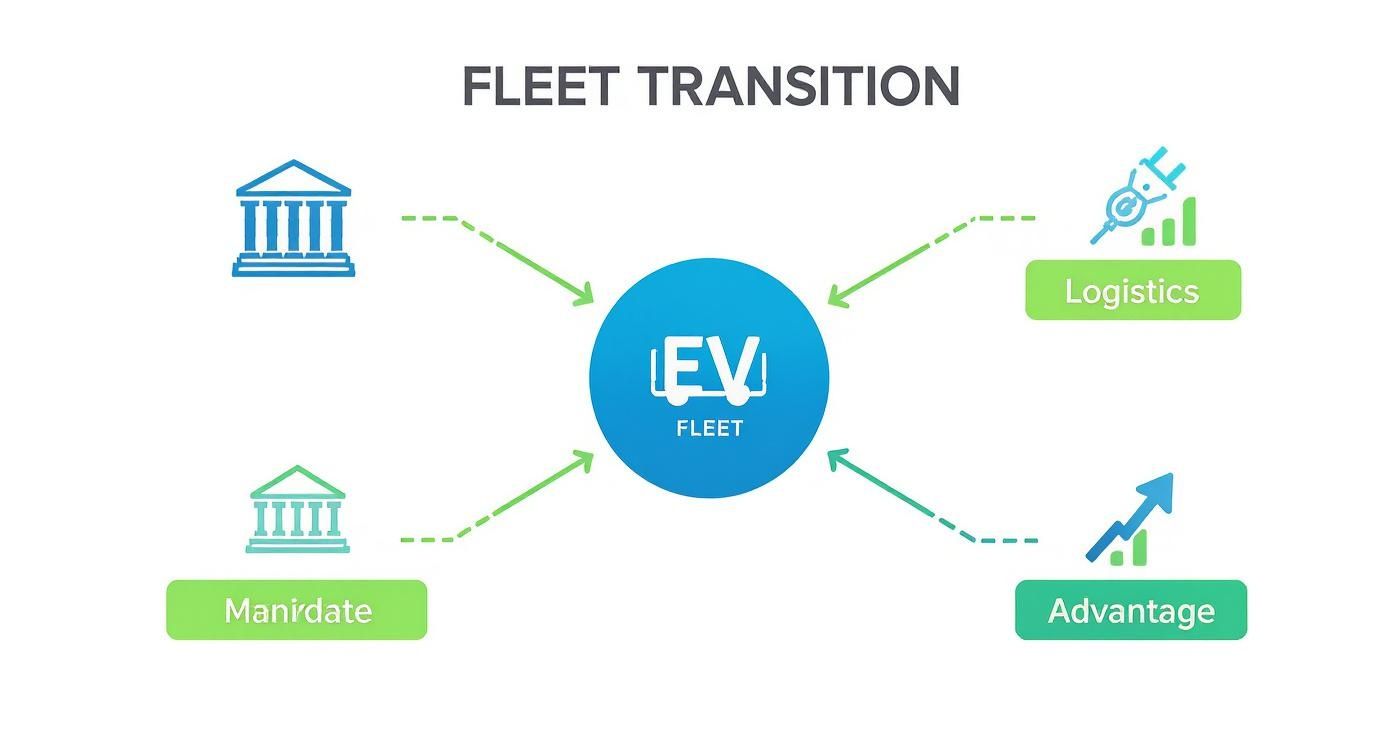
It is clear that without getting the charging puzzle right, all the potential benefits and green mandates are just out of reach.
The Challenge of Public Infrastructure Disparity
Trying to depend on public chargers is made even trickier by the massive regional differences across the UK. By January 2025, the national average for public charging points was 108.5 devices per 100,000 people . But that number hides the real story.
Dig a little deeper and you see London boasting the highest density at 250.4 devices per 100,000 , while Scotland led the way on rapid charger availability at 29.0 per 100,000 . These kinds of inconsistencies make a nationwide public charging strategy a non-starter for most commercial fleets.
Mobile charging shifts the whole paradigm from "where can I find a charger?" to "let's bring the charge to the vehicle." This one change unlocks incredible operational freedom and turns a potential headache into a real strategic asset.
Mobile Charging: A Flexible and Profitable Alternative
This is where mobile charging completely changes the game. It provides a powerful solution that sidesteps the limitations of fixed infrastructure. Instead of forcing every vehicle back to one spot, mobile units bring the power directly to where it is needed, when it is needed. Suddenly, your energy supply is not tied to a postcode.
This approach brings some serious advantages to the table:
- Wipe Out Grid Upgrade Costs: Mobile chargers let you avoid the multi-thousand-pound bills and agonisingly long lead times that come with beefing up your depot’s grid connection for fixed high-power chargers.
- Guarantee Operational Continuity: If a depot charger goes down or a vehicle is stranded with a low battery, a mobile unit can be sent out for a quick boost. That simple act prevents costly downtime and expensive recovery call-outs.
- Unlock New Revenue Streams: A mobile charger is an asset you can put to work. You could offer a premium on-demand charging service to other local businesses, help out stranded EV drivers or provide power at events. Your charging capability just became a profit centre.
For a deeper dive into how fixed and mobile models stack up, check out our article on the future of EV charging stationary vs mobile solutions.
Comparison of EV Fleet Charging Models
To help make the decision clearer, this table compares the key features of different EV fleet charging models. It is designed to help operators see which option best fits their unique operational needs.
| Charging Model | Best For | Initial Cost | Flexibility | Key Advantage |
|---|---|---|---|---|
| Depot Charging | Fleets with fixed routes and overnight dwell time. | Very High | Low | Predictable overnight refuelling on cheaper tariffs. |
| Public Network | Ad-hoc top-ups and emergency charging. | Low | Medium | Leverages existing infrastructure without capital outlay. |
| Mobile Charging | All fleets, especially those needing flexibility or avoiding grid upgrades. | Medium | Very High | Delivers power on-demand, ensuring uptime and creating revenue opportunities. |
In the end, the most robust ev fleet charging strategy often uses a blend of these options. But one thing is clear: adding mobile charging into the mix provides a layer of resilience and financial opportunity that fixed infrastructure on its own simply cannot deliver.
The Financial Case for Mobile EV Charging
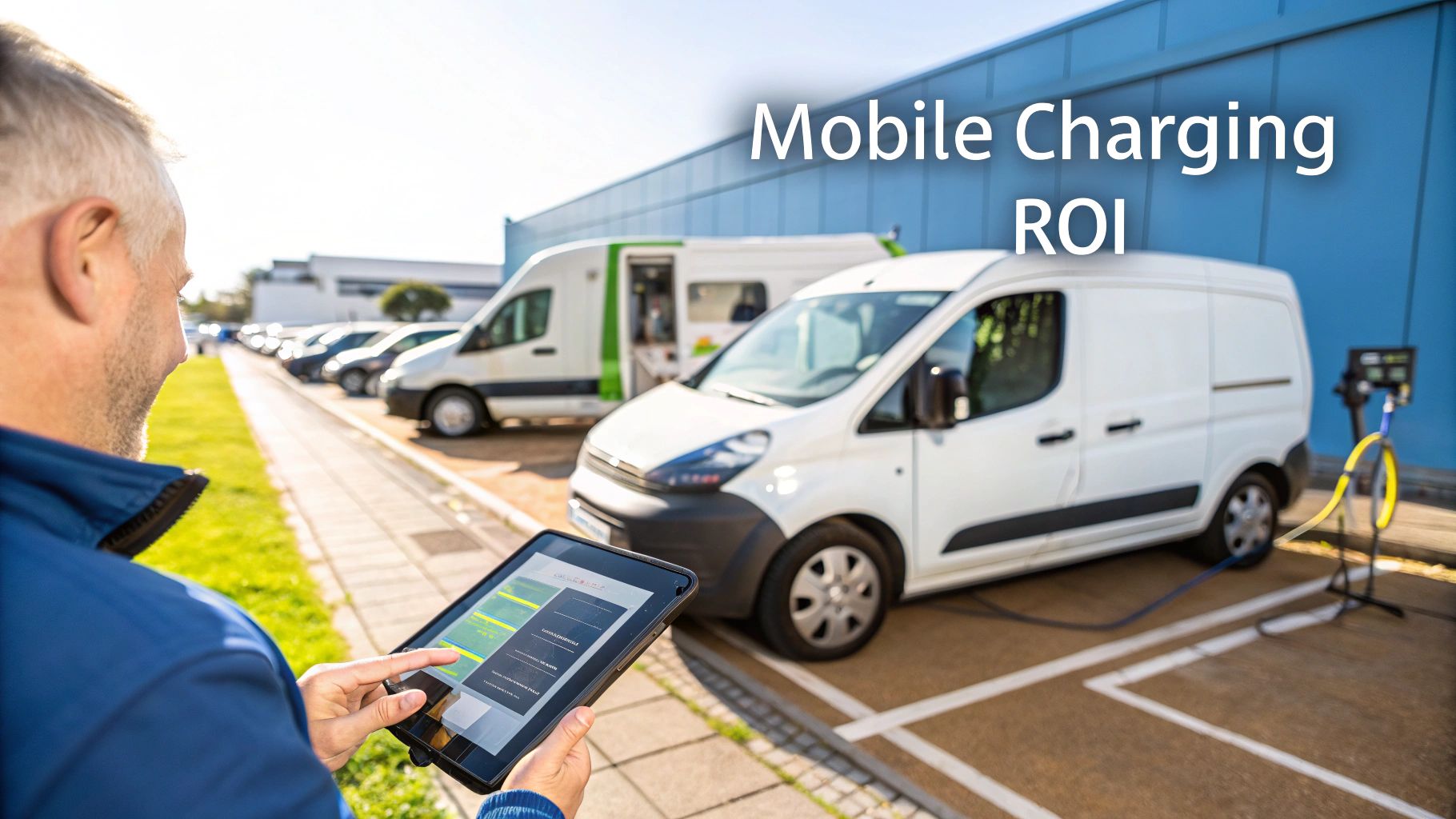
When you are shifting an entire fleet to electric power, the vehicles themselves are just the start. The real conversation—and the one that often makes fleet managers nervous—is about infrastructure. This is where the numbers can look pretty intimidating.
But here’s the thing: mobile EV charging flips the script. It presents a powerful business case that can turn a massive potential cost into a flexible, profitable asset. It is not just a backup plan for emergencies; it is a smart financial tool.
The biggest win for mobile charging is all about what you do not have to spend. Installing fixed, high-power DC chargers at a depot is a huge undertaking. It often means costly grid upgrades, major groundworks and wading through a swamp of planning permissions. Costs can easily spiral into the tens, or even hundreds, of thousands of pounds before you have charged a single van.
Mobile solutions let you sidestep that entire headache. By bringing the charger to your fleet when you need it, you wipe out that colossal upfront investment. This means you can scale your charging capability as your fleet grows, matching your spending to your actual needs instead of sinking capital into fixed infrastructure that might sit underused for years.
Unlocking New Revenue Streams
Beyond just saving money, a mobile charger is an asset that can make you money. This completely changes the financial picture. Instead of being a sunk cost gathering dust, your charging unit becomes an active, income-generating part of your business.
You can build several profitable models around a mobile charging unit.
- Premium On-Demand Services: Picture this: a local delivery van runs out of juice mid-route. For a business, a vehicle that is not moving is a vehicle that is losing money. You can offer a rapid-response charging service, charging a call-out fee plus a per-kWh rate to get them moving again fast.
- Scheduled Top-Ups: Lots of local businesses are going electric but do not have their own charging setup yet. You can provide contracted, regular charging services for their fleets, creating a predictable, recurring revenue stream.
- Event and Temporary Site Power: Think about construction sites, music festivals and outdoor markets. They all need temporary power. A mobile EV charger can service everything from electric diggers to staff vehicles and attendee cars, opening up a whole new B2B service opportunity.
Once you start thinking of a mobile charger as a service you can offer—not just a tool you use—the whole investment is reframed. It is no longer just about keeping your own fleet on the road; it is about becoming a crucial energy provider in your local area.
Calculating the Earning Potential
So, what could this actually look like in terms of pounds and pence? Let's walk through a hypothetical scenario where you are running a mobile charging unit as a business service.
We will use a conservative pricing structure:
- Emergency Call-Out Fee: £100 (to cover your travel and time)
- Scheduled Service Fee: £50 (for pre-booked, less urgent jobs)
- Energy Price: £0.75 per kWh (a healthy margin over your electricity cost)
Now, let's map out a typical day's work.
| Service Type | Number of Jobs | Fee Revenue | Energy Delivered (avg.) | Energy Revenue | Total Revenue |
|---|---|---|---|---|---|
| Emergency Call-Out | 2 | £200 | 40 kWh per job | £60 | £260 |
| Scheduled Top-Up | 4 | £200 | 30 kWh per job | £90 | £290 |
| Daily Total | 6 | £400 | 200 kWh | £150 | £550 |
Based on these perfectly realistic figures, a single mobile unit could bring in £550 in daily revenue . If you operate just five days a week, that is over £10,000 per month in potential earnings. It shows how quickly a mobile charger can pay for itself and become a serious profit centre.
Our in-depth analysis of the economics of mobile EV charging goes into even more detail on how these models work in the real world.
Holistic Financial Benefits
The financial argument for mobile charging is not just one-dimensional. It is not only about the money you can make but also about the money you do not have to spend and the operational agility you gain. By avoiding those eye-watering grid upgrade costs, you free up capital to invest in other areas of your business.
This kind of financial flexibility is a massive strategic advantage. As you build your case, remember that every pound saved contributes to a healthier bottom line. That is why smart fleet managers are always looking for strategies to reduce your truck insurance costs and other operational expenses. Mobile charging fits perfectly into this mindset of smart, efficient financial management.
Ultimately, bringing mobile units into your EV fleet charging plan gives you a powerful mix of cost avoidance, revenue generation and operational toughness. It allows you to electrify with confidence, knowing you have a flexible, scalable and financially sound solution to power your vehicles and grow your business.
Building a Robust Fleet Electrification Strategy
Making the switch to an electric fleet is about more than just buying vehicles and chargers. It calls for a detailed, practical strategy that gets to the heart of how your fleet operates day-to-day. You need a blueprint that blends smart technology with the real-world demands of your business, creating a charging infrastructure that is efficient, cost-effective and above all, reliable.
The first step is to get stuck into your existing fleet data. Modern telematics systems are a goldmine of information, revealing patterns that are absolutely vital for planning your EV fleet charging needs. You simply have to understand the fundamentals of your operation before you can make any decisions.
Analysing Your Fleet's Duty Cycles
Every single vehicle in your fleet has a unique daily routine. We call this its duty cycle . This covers everything from typical mileage and common routes to, most importantly, its dwell times —those periods when it is parked up and available to be charged. Digging into this data lets you accurately calculate the daily energy consumption for each vehicle.
Think about it: a delivery van covering 100 miles a day with dozens of stops has completely different charging needs to a long-haul truck. Understanding these cycles allows you to map out a precise charging schedule. This ensures every vehicle starts its shift with plenty of range, all without you having to over-invest in charging capacity you do not actually need.
A robust electrification strategy is built on data. By understanding your vehicle duty cycles and energy needs first, you can design a charging system that supports your operations, rather than dictating them.
This data-first approach takes the expensive guesswork out of the equation and makes sure your infrastructure is a perfect match for your fleet’s requirements from day one.
Navigating Regional Infrastructure Gaps
One of the biggest hurdles for UK fleets is the patchy distribution of charging infrastructure. This is not just about public chargers; it is also about how ready corporate fleets are themselves. The rate of fleet electrification varies wildly across major UK cities, highlighting a real divide in EV adoption.
In 2025, for example, Bristol was leading the pack with 44.5% of its fleet vehicles being electric, with Liverpool just behind at 43.3% . Meanwhile, cities like Leeds and Manchester were hovering around 26% to 28% . And Transport for London? They reported that a surprisingly low 3.2% of their heavy goods vehicles and vans were electric.
These regional differences mean a one-size-fits-all strategy just will not work. A fleet working in central London faces different challenges to one based in a more rural spot. This is where a blended strategy becomes non-negotiable.
Creating a Blended and Smart Charging Strategy
The most resilient electrification plans are the ones that mix different charging methods to create a flexible, failsafe system. This usually involves a combination of:
- Depot Charging: The foundation of most fleet strategies. You use lower-cost, off-peak electricity to charge vehicles overnight at your home base.
- Public Charging: Good for opportunistic top-ups during the day but it is risky to rely on the public network as your primary source.
- Mobile Charging: Involves deploying mobile units to provide power wherever it is needed—whether for emergency top-ups, at temporary sites or to supplement depot charging during periods of high demand.
This blended approach gets even smarter when you add smart charging software into the mix. This tech can automate charging schedules to make the most of the cheapest electricity tariffs, which are usually overnight. It also uses load management to stop your depot's energy demand from overwhelming its grid capacity, helping you avoid those eye-watering peak-demand charges and the need for expensive grid upgrades.
As you build out your strategy, it is also worth keeping an eye on future technologies. For instance, some forward-thinking fleets are starting to explore the benefits of bidirectional charging , which allows vehicles to push power back to the grid or a building, opening up new ways to save money and improve efficiency.
How ZAPME Delivers True Charging Flexibility
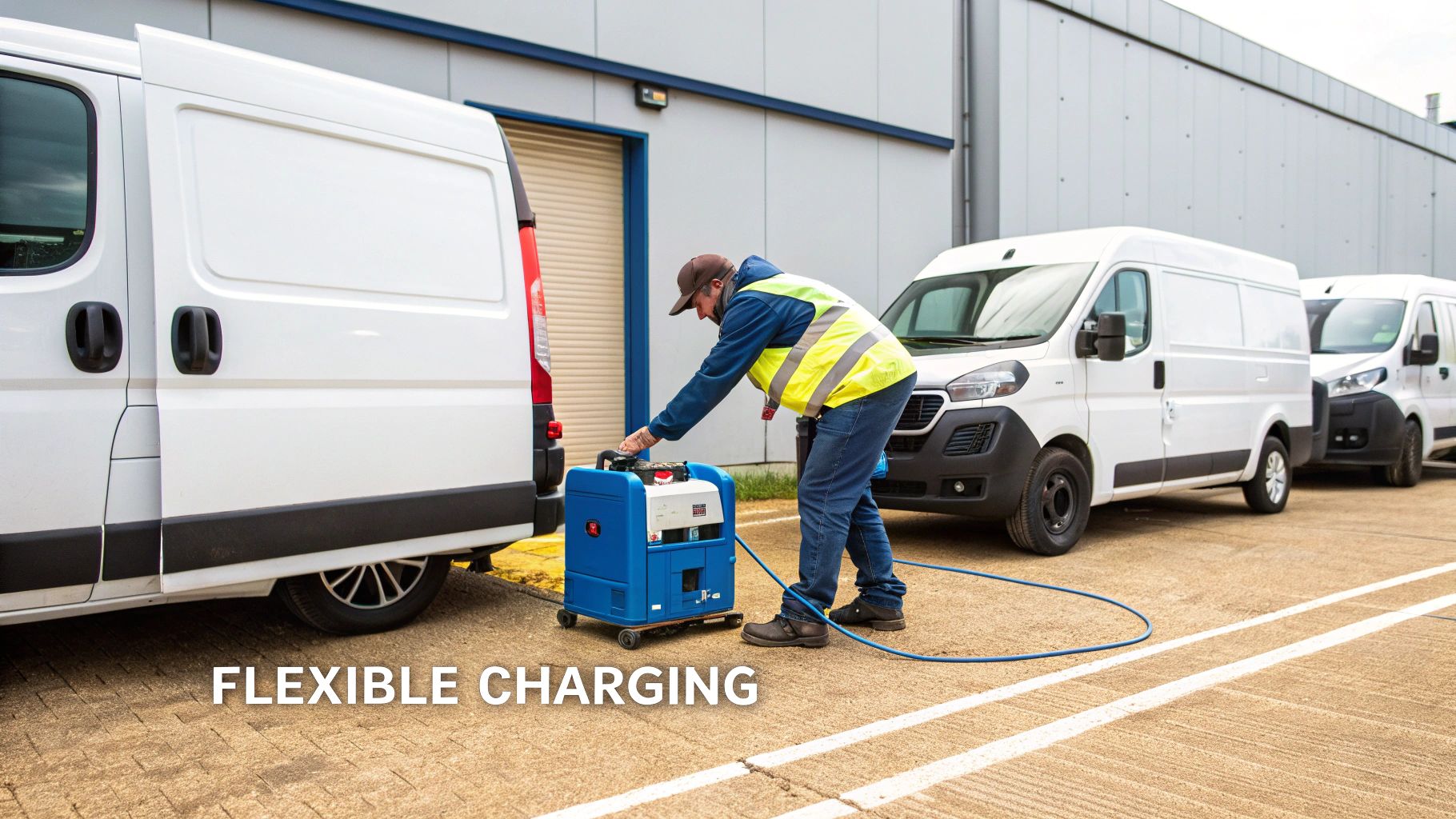
It is one thing to talk about mobile ev fleet charging in theory but the real test is how it performs out in the field. ZAPME’s mobile solutions are designed to deliver tangible advantages right from day one, tackling the exact pain points that keep fleet managers awake at night—from crippling infrastructure delays to a complete lack of operational agility.
Our entire approach is built on a simple premise: provide power precisely where it is needed, when it is needed. This completely changes the charging equation. Instead of vehicles being tied to a fixed spot on a map, the energy source becomes a mobile asset that serves the fleet. That is how charging is transformed from a logistical bottleneck into a strategic advantage.
The secret to this flexibility lies in the design of the charging units themselves. They are engineered for rapid deployment and portability, meaning they can be moved between sites or dispatched to a vehicle with minimal fuss. In a commercial setting where every minute of downtime hits the bottom line, that speed is critical.
Power and Portability in Action
At the heart of ZAPME's offering is a range of mobile units with power outputs designed for the real world. With capacities from 10kWh up to 300kWh , our units can handle everything from a quick top-up to get a stranded van moving again to a substantial recharge for heavy-duty electric machinery. You get rapid and ultra-rapid charging speeds without the permanence and eye-watering cost of fixed infrastructure.
This combination of serious power and portability unlocks powerful solutions to common business problems. It is about much more than just emergency rescue; it is about proactively managing your energy to keep the fleet running at peak efficiency.
Just imagine how this flexibility could be a game-changer for your operations:
- Mid-Shift Top-Ups: A delivery driver’s lunch break becomes a charging opportunity, extending their operational range without a time-consuming trip back to the depot.
- Off-Grid Operations: A construction site can power its electric diggers and tools even where no grid connection exists, finally ditching noisy, polluting diesel generators for good.
- Premium Customer Services: A vehicle rental company can deliver a fully charged car directly to a client's door, offering on-demand charging as a real value-added service.
ZAPME's technology decouples a fleet's energy requirements from its geographical location. This simple shift addresses the primary barriers to electrification—infrastructure cost, installation delays and operational inflexibility—head-on.
With this level of agility, a lack of fixed charging points never has to be a barrier to productivity or business growth again.
A Profitable Business Model for Operators
Beyond servicing your own fleet, owning a ZAPME mobile charger opens up a significant new revenue stream. The same flexibility that makes it invaluable for your operations is exactly what other businesses will pay a premium for. As an operator, you have everything you need to establish a lucrative charging-as-a-service business.
Think of the potential income. You could offer an emergency roadside assistance service for stranded EV drivers, charging a call-out fee plus a per-kWh rate. A typical emergency call-out could realistically generate £150-£200 , providing a vital service while turning a healthy profit.
You can also contract with local businesses that are electrifying their own fleets but are still stuck waiting for their depot infrastructure to be installed. By providing scheduled daily or weekly top-ups, you create a steady, predictable revenue source. With just a handful of regular clients, a mobile unit can quickly pay for itself and become a substantial profit centre, generating thousands of pounds in extra income each month. It is how an operational tool becomes a powerful financial asset.
Got Questions About EV Fleet Charging? We've Got Answers.
Making the switch to an electric fleet throws up a lot of valid questions for any manager. Getting straight, practical answers is the only way to build a strategy that actually works on the ground. Here, we tackle the most common queries we hear, focusing on how mobile solutions can give you a serious financial and operational edge.
How Much Does It Really Cost to Set Up Depot Charging?
The honest answer? It varies wildly. A handful of low-power AC chargers might only set you back a few thousand pounds. But if you need multiple DC fast chargers, you could easily be looking at tens or even hundreds of thousands.
The real sting in the tail, though, is often the grid upgrade needed to handle all that extra electrical load. That is where the big, disruptive costs hide. This is exactly where mobile charging comes in, offering a massive financial advantage by letting you deliver fast charging without the huge upfront capital and messy civil engineering works. It makes for a much more manageable, phased transition.
Can a Commercial Fleet Just Rely on Public Charging?
While the UK’s public network is getting better, relying on it completely for a commercial fleet is a huge gamble. You have zero control over charger availability, reliability or pricing. That can lead to drivers wasting valuable time queueing for a charger, which can absolutely cripple your fleet’s efficiency.
On top of that, the stark regional differences in charger density make this an unworkable strategy in many parts of the country. A smart fleet uses the public network as a helpful backup, not a primary fuel source. The most resilient strategies always combine dependable depot charging with flexible mobile options.
The single greatest advantage of mobile charging is operational flexibility. It decouples your fleet’s energy needs from a fixed geographical location, turning a potential constraint into a strategic asset.
What’s the Single Biggest Advantage of Mobile EV Charging?
In a word: flexibility . Mobile charging cuts the cord, freeing your energy needs from a fixed spot on a map. It brings the charge directly to the vehicle, whether that is for an emergency roadside rescue or for scheduled top-ups at a temporary work site. The bottom line is it keeps your vehicles on the road, earning their keep.
This flexibility does not just prevent costly downtime; it can unlock entirely new ways to make money. Businesses can offer charging as a premium service, transforming an operational chore into a profitable part of the business. An operator with a mobile charger can make substantial money by turning their asset into an income generator.
How Do I Figure Out the Energy Needs for My Electric Fleet?
First things first, you need to dig into your fleet's telematics data. You are looking for a solid understanding of the average daily mileage for each vehicle, its typical routes and how long it usually sits still (dwell times). A vehicle’s efficiency, measured in miles per kilowatt-hour (kWh), is another critical piece of the puzzle.
A simple starting point for your calculation is:
- (Total Daily Miles / Vehicle Efficiency in miles per kWh) = Daily kWh Needed
Once you have this baseline number, it is vital to build in a buffer of at least 20-30% . This is your safety net for real-world variables like cold weather (which hits battery performance) or unexpected detours and traffic that chew through energy. Smart charging software can automate these calculations and help you optimise schedules to save the most money.
Ready to unlock true charging flexibility and turn your energy strategy into a profitable asset? Discover how ZAPME ’s mobile EV fleet charging solutions can power your transition. Visit us at https://www.zapme.biz to learn more.