

UK EV Chargepoint Grant: Your Complete Guide
Making the switch to an electric vehicle is a big move but figuring out the charging situation can feel like a major hurdle. This is especially true if you live in a flat or a rented house without a private driveway. The UK government gets this and that's why they introduced the EV chargepoint grant .
Unlocking Financial Support for Your EV Charger
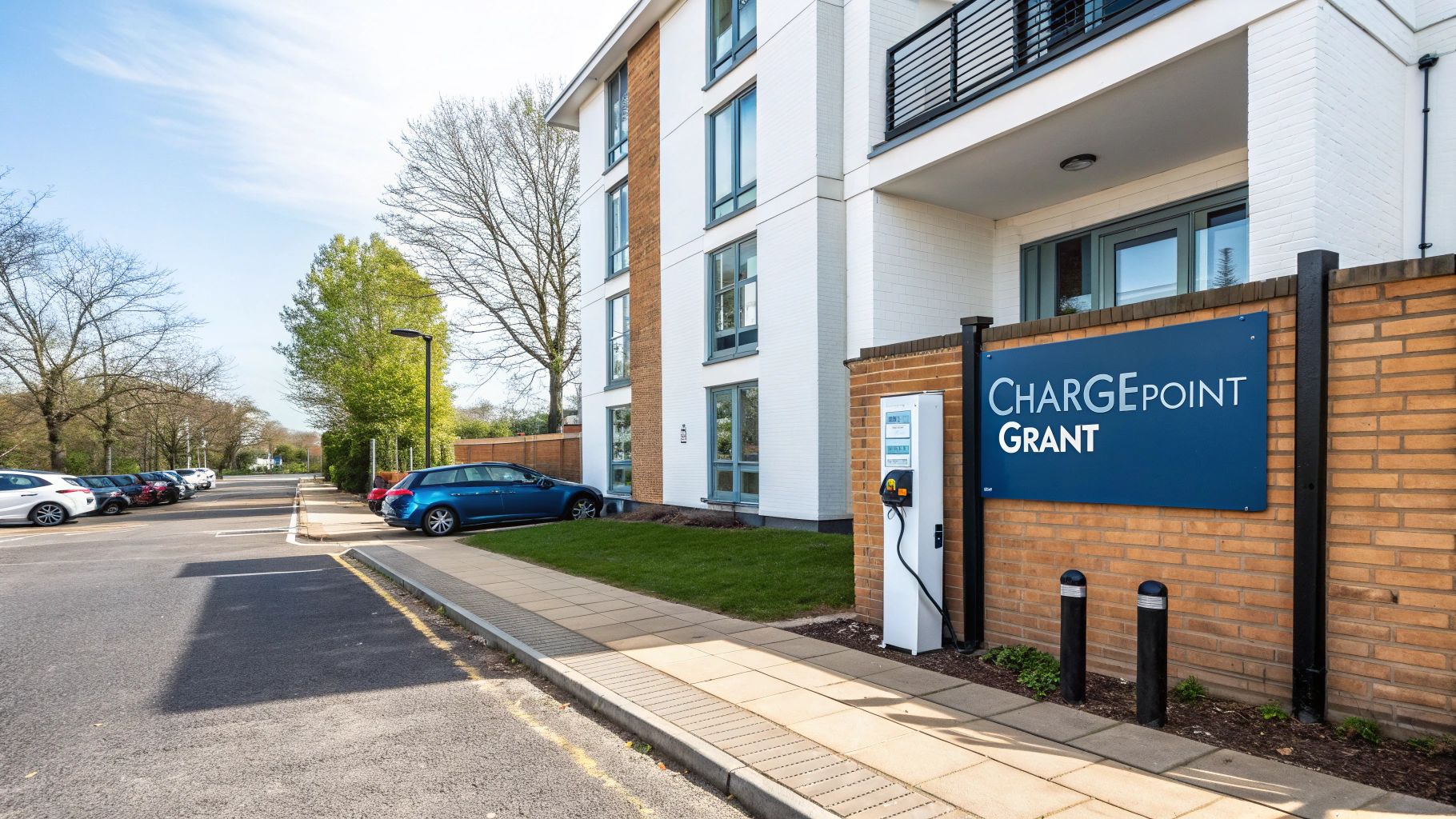
This grant is a straightforward bit of financial help designed to get more chargers into homes that need them most. It provides up to £350 off the cost of buying and installing an EV chargepoint, making home charging a realistic option for people who were previously left out.
The whole point of the scheme is to bridge the gap for those living in rental properties or blocks of flats. By covering a decent chunk of the initial cost, the grant makes the investment far more manageable and levels the playing field for EV ownership across the country.
A New Focus: From Homeowners to Renters and Flat Dwellers
You might remember the old Electric Vehicle Homecharge Scheme (EVHS). It did a fantastic job of encouraging early EV adoption for homeowners with their own driveways but as the market grew, it became obvious that a different strategy was needed to support everyone else.
The EVHS wrapped up in March 2022, making way for the new, more targeted EV chargepoint grant . This new scheme is aimed squarely at:
- Tenants living in any kind of rented property.
- People who own and live in a flat .
- Landlords looking to install chargers for their tenants.
This is a smart move. It tackles one of the biggest roadblocks stopping people in flats and rented homes from going electric. Without easy access to home charging, making the switch just wasn’t practical for many. If you're weighing up your options, you can dive deeper in our comprehensive guide to EV charging at home in the UK.
Is the Grant Making a Difference?
Absolutely. The numbers speak for themselves. Since it kicked off in April 2022, the government's grant has helped install 23,178 charging sockets .
Even more telling is that a massive 60% of these installations are in flats and rented properties, proving the scheme is hitting its target right on the money. This is all part of a much bigger push to build a charging network that works for everyone, everywhere. For a closer look at the data, you can learn more about the government's EV charging grant statistics.
Ultimately, the EV chargepoint grant is much more than just a discount. It’s a vital tool for creating a fairer, more inclusive charging network, ensuring the benefits of driving electric are open to all.
Who Can Apply for an EV Chargepoint Grant?
Figuring out the rules for an EV chargepoint grant can feel like wading through treacle but the system is actually designed to support specific groups who need it most. The government has shifted its focus over time, now concentrating on getting chargepoints to those who can’t just stick one on the side of their own house. This means tenants and people living in flats are the priority, so the eligibility criteria are pretty specific.

So, who gets the nod? You need to either own and live in a flat or be renting any type of residential property. Your place must be in the UK and, critically, it must have its own designated, private off-street parking space. Think of a garage, a driveway or a private parking bay that’s legally part of your property.
Of course, you also have to own, lease or be the main driver of an eligible electric vehicle—the grant is there to help active EV drivers, after all. A quick heads-up: if you’ve already had a grant for the same property under this scheme or its predecessors (like the old EVHS), you won’t be able to apply again.
Landlords and Property Managers
Landlords are in a unique position to really expand the UK's charging network and the grant scheme absolutely recognises that. If you're a landlord, you can apply for funding to install chargepoints at the properties you rent out, whether that’s a single-tenancy house or a larger block of flats.
The Electric Vehicle Chargepoint Grant (EVCG) offers up to £350 per socket and you can claim up to 200 grants each year as a landlord. The main condition? The property has to have suitable off-street parking. You can find all the finer details on funding caps and criteria by exploring the latest on the 2025 UK EV chargepoint grants.
For those managing larger car parks, like at a block of flats, the EV Infrastructure Grant offers even more substantial help. It provides up to £500 per parking bay , capped at £30,000 per building , to cover the cost of installing the underlying infrastructure. It’s all about future-proofing buildings, making it much easier and cheaper to add more chargepoints down the line as demand grows.
Businesses and Workplace Charging
Businesses aren’t left out of the picture either. The Workplace Charging Scheme (WCS) is a handy voucher-based system that helps organisations cover the upfront cost of buying and installing EV chargepoints. This is open to all sorts of organisations, including businesses, charities and public sector bodies.
Under the WCS, you can get up to £350 per socket for a maximum of 40 sockets across all your sites. It’s a fantastic way to offer charging for your employees or to power up your company's own electric fleet. Encouraging people to charge at work is a key part of the government's strategy to make EV ownership practical for everyone, especially commuters. For a deeper dive into setting up chargers at your business, have a look at our guide to workplace EV charger schemes.
To be eligible for the WCS, your business must have dedicated off-street parking for staff or fleet use. You don't need to already have a fleet of electric vehicles but you will need to declare your intent to encourage uptake among your staff.
To help you see how these different pots of money fit together, here's a quick breakdown of the main schemes available right now.
UK EV Chargepoint Grant Eligibility at a Glance
This table gives you a snapshot of who can apply for what, how much funding is available and the key things you need to know before you start.
| Grant Scheme | Eligible Applicants | Funding Amount | Key Conditions |
|---|---|---|---|
| EV Chargepoint Grant | Flat owner-occupiers & tenants | Up to £350 per socket | Must have private, off-street parking & own an eligible EV. |
| EV Chargepoint Grant for Landlords | Residential & commercial landlords | Up to £350 per socket (200 grants per year) | Property must have designated off-street parking. |
| EV Infrastructure Grant | Landlords of residential properties | Up to £30,000 per building | For future-proofing car parks with cabling & infrastructure. |
| Workplace Charging Scheme | Businesses, charities, public sector | Up to £350 per socket (40 sockets max) | Must have dedicated off-street parking for staff or fleet. |
As you can see, there are several routes to getting financial support, each tailored to different needs. The key is to identify which scheme fits your situation and make sure you tick all the right boxes before you apply.
How UK Charging Grants Have Evolved
To really get to grips with the current EV chargepoint grant , it helps to look at how we got here. The UK’s approach to supporting electric vehicle adoption hasn’t stood still; it’s evolved to meet the needs of a market that’s growing up fast. The journey started with a landmark scheme that laid the groundwork for today's more focused grants.
That first big initiative was the Electric Vehicle Homecharge Scheme (EVHS). Kicking off in 2014, it was the main driver for getting chargers into homes but its focus was squarely on homeowners with private, off-street parking. This was a logical first step. These "early adopters" were the easiest group to support and were absolutely vital for building initial momentum for EVs.
The EVHS was incredibly successful, normalising the idea of plugging in your car overnight just like you would a mobile phone but its success also highlighted a growing problem. As more people wanted to make the switch, it became obvious that a huge chunk of the population was being left behind—especially those living in flats or rented accommodation.
Shifting Focus From Homeowners to Tenants
Recognising this gap, the government wrapped up the EVHS in 2022 and rolled out the grants we have today. This pivot wasn't an admission of failure; it was a strategic evolution. The new grants were specifically designed to target the exact groups the old scheme couldn't effectively reach: tenants, people in flats and their landlords.
This shift shows a more mature understanding of the UK’s housing and the different needs of its residents. The goal is no longer just about getting chargers into homes with driveways. It’s about ensuring everyone has fair access, whether they own a detached house or rent a flat in a city centre.
"The transition from the EVHS to the current EV Chargepoint Grant marks a significant change in strategy. It signals a move from simply incentivising early adopters to building a truly inclusive national charging network that supports all drivers."
This backstory is important because it explains the "why" behind today's eligibility rules. If you've ever wondered why the grant seems so focused on flats and rented properties, it's because the government already spent years successfully helping homeowners through the previous scheme.
The Impact of Early Grant Schemes
The legacy of the EVHS is huge. Between 2014 and its closure in 2022, the scheme helped install 340,222 domestic chargers with £140.8 million in funding. That laid a critical foundation for later schemes to build on. Since 2017, public charging schemes have added another 8,354 devices with £31.1 million in support to local councils and in 2025 alone, £200 million was committed to expanding infrastructure across various sectors. For more detail on this funding, you can discover the full story of UK electric car government grants.
Understanding this journey helps make sense of the government's long-term vision. The aim is to build a comprehensive charging network that leaves no one behind, tackling the easier wins first before moving on to solve the more complex challenges. To get the complete picture of financial support for EV adoption, it's also worth looking into other electric vehicle tax credits that often work alongside these grant schemes.
Your Step-by-Step Application Guide
Applying for an EV chargepoint grant can feel like wading through a sea of paperwork but when you break it down, it’s a surprisingly straightforward process. The trick is to take it one step at a time and, crucially, to work with an approved installer who knows the ropes. In fact, they handle most of the heavy lifting, which simplifies things for you enormously.
Your journey starts with a simple check: do you meet the eligibility criteria for the specific grant you're after? Once you've confirmed you qualify, your next move is to find an installer authorised by the Office for Zero Emission Vehicles (OZEV) . Think of them less as just electricians and more as your partners in this process; they're the ones responsible for submitting the claim on your behalf.
Finding the Right Installer
You can't just pick any electrician to fit your chargepoint if you want to claim the grant. It is absolutely essential that you choose an OZEV-authorised installer . The government keeps an official list of approved companies, which is your guarantee that they meet strict safety and quality standards.
When you get in touch with an installer, they'll give you a quote and talk you through the practicalities of the installation at your property. They will also double-check your eligibility and let you know exactly what paperwork you need to pull together. This professional will handle the entire grant application and the best part is they deduct the grant amount straight from your final bill. You only pay the difference.
This infographic shows how the grant focus has shifted from the old EVHS for homeowners to the current EVCG , which supports renters and people in flats. It's why the application process is now geared towards these groups.
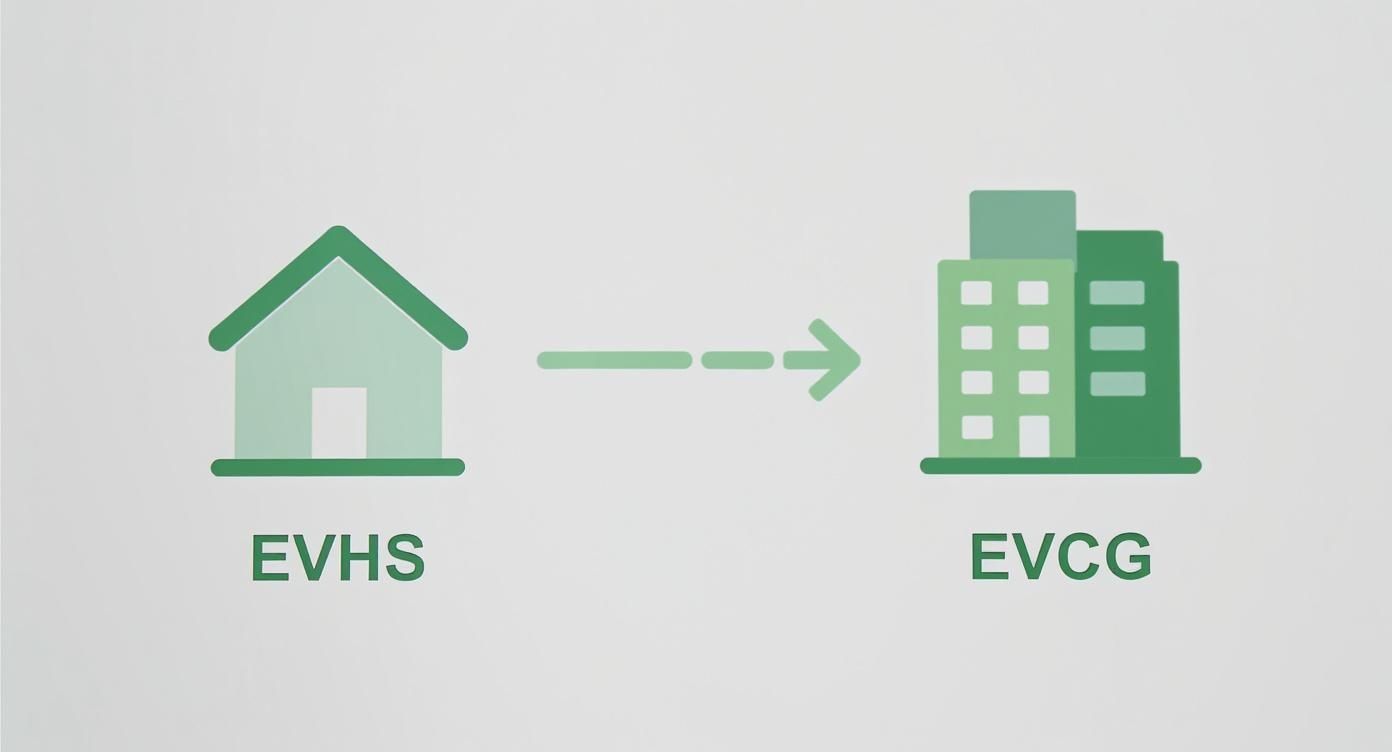
The image really highlights the government's strategic pivot to help those living in properties without private driveways, making the whole scheme far more inclusive.
Preparing Your Documentation
To keep the application moving smoothly, you’ll need to gather a few key documents. Your installer needs this evidence to prove your eligibility to OZEV , so having everything ready will prevent delays or a potential rejection.
Here’s a quick checklist of what you’ll almost certainly need:
- Proof of Property: You’ll need to show you live at the address. This could be a council tax bill, a recent utility bill (within the last three months) or your driving licence. If you're renting, your tenancy agreement is essential.
- Proof of EV Ownership or Lease: You have to demonstrate that you own, lease or are the main user of an eligible EV. This can be your vehicle's registration document ( V5C ), a lease agreement or a company car letter.
- Designated Parking: You must provide proof of a dedicated off-street parking space. Photos or property deeds usually do the trick.
- Landlord's Permission: For tenants, this is a big one. You will need written permission from your landlord or the property management company to have the chargepoint installed.
The Application and Installation Journey
Once you've picked your installer and have your documents in order, the process generally looks like this:
- Online Eligibility Check: Your installer will submit your details and you’ll get a link to an online form where you confirm your eligibility. You'll need a reference number from your installer to do this.
- Confirmation and Scheduling: After you’ve successfully completed the check, both you and the installer will get a confirmation. Now you can get the installation date in the diary.
- Installation Day: The installer arrives and fits your shiny new chargepoint. They'll take photos of the finished installation, as this is part of the evidence needed for the grant claim.
- Claim Submission: With the job done, your installer completes the final claim with OZEV , submitting all the paperwork, photos and your invoice.
- Final Payment: The grant is paid directly to your installer. You then simply pay the remaining balance on your final invoice, which will clearly show the grant amount deducted from the total cost.
It's worth knowing that OZEV sometimes audits installations to make sure they meet the grant requirements. This is just a standard procedure to ensure the scheme is being run correctly, so don't be alarmed if it happens.
The Business of Mobile EV Charging
While the ev chargepoint grant scheme is a fantastic step towards building our fixed charging infrastructure, it leaves a huge, profitable gap in the market. The reality is that not every location is right for a permanent charger and not every EV driver can get to one when they desperately need it. This is where mobile EV charging steps in, not just as a handy service but as a serious business opportunity.
Think of mobile charging as a service station on wheels. Instead of drivers hunting for a charger, the charger comes directly to them. This simple shift creates a remarkably flexible and scalable business model that can tap into revenue streams by serving customers in charging 'not-spots' or at moments of peak demand. The key advantage is agility. A mobile charging operator is not tied to one location; they can go wherever the demand is, precisely when it's needed, and capitalise on opportunities a fixed charger simply cannot reach.
Identifying Profitable Opportunities
The secret to making money is spotting underserved locations and situations. A mobile charging business thrives by focusing on specific niches and providing a service so essential that customers are happy to pay a premium. You are not just selling electricity; you are selling the convenience of on-demand energy delivery.
Consider these high-demand scenarios where a mobile charging operator can generate substantial income:
- Events and Festivals: Large gatherings, from music festivals to country shows, attract thousands of EV drivers who will need a top-up to get home safely.
- Business and Retail Parks: Many older commercial sites lack sufficient charging points for employees and visitors, creating a captive audience during the working day.
- Residential Kerbside Charging: In cities across the UK, countless people in terraced houses and flats have no off-street parking. A scheduled, local mobile charging service is the perfect solution.
- Fleet Depot Support: As commercial fleets go electric, they often need extra charging capacity during busy periods or at temporary sites without their own fixed infrastructure.
Each of these scenarios represents consistent, predictable revenue. By setting up a mobile charger at a busy event for a single weekend, an operator could serve dozens of customers a day, earning significant income before moving on to the next opportunity.
How Much Can an Operator Realistically Make?
The profitability of a mobile charging service is compelling. Unlike a fixed installation with its high upfront costs and reliance on passing trade, a mobile unit's revenue is actively pursued. The operator is in control, setting prices based on demand, location and the convenience they offer.
Let's break down the potential earnings. A common model is to charge a call-out fee plus a competitive price per kilowatt-hour (kWh). For example, a £15 service fee plus 75p per kWh .
A single mobile unit delivering a 40kWh charge to just five vehicles per day at this rate would generate over £225 daily . Operating five days a week, this translates to more than £1,125 per week or an annual turnover exceeding £58,000 from one unit.
This is a conservative estimate. At a weekend festival or a bustling retail park, the number of daily charges could easily double or triple, sending revenue soaring. Scaling up is refreshingly simple: just add more mobile units to the fleet. This allows you to serve multiple locations at once or even deploy a whole team of chargers to cover a major event. For any business entering this space, smooth operations depend heavily on smart planning, particularly proven asset and inventory management strategies.
A Flexible and Future-Proof Business
The mobile charging model isn’t just about plugging gaps; it’s about building a resilient and adaptable business. While the ev chargepoint grant helps build out the core network, mobile charging provides the essential flexibility the grid needs. Operators can respond to power cuts, support emergency services or set up temporary charging hubs while permanent ones are being repaired.
This business model offers a strong return on investment. The initial outlay for a mobile charging unit is far less than the civil engineering and grid connection costs associated with a permanent rapid charger. With lower overheads and the ability to go straight to the customer, the path to profitability is much faster.
The financial case is clear. To truly understand the numbers and see how different models can be shaped for specific business goals, it’s worth exploring the economics of mobile EV charging in a deep dive into ZAPME's model. As the number of EVs on UK roads continues to surge, the demand for convenient, on-demand charging will only grow, positioning mobile charging operators for incredible success.
Common Questions About EV Chargepoint Grants
It’s completely normal to have a few questions left, even after getting your head around the main schemes. Wrapping up the final details is key to moving forward with confidence. Let's tackle some of the most common queries that pop up.
Getting these things straight from the start will make for a much smoother application and save you any headaches down the line.
Can I Choose Any Installer for My Grant-Funded Chargepoint?
Not just anyone, no. You must use an installer who is officially authorised by the Office for Zero Emission Vehicles (OZEV) . These professionals are certified to meet strict safety and quality standards, which is a non-negotiable part of the grant conditions. It ensures the job is done right.
The great thing is, your authorised installer will usually handle the entire grant application for you. They’ll deduct the grant amount straight from your final invoice, so you only have to cover the difference. You can find a full list of OZEV-approved installers on the government's website.
What Happens If My Grant Application Is Rejected?
If your application for an EV chargepoint grant doesn't go through, your chosen installer will be told why. It’s rarely a dead end. Common reasons are things like incomplete paperwork, the property not being eligible or an issue with the installation plan.
Most of the time, you can simply fix the problem and reapply. This is exactly why working closely with an OZEV-approved installer from day one is so important—they know the process inside out and can spot potential issues before the application is even sent.
A rejected application is often just a bump in the road. Most issues are correctable, allowing you to resubmit once you've provided the necessary information or made the required changes.
Does the Grant Cover the Full Cost of Installation?
The grant is designed to cover a big chunk of the cost but not all of it. For example, a grant might give you up to £350 towards the charger but the total price will depend on the model you pick and how complex the installation is.
You’ll be responsible for paying the difference. That's why you should always get a full, itemised quote from your installer before any work starts. No surprises, just a clear picture of your final contribution.
How Long Are the Current Grant Schemes Available For?
Government grant schemes don't last forever. They all have end dates, though sometimes they get extended. The popular Workplace Charging Scheme , for instance, is currently set to run until 31st March 2026 but these things are always under review and depend on available funding.
Policies can and do change, so it’s always smart to check the official government website for the latest deadlines. Acting sooner rather than later can help you avoid the disappointment of a scheme closing before you’ve had a chance to apply.
While grants are fantastic for fixed chargers, they don't solve every charging puzzle. For true flexibility and power on demand, ZAPME offers pioneering mobile EV charging solutions. Our vehicle-mounted units bring rapid charging directly to your fleet, event or customers, wherever they happen to be. Discover how our Energy as a Service model can create new revenue streams and solve your charging challenges by visiting us at https://www.zapme.biz.