

Electric vehicle fleets: A complete UK guide
The switch to electric vehicle fleets is not a far-off concept anymore; for UK businesses it is happening right now. This guide is your practical roadmap. We will look at how moving to electric is more than just a green initiative—it is a strategic decision that sharpens your operational efficiency, cuts long-term costs and builds a resilient, forward-thinking brand.
Let’s navigate this transformation together, turning what feels like a regulatory headache into a powerful commercial advantage.
Why UK Fleets Are Switching to Electric
The momentum behind electrifying commercial fleets in the UK is impossible to ignore. It is a decisive shift, driven by a perfect storm of regulatory deadlines, the soaring running costs of traditional vehicles and a much-needed focus on corporate responsibility. For fleet managers this is not just about hitting environmental targets; it is about future-proofing your entire operation against inevitable change.
The UK government has drawn a clear line in the sand, steering us away from internal combustion engines. This legislative push is the primary catalyst forcing businesses to completely rethink their fleet makeup. By mid-2024, the UK had already blown past 1,145,000 fully electric cars on its roads, a number that just keeps climbing.
This growth is being supercharged by policies like the Zero Emission Vehicle (ZEV) Mandate, which demands a huge slice of new car sales be zero-emission, gunning for 100% by 2035 . You can dig deeper into what these EV statistics mean for the industry if you want the full picture.
The Economic Case for Electrification
Compliance aside, the financial arguments for making the switch are becoming too strong to dismiss. While the upfront cost of an electric vehicle can feel steep, the Total Cost of Ownership (TCO) almost always tells a much more favourable story. The relentless rise in petrol and diesel prices, paired with the endless maintenance of traditional engines, makes an electric fleet a seriously attractive long-term investment.
Fleet managers are finding big savings in a few key areas:
- Drastically Reduced Fuel Costs: Electricity is significantly cheaper per mile than petrol or diesel. That is an immediate saving you will see on the books.
- Lower Maintenance Bills: EVs have far fewer moving parts. Think about it: no more oil changes, exhaust system repairs or surprise engine component failures.
- Tax Incentives and Grants: The government has put various schemes in place to soften the financial blow, making the transition much more accessible for businesses of all sizes.
The decision to electrify is no longer a question of 'if' but 'when'. The operational and financial benefits are too significant to ignore, turning what seems like a regulatory burden into a clear competitive advantage for forward-thinking businesses.
This guide is designed to break down the complex process of going electric into clear, manageable steps. We will give you the practical insights you need to plan and execute a successful transition, ensuring your business is not just compliant but is geared up for a more efficient and sustainable future.
Choosing the Right Electric Vehicles for Your Business
Picking the right vehicles is the foundation of any successful electric fleet. It is all too easy to get distracted by flashy range figures or rapid charging times but for a commercial operation the only number that really matters is the Total Cost of Ownership (TCO) .
This is not about the price you see on the windscreen. TCO shifts your focus to the genuine, long-term savings you can bank over the vehicle's entire life. By properly calculating the reduced spend on fuel, maintenance and taxes you get a much clearer financial picture and can build a rock-solid business case. Think of it as an investment, not just a purchase.
Analysing Your Fleet's Unique Needs
Before you even start looking at vehicle brochures you need a crystal-clear picture of what your operation actually demands. Every fleet is different so a 'one-size-fits-all' approach is a recipe for disaster. The first step is to get granular with data from your current vehicles.
You need to nail down these key operational factors:
- Daily Mileage: What is the average and maximum distance your vehicles cover each day? Do not forget to account for seasonal swings – cold weather can slash an EV's range by 20-40% .
- Typical Routes: Are your drivers doing stop-start city deliveries or are they eating up miles on the motorway? This directly impacts the battery size and type of vehicle you will need.
- Cargo and Payload: What is the typical weight and volume you are carrying? Overloading an EV is not only illegal but a surefire way to drain the battery and miss your range targets.
- Vehicle Downtime: When are your vehicles actually sitting idle? Knowing this is crucial for planning your charging strategy, whether that is overnight at the depot or opportunistically during driver breaks.
Mapping this out gives you a detailed blueprint for your ideal electric vehicle, ensuring you invest in assets that are a perfect match for your workflow.
Comparing Electric and Diesel TCO
To really see the numbers come to life let’s compare the projected costs of running a typical electric van against its diesel equivalent over five years. Yes, the initial outlay for the EV is often higher but the running cost savings start adding up from day one, leading to a significantly lower TCO in the long run. For a deeper dive you can explore our full guide to the types of electric vehicles built for commercial use.
Take a look at this simplified TCO comparison to see just how the numbers stack up.
TCO Comparison Electric vs Diesel Commercial Vans (5-Year Projection)
This table shows the projected Total Cost of Ownership for a typical electric van compared to a diesel equivalent over five years, factoring in purchase price, government grants, fuel/energy, maintenance and taxes.
| Cost Component | Electric Van Example | Diesel Van Equivalent |
|---|---|---|
| Initial Purchase Price | £45,000 | £35,000 |
| Government Grants | -£5,000 | £0 |
| Fuel/Energy Costs | £7,500 | £20,000 |
| Maintenance & Service | £2,000 | £6,500 |
| Taxes (VED & ULEZ) | £0 | £4,500 |
| Total 5-Year TCO | £49,500 | £66,000 |
As you can see, the electric van delivers a projected saving of £16,500 over just five years. This is not small change; it is a significant reduction in operational expenditure that makes a compelling financial case for going electric.
The UK market for electric light commercial vehicles (LCVs) is growing fast, with great options for almost every trade. Last-mile delivery firms will find agile, compact vans are a perfect fit. For trades like plumbing or electrical work you will want models that offer versatile payload options and customisable storage.
Armed with your own operational data and a clear TCO projection you can confidently choose the vehicles that will drive your business forward—cleanly, efficiently and profitably.
Building a Smart and Flexible Charging Infrastructure
An electric fleet is only as good as its charging strategy. Get it right and you unlock efficiency and profit. Get it wrong and you are left with expensive assets sitting idle. Let's break down how to power your vehicles, from traditional depot setups to the game-changing flexibility of mobile charging.
For most fleets the journey starts with depot charging . This means installing charging points at your home base where vehicles park overnight. It is a logical and often cost-effective first step but it demands serious thought about your depot's layout and, crucially, its existing grid capacity.
Your first big decision is between AC and DC chargers. AC (alternating current) chargers are the slow and steady option, taking 4-8 hours for a full charge. They are perfect for vehicles that return to base overnight. In contrast, DC (direct current) rapid chargers can get a vehicle back on the road in under an hour but they come with a much higher price tag and put a far greater strain on your electrical supply.
Balancing Depot Charging with On-The-Move Flexibility
While depot charging is a solid foundation, a truly resilient fleet needs options for when vehicles are out on the road. This is where on-the-move charging becomes non-negotiable and mobile charging services, in particular, are completely changing the game.
Mobile charging, like the solutions we offer at ZAPME, brings the charger directly to the vehicle. Think about that for a second. It completely removes the need for a driver to waste valuable time and energy heading back to base for a top-up. For a growing number of businesses this is not just a convenience—it is a massive strategic advantage that directly boosts vehicle uptime and productivity.
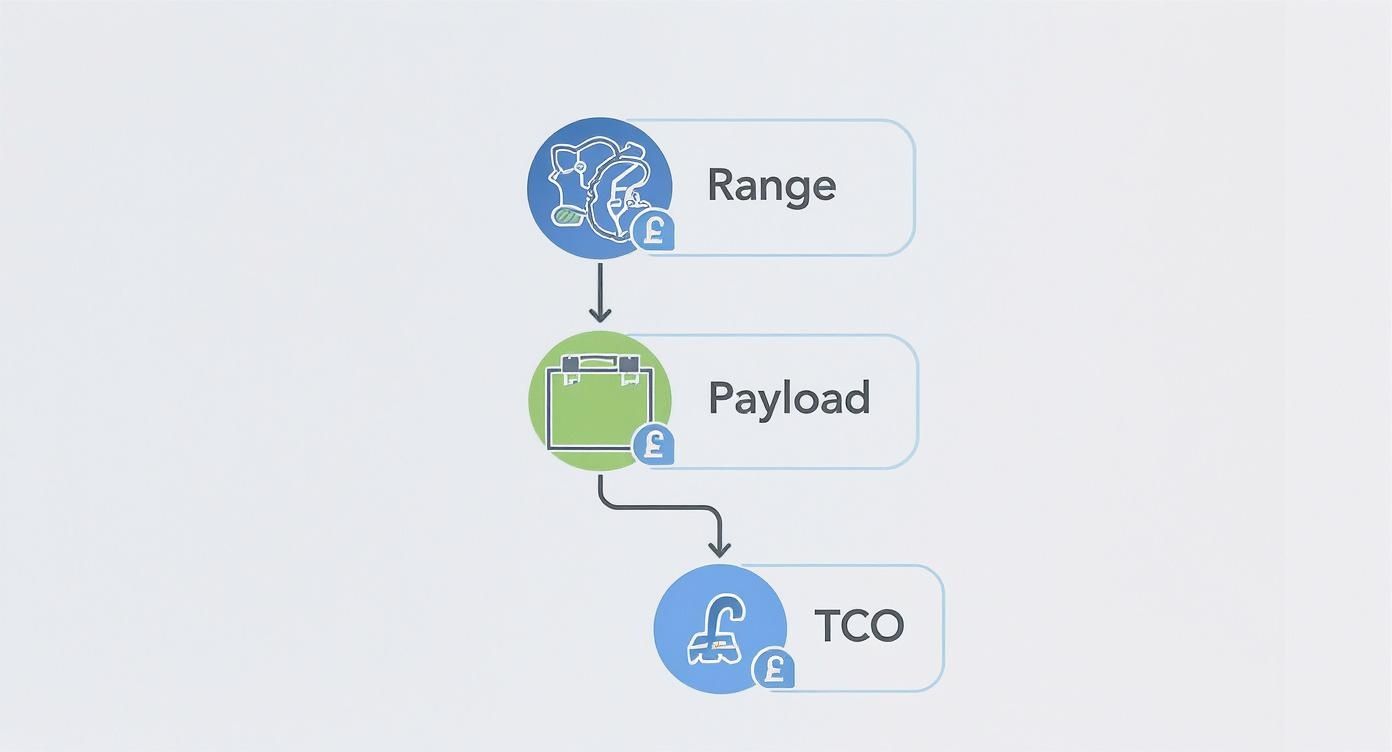
This decision tree shows how crucial factors like Range, Payload, and Total Cost of Ownership (TCO) all feed into your vehicle choice.
Unlocking Uptime and Profit with Mobile Charging
The benefits of adding a mobile charging solution to your mix go way beyond simple convenience. It opens up entirely new ways of operating and can even create a secondary revenue stream. Imagine a delivery van running low on battery miles from its depot. Instead of abandoning the route, a mobile charging unit meets it on-site for a rapid boost, keeping the vehicle on schedule and earning money.
This capability is a lifeline for:
- Fleets without a central depot: If your vehicles are scattered across various sites mobile charging can become your primary power source.
- Emergency support: A rapid response for a vehicle with a low battery can be the difference between a completed job and a failed one.
- Avoiding capital expenditure: Mobile charging lets you expand your EV fleet without sinking huge sums into costly depot grid upgrades. To get a feel for what is involved, check out our commercial EV charging installation guide.
By bringing the charge to the vehicle you fundamentally change the fleet management equation. You are no longer tethered to fixed locations, which unlocks far greater route optimisation and gets more work out of every single asset.
The financial upside is just as compelling. A mobile charging unit is an asset that can serve more than just your own fleet. During downtime that same unit can be contracted out to service other local businesses, respond to public call-outs or support community events.
The Financial Case for Mobile Charging Operators
Let's get practical. Say you operate just one mobile rapid charging unit. By providing charging services to other local fleets or the public when your own vehicles do not need it you could generate serious income. You can easily charge a premium for the convenience of on-demand, on-location power.
Here is how the numbers could stack up:
- Service Calls: A call-out fee plus a per-kWh rate could easily bring in £50-£100 per charging session .
- Contract Services: A monthly retainer from a nearby business to provide regular top-ups for their two or three electric vans could mean a steady £400-£600 per month .
Combine a few service calls a day with one or two small business contracts and a single mobile charging unit could generate upwards of £25,000 to £40,000 in additional annual revenue . Suddenly, an operational tool has become a genuine profit centre, helping to offset your own fleet's energy costs and contributing directly to your bottom line. We will dive deeper into these business models in the next section.
Turning Mobile Charging into a New Revenue Stream
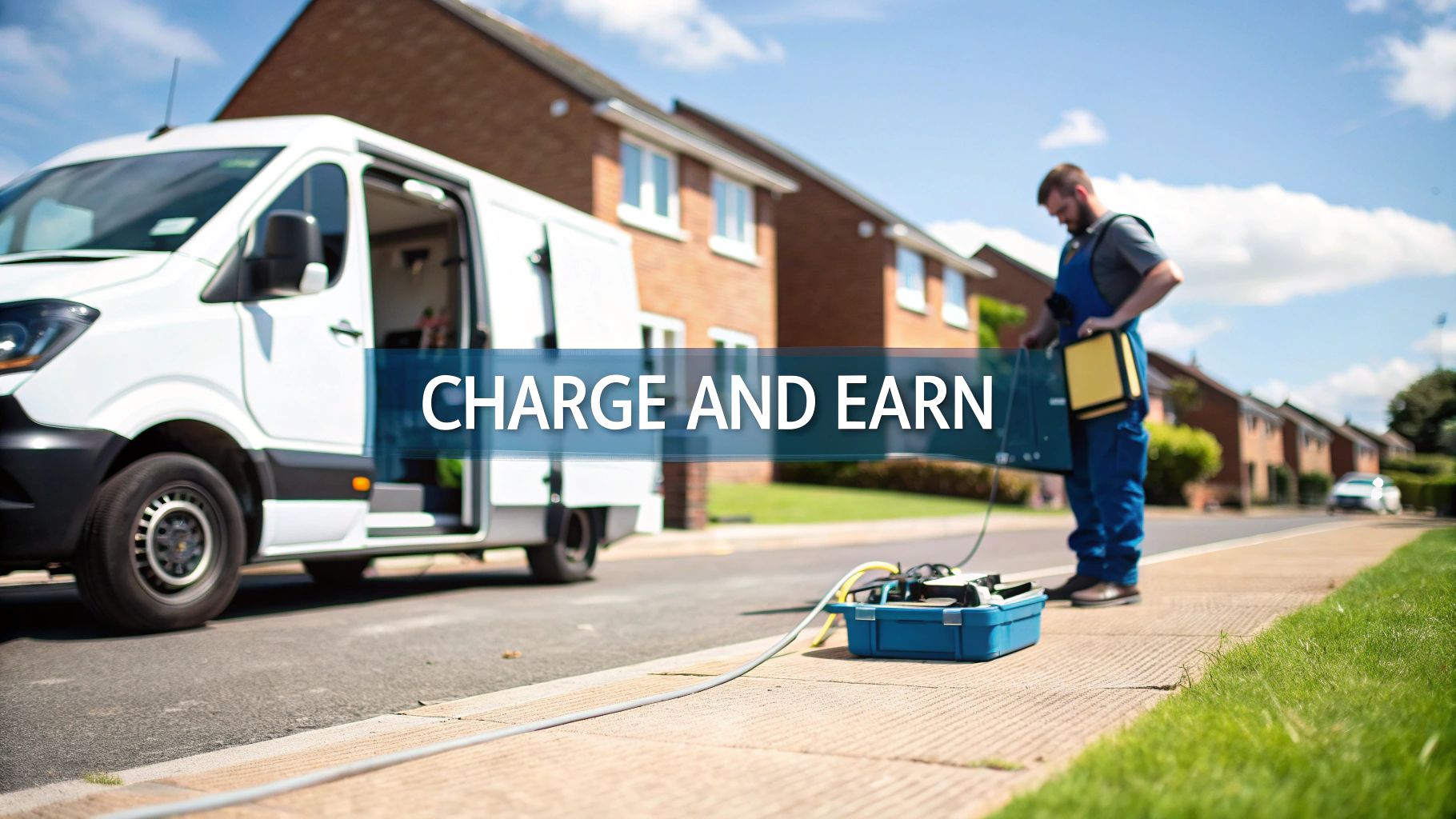
When you adopt this entrepreneurial mindset it becomes clear how a mobile charger not only reduces your own capital outlay on fixed infrastructure but also opens the door to a lucrative new profit stream that strengthens your entire business.
Funding Your Fleet's Electric Transition
Making the switch to an electric fleet is a big move but with the right financial plan it is completely manageable. Let's cut through the noise and look at how you can actually fund this transition, exploring the grants, incentives and operational models that can seriously slash the upfront costs.
The good news? You are not in this alone. The UK government and various other bodies offer substantial support to encourage businesses to go electric. Knowing how to navigate these options is the key to building a cost-effective electrification strategy.
Tapping into Government Grants and Tax Incentives
The most direct way to soften the financial blow is through government support. These schemes are designed specifically to lower the barrier to entry for businesses adopting cleaner transport and it pays to know what is available. While the specifics can change they generally cover both buying the vehicles and getting the charging infrastructure installed.
Keep an eye on these key funding avenues for UK fleets:
- Vehicle Grants: While grants for electric cars have largely been phased out for retail buyers commercial vehicles often still get a helping hand. The Plug-in Van Grant, for example, can knock a significant chunk off the purchase price of a new electric van.
- Workplace Charging Scheme (WCS): This is a brilliant voucher-based scheme that helps businesses with the upfront cost of buying and installing EV charge points. It can cover up to 75% of the total costs of purchase and installation, capped at a set amount per socket. It is a no-brainer for any business setting up depot charging.
- Capital Allowances: Do not overlook the tax benefits. Businesses can often claim 100% first-year capital allowances on electric vehicles and charging infrastructure. In simple terms you can deduct the full cost from your pre-tax profits in the year you buy them, which can make a big difference to your corporation tax bill.
Securing these funds is all about planning and timing. You have to be on the ball. Always check the official government websites for the latest eligibility rules and deadlines so you do not miss out on these valuable opportunities.
This government backing is a direct response to the explosion in EV adoption. As of August 2025, the UK had over 1.6 million fully electric vehicles on its roads, supported by a growing network of over 85,163 public charging points . This expanding infrastructure makes running an EV fleet more practical than ever. For a deeper dive into these figures you can discover more about the UK's EV growth on fleetsauce.co.uk.
Exploring Smarter Operational Models
Beyond direct grants fresh business models are popping up that completely change the financial picture of going electric. These options shift the focus from a massive one-off capital spend to more predictable, manageable operational costs. This really helps with cash flow and dials down the risk.
Ownership vs Leasing
The age-old debate of buying versus leasing has never been more relevant than with EVs.
- Outright Ownership: Buying your vehicles gives you total control and you get to keep the long-term asset value. The catch, of course, is the hefty upfront capital required.
- Leasing: This is a popular route. It gives you access to the latest EV tech for a fixed monthly fee and you do not have to worry about things like battery degradation or what the vehicles will be worth in a few years. It turns a capital expense into a simple operational one.
The Rise of Energy-as-a-Service
A particularly smart model gaining traction is Energy-as-a-Service (EaaS) . Think of it as a subscription for your entire charging ecosystem. An EaaS provider handles everything from installation and maintenance to the energy supply itself, all for a predictable monthly fee.
This approach takes the headache and capital spend of building and running your own infrastructure completely off your plate. It is perfect for businesses that want all the benefits of an electric fleet without the operational complexity. You get to focus on your actual business while the energy management is handled by experts. It provides cost certainty and ensures your charging setup is always running as efficiently as possible.
Your Phased Electrification Rollout Plan
Switching to an electric fleet is not something you do overnight. It is a journey, not a single leap. The smartest approach is a carefully phased rollout, which lets you manage risk, gather crucial data and make sure the operational shift is a smooth one.
Think of it as a series of controlled experiments. Each stage builds on the last, giving you the real-world insights needed to scale up successfully. Rushing the process is a classic mistake and it often leads to expensive errors down the road. This checklist breaks it all down into clear, manageable stages.
Starting With a Fleet Audit
First things first: you need a deep dive into your current fleet. Before you can even think about which vehicles to replace you have to understand exactly how they are used day in, day out. Get your hands on telematics data to analyse daily mileage, routes, payloads and vehicle downtime.
This data is your foundation. It will quickly show you which vehicles are consistently operating well within the range of current EV models, making them the perfect low-risk candidates for your initial pilot programme. Do not just look at the averages; the outliers tell you just as much about the full scope of your operational needs.
A common pitfall is underestimating the complexity of your own operations. A detailed fleet audit provides undeniable data that removes guesswork and ensures your first electric vehicles are set up for success from day one.
Designing Your Pilot Programme
Once you have pinpointed the best vehicles to swap out it is time to design a small-scale pilot. This is your chance to test absolutely everything in a controlled, low-risk environment. The goal is not just to see if the vehicles work—it is to understand precisely how they integrate into your daily workflow.
Your pilot programme should be laser-focused on answering a few key questions:
- Real-World Performance: How do the EVs actually perform on your specific routes, with your typical payloads and in different weather conditions?
- Charging Behaviour: How does your planned charging strategy work in practice? Are overnight charges enough or do your drivers need to top up during the day?
- Driver Feedback: What do your drivers think? Their buy-in is absolutely critical for long-term success, so getting them on board early is a must.
This stage is also the perfect time to evaluate your location's readiness. A look at urban electric fleet adoption shows just how much things vary across the UK. For example, Bristol is leading the charge with 44.5% of its fleet being electric, with Liverpool close behind at 43.3% . In stark contrast, London's commercial fleet is only 3.2% electric, highlighting a major electrification divide. Knowing your local context is vital and you can learn more about these regional fleet findings.
Training and Measuring for Success
Proper training for both drivers and technicians is completely non-negotiable. Drivers need to get the hang of new techniques like regenerative braking to really maximise range while your technicians will need new skills to maintain the vehicles safely. Running dedicated training sessions during the pilot phase makes sure your team is ready when you decide to scale up.
Finally, you need to establish clear Key Performance Indicators (KPIs) to measure whether your pilot is a success. Track metrics like cost per mile, vehicle uptime, energy consumption and total maintenance costs. This hard data will form the business case for your full rollout, giving you concrete proof of the financial and operational benefits of going electric.
Got Questions About Electric Fleets? We've Got Answers
When you are planning a switch to an electric fleet the same questions tend to pop up time and time again. We have been there and we have heard them all. Here are straight-up answers to the most common queries we get from fleet managers, designed to give you clarity and help you make the right call.
What is the Biggest Hidden Cost I Should Know About?
Hands down, the most significant and often overlooked expense is the potential need for a grid infrastructure upgrade at your depot. It is a classic "gotcha" moment for many operators.
You get excited about installing a bank of high-power chargers only to find out they will easily overwhelm your site's current electrical capacity. This is not a small problem; it means getting your Distribution Network Operator (DNO) involved for costly and time-consuming work that can drag on for months. Factoring this into your initial budget and timeline is non-negotiable if you want to avoid serious delays and financial headaches.
How Badly Do Cold Weather and Heavy Loads Hit the Range?
They have a real impact and you need to plan for it. Both cold temperatures and heavy payloads will noticeably reduce an electric vehicle's effective range. It is not unusual to see a drop of 20-40% in harsh winter conditions.
It is vital to factor this performance dip into your vehicle selection and route planning. Always choose vehicles with a real-world range that comfortably exceeds your longest daily routes, even in a worst-case scenario. This is how you maintain operational reliability.
Building in that buffer ensures your drivers can get their jobs done without succumbing to range anxiety when the weather turns or the cargo is heavy.
Can Mobile Charging Genuinely Replace Depot Charging?
For certain fleets, absolutely. If your vehicles operate far from a central hub and do not return daily or if your depot has grid limitations that are just too difficult to overcome a strategy built around mobile charging and public networks can be a perfectly sound alternative.
For most businesses, though, the sweet spot is a blended approach. Combining affordable, slow-and-steady overnight depot charging with the tactical flexibility of on-demand mobile top-ups gives you the best of both worlds: cost-efficiency and operational resilience. This hybrid model keeps your electric fleet charged, agile and always ready for the day ahead.
Ready to build more flexibility into your fleet's charging strategy? See how ZAPME 's mobile and portable EV charging solutions can slash downtime and even open up new revenue streams for your business. Discover our range of powerful units.