

Type 2 charging: Your quick guide to UK EV charging
Think of a Type 2 charger as the EV equivalent of the USB-C cable. It has become the go-to standard for electric vehicles across the UK and Europe, the one connector you will find on virtually every new EV, home wallbox and public AC charging point. It is the default for day-to-day charging.
The Go-To Standard for UK EV Charging
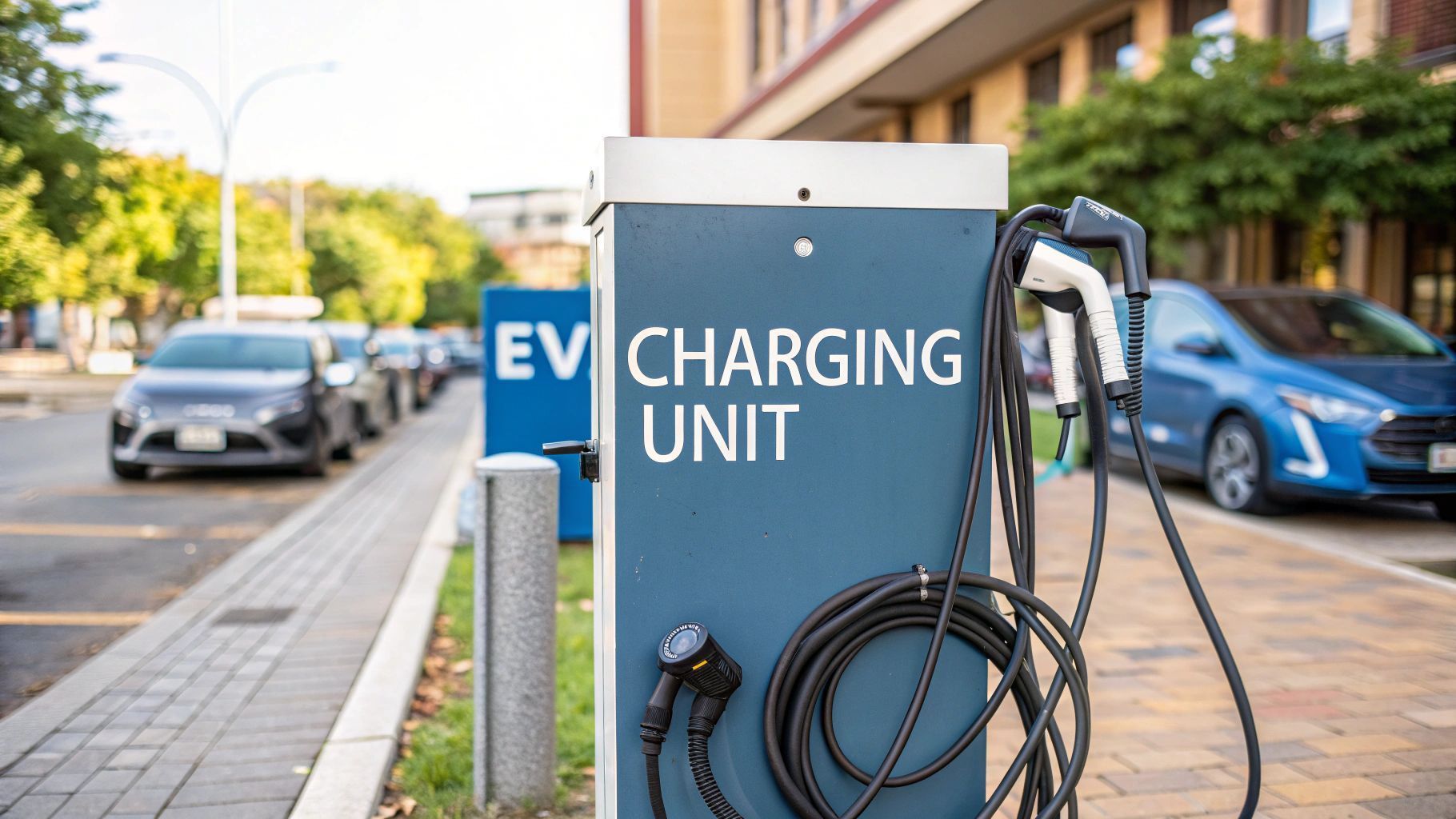
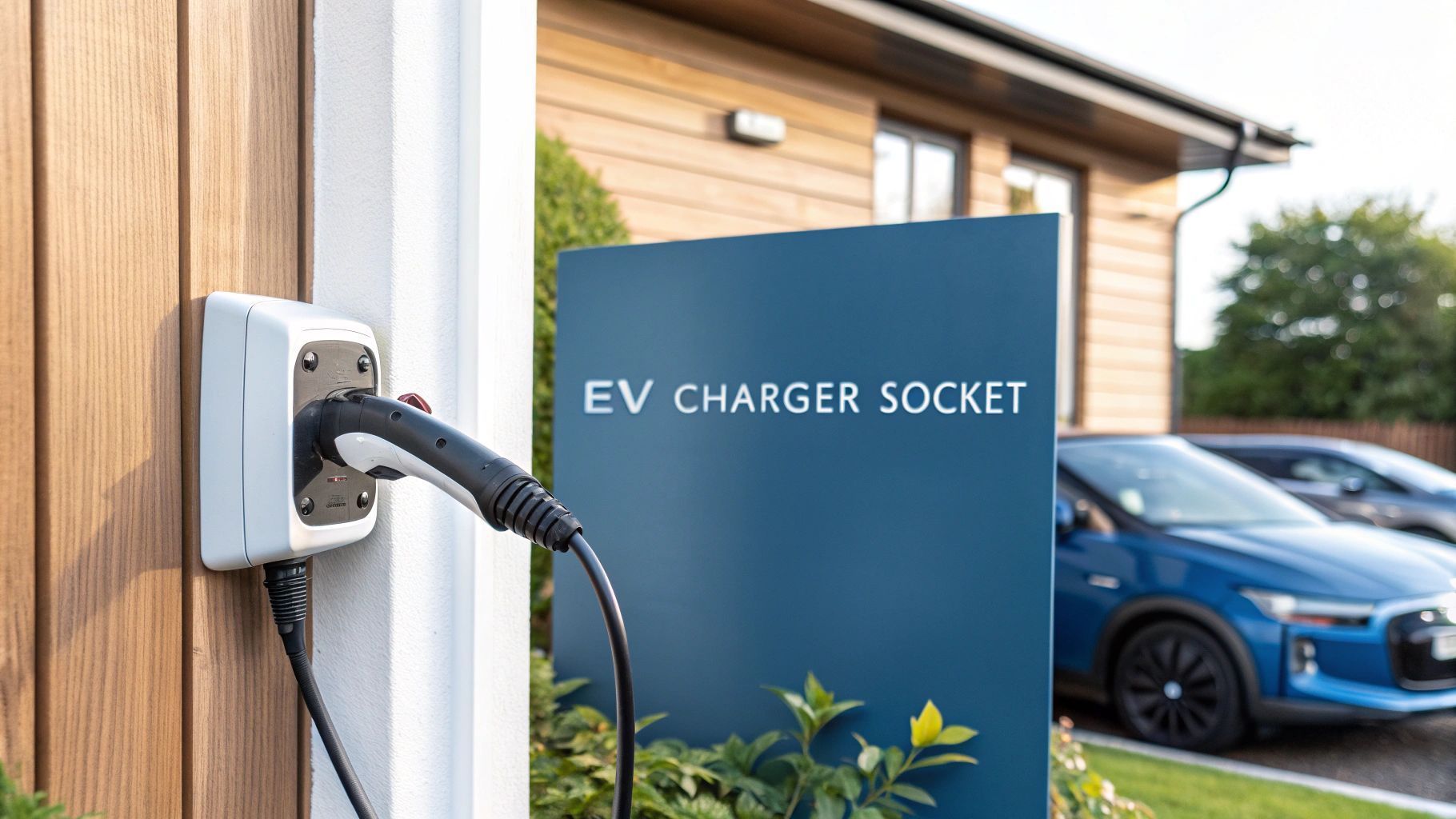
Put simply, a Type 2 plug is what you will use for most of your EV charging. It is the socket for your overnight top-up at home and the one you will find waiting for you at supermarkets, car parks and workplaces. This widespread adoption makes life incredibly convenient for EV drivers right across the country.
One of its biggest strengths is its versatility. A Type 2 connection can handle everything from a slow 3.7kW trickle charge at home to a much faster 22kW top-up at a public station. This flexibility means the same connector works whether you have hours to spare or just need a quick boost while you are out.
Why It Became the Standard
The success of the Type 2 connector in the UK and Europe comes down to its clever design and built-in safety. Unlike a normal household plug, it creates a secure “digital handshake” between the car and the charging point before any electricity starts to flow. This communication protocol confirms everything is safely connected, making the whole process incredibly reliable.
By becoming the mandated standard for AC charging across Europe, the Type 2 connector cut through the early market confusion. That single decision created a unified infrastructure, letting drivers use chargers from any manufacturer without needing a bag full of adaptors.
To give you a quick reference point, here is a simple breakdown of what makes a Type 2 charger what it is.
Type 2 Charging at a Glance
This table summarises the core characteristics of the UK’s standard AC charging system.
| Characteristic | Description |
|---|---|
| Primary Use | Home, workplace, and public AC charging. |
| Common Power Levels | 3.7kW , 7.4kW (single-phase) and 11kW , 22kW (three-phase). |
| Connector Design | A seven-pin plug designed for safety and communication. |
| Geographic Standard | The official standard for the UK and all of Europe. |
It is this blend of safety, flexibility and standardisation that has cemented the Type 2 connector's role as the foundation of everyday EV charging.
A Look Inside the Type 2 Connector
To really get to grips with type 2 charging , you have to look at the plug itself. You will often hear it called a ‘Mennekes’ connector—a nod to its original German designer—and its clever seven-pin design is the secret to its success. It is what allows it to balance serious power delivery with the critical safety communications that make it so reliable. It is a world away from a simple domestic plug.
At its heart, the connector dedicates several pins to the main job: sending electricity to your car. For the kind of charging you would do at home overnight, a single-phase connection uses one live pin, a neutral pin and an earth pin. But for faster charging, like you would find at a workplace or public car park, it can bring three live pins into play for a three-phase supply. This setup massively boosts the power output without needing a totally different plug.
The Smart Handshake for Safe Charging
The real magic of the Type 2 connector, though, is in its two smallest pins: the Control Pilot (CP) and Proximity Pilot (PP) . These two are responsible for a constant digital conversation between your vehicle and the charging station. Think of it as a pre-flight safety check that happens every single time before any power starts to flow.
This communication process, often called a 'digital handshake', confirms a few vital details:
- Secure Connection: It checks that the plug is properly seated and locked into the vehicle's socket. No loose connections here.
- Cable Capacity: The Proximity Pilot tells the car the maximum current the charging cable can safely handle, which is crucial for preventing overheating.
- Ready to Charge: The Control Pilot acts like a traffic controller, telling the vehicle when the charger is ready and signalling to the charger that the car is ready to accept power.
This intelligent handshake is the system's most important safety feature. It guarantees that high-voltage electricity only flows when a secure, verified connection is established between the car and the charger, giving EV owners complete peace of mind every time they plug in.
This entire process shows how type 2 charging is inherently safe by design, which is a key reason it became the standard across the UK and Europe. The image below shows the common places you will find this safe and reliable charging in action.
This just goes to show how versatile the Type 2 connector is, acting as the go-to solution for everyday charging environments—from overnight at home to top-ups at the office or public destinations.
Understanding Real-World Charging Speeds
The kilowatt (kW) rating you see on a charger is a bit like a car's top speed – it tells you the maximum power it can deliver but what does that actually mean for your day-to-day charging? In the real world, the speed of Type 2 charging really comes down to one thing: the difference between the electrical supply at your home versus what you find at public or commercial sites.
Getting your head around this is the key to managing your expectations and making the most of your EV.
Most homes in the UK run on a single-phase electricity supply. This means a typical home wallbox will deliver power at either 3.7kW or, more commonly, 7.4kW . A 7.4kW charger is the sweet spot for overnight use, adding roughly 30 miles of range for every hour it is plugged in. That is more than enough to top up most EV batteries from empty while you sleep.
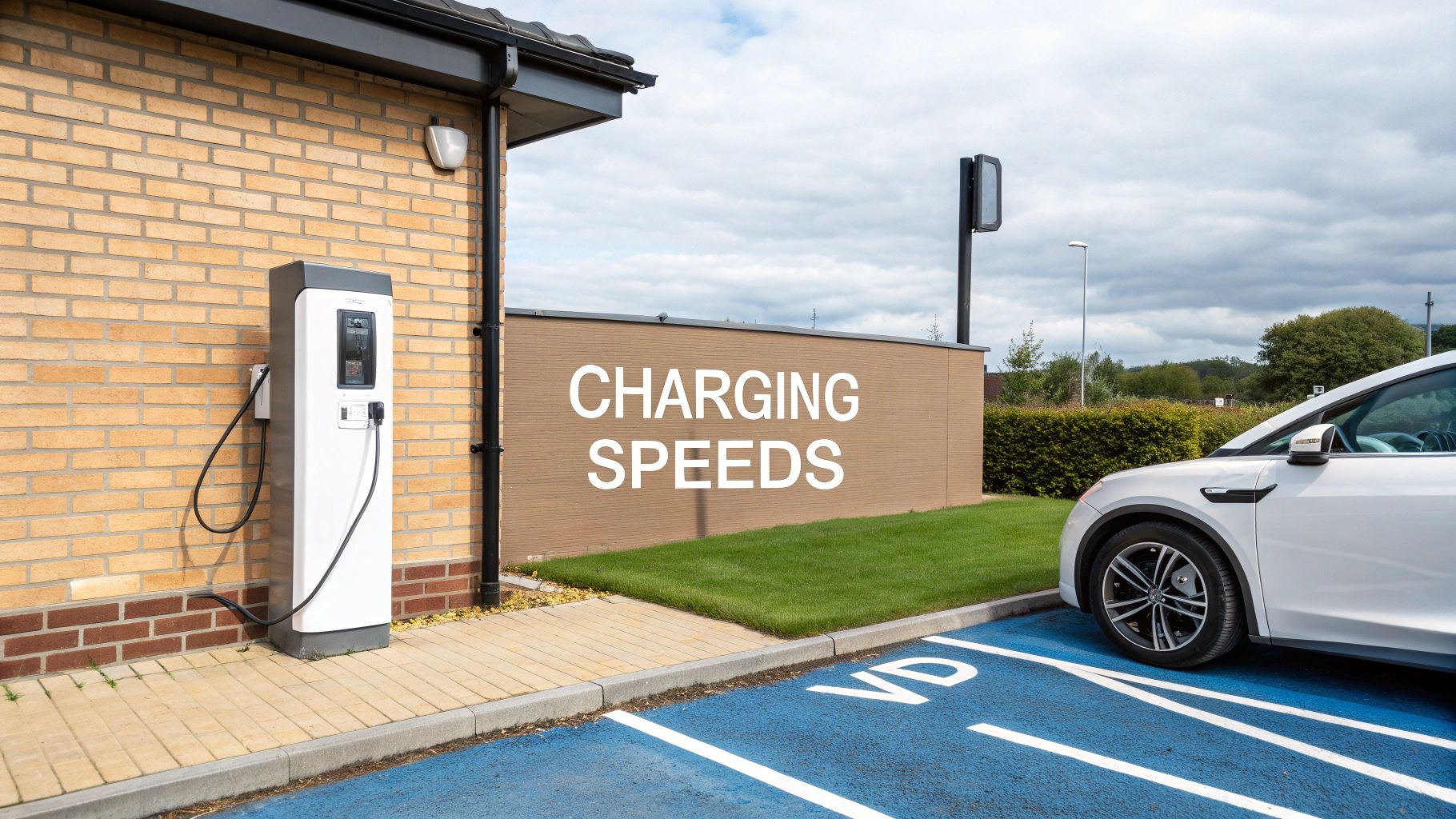
Faster Charging Out and About
Things get a lot faster when you leave home. Many commercial buildings, supermarkets and dedicated public charging hubs are hooked up to a more robust three-phase supply. This allows for significantly punchier Type 2 charging speeds, typically 11kW or even 22kW .
A 22kW charger can add over 80 miles of range in just an hour, which is perfect for a meaningful top-up while you are doing the weekly shop or hitting the gym.
To give you a clearer picture, here is how those numbers translate into actual range.
Type 2 Charging Speeds and Real-World Range
| Power Output (kW) | Typical Location | Approx. Range Added Per Hour |
|---|---|---|
| 3.7kW | Home (older or basic wallbox) | 15 miles |
| 7.4kW | Home (standard modern wallbox) | 30 miles |
| 11kW | Workplace, public car parks | 45 miles |
| 22kW | Supermarkets, public rapid hubs | 80+ miles |
As you can see, the location makes all the difference. While home charging is about convenience, public chargers are designed to give you a quicker boost when you need it.
It is crucial to remember that charging is a partnership. The final speed is always limited by the slowest link in the chain—whether that is the charger, the cable, or your car's own onboard electronics.
Why Your Car Might Not Charge at Full Speed
Just because you plug into a zippy 22kW charger, it does not automatically mean your car will drink electricity that fast. Every EV has an onboard AC charger with its own maximum rate.
For instance, if your vehicle's limit is 11kW , it will only ever draw 11kW of power, even if it is connected to a 22kW station. It cannot be forced to accept more than it was designed for.
Knowing your car’s limit helps you pick the right charger and saves you from waiting around expecting a faster result. To get a better handle on this, check out our guide on how many kilowatts are needed to charge an electric car in the UK. It is essential knowledge for charging efficiently, wherever you are.
The Business of Mobile Charging
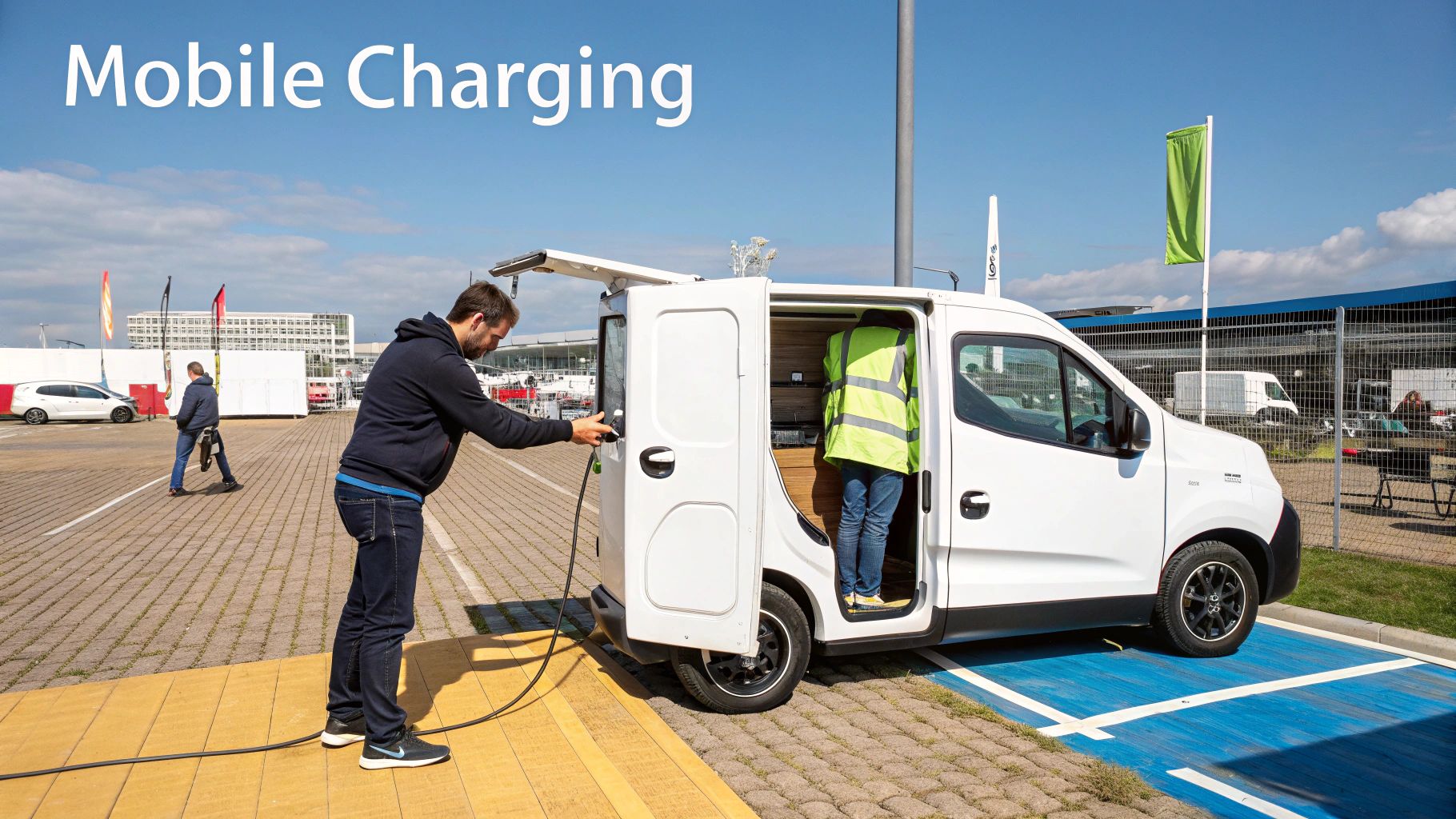
The real power of Type 2 charging is not just about what happens at a fixed wallbox or a public station. It is the engine driving a dynamic, profitable new service industry: mobile charging. This on-demand model is the perfect antidote to 'charge anxiety' for EV drivers and it opens up some serious revenue streams for savvy operators.
Mobile charging completely changes the game. It takes the standard EV infrastructure, which has always been static, and turns it into a flexible, go-anywhere service. This creates a business model that simply was not possible before, allowing operators to bring the charge directly to the customer, right when and where they need it most.
Unlocking Diverse Revenue Streams
The financial model for a mobile charging business is about much more than just selling electricity. You are selling convenience, peace of mind and a solution to a critical problem. That means you can build several layers of income.
Your primary revenue will come from direct service fees. This usually looks like a call-out charge plus a per-kWh rate for the energy delivered. Because it is a premium service, you can command higher rates than fixed public chargers. Drivers are more than willing to pay for the sheer convenience of getting a charge delivered to their stranded car or topped up while they are at an event.
Beyond one-off call-outs, the really big opportunity lies in B2B partnerships. These contracts create a stable, predictable income stream and can include:
- Fleet Support: Providing on-site top-ups for commercial EV fleets at their depots, which saves them from having to invest in expensive infrastructure upgrades.
- Event Services: Deploying units at festivals, outdoor concerts or sporting events where charging facilities are usually non-existent.
- Roadside Assistance: Partnering with breakdown services to become their go-to EV emergency response provider.
For any business running an EV fleet, getting a handle on evolving fleet payment solutions is essential for smooth financial management. Mobile charging operators can slot right into these systems.
Calculating the Return on Investment
The profitability of mobile charging becomes crystal clear when you look at real-world scenarios. Just imagine deploying a ZAPME mobile unit at a weekend-long music festival packed with thousands of EV drivers. With few, if any, fixed chargers on-site, the demand would be huge.
Let's break down a simple example:
- Service: You offer a 50 kWh top-up service.
- Pricing: You charge a premium rate of £0.95 per kWh .
- Revenue per Charge: That is 50 kWh x £0.95 = £47.50 .
- Daily Target: You aim to complete 10 charges per day.
- Daily Gross Revenue: That works out to £47.50 x 10 = £475 .
Over a three-day festival, a single unit could bring in over £1,400 . Now, picture scaling that across multiple units or landing regular event contracts and the strength of the business model is undeniable. The trick is to identify those locations where demand completely outstrips the supply of fixed charging points. You can discover more by exploring the economics of mobile EV charging in our deep dive.
Mobile Type 2 charging is not just a niche emergency service. It is a highly scalable business model that capitalises on the flexibility of modern battery technology to create a profitable enterprise for forward-thinking entrepreneurs.
This model proves that with the right kit and a smart strategy, mobile Type 2 charging offers a compelling and lucrative opportunity in the ever-expanding EV market.
How Type 2 Fits with Other Connectors
In the UK and Europe, the Type 2 charging connector is the undisputed champion of day-to-day power. It is the standard you will find on almost every new electric vehicle sold here. This widespread adoption means that whether you are charging at home, the office or the supermarket, you will be met with a familiar connector, making life much simpler.
But this dominance is not just about convenience; it is about smart, future-proof design. The Type 2 standard cleverly forms the foundation for faster DC charging through a backward-compatible system, which brings us to its close cousin, the CCS connector.
The Link Between Type 2 and CCS
Think of the Combined Charging System (CCS) socket on your car as a Type 2 port with an extension. It is essentially the standard Type 2 inlet with two much larger DC pins added underneath. This ingenious design means a CCS port can happily accept a standard Type 2 plug for all your regular AC charging needs.
When you need a rapid top-up on a long journey, you will use a CCS plug. This engages both the upper Type 2 section and the lower DC pins at the same time, allowing the charger to bypass the car’s onboard AC-to-DC converter and pump high-power DC electricity directly into the battery. The result? Much, much faster charging.
For a deeper dive into the different plugs you will encounter on the road, check out our guide on UK EV charger connector types explained.
Why Type 2 Won the Connector Contest
While CCS is now the go-to for rapid DC charging in Europe, other standards are still out there. You might spot a CHAdeMO connector, a standard developed in Japan and commonly found on older models like the Nissan Leaf. However, the industry has overwhelmingly shifted towards CCS in Europe, largely because its design cleverly incorporates the ever-present Type 2 plug.
This integration solidified Type 2's position, ensuring a single port could handle both slow AC top-ups and ultra-fast DC charging. This regional alignment is crucial but it does not mean access is equal everywhere. For example, London boasts an impressive density of 250 charging devices per 100,000 people, while Northern Ireland has just 36 , highlighting a significant gap in accessibility. Discover more insights about regional UK charger provision.
The key takeaway is simple for UK drivers. Your everyday charging will almost certainly be done using a Type 2 connector. This single standard underpins the entire AC charging network and even provides the gateway to DC rapid charging via CCS.
Your Type 2 Charging Questions Answered
Even when you get the hang of the tech, a few practical questions always pop up once you start using Type 2 charging out in the wild. We have put together some of the most common queries we hear from drivers, with straightforward answers to help you charge with confidence.
Think of this as the practical part of the guide, designed to clear up any lingering doubts you might have.
Can I Use Any Type 2 Cable at Any Charger?
Mostly, yes—the plug will always fit. But there is a crucial detail to be aware of. The cable itself has a maximum power rating and that can become a bottleneck for your charging speed.
Let's say you have a cable rated for 7.4kW but you plug into a zippy 22kW public charger. Your car will only ever draw a maximum of 7.4kW . The entire system is smart; it always defaults to the slowest component in the chain, whether that is the charger, the cable, or your car's own onboard charger.
Using a lower-rated cable is perfectly safe but you will not get the full speed. To make the most of those faster AC public chargers, it is best to carry a cable that matches or exceeds your EV's maximum AC charging capability—a 22kW -rated cable is a great all-rounder.
What Happens If a Public Charger Is Faulty?
Running into a broken public charger is frustrating but it is rarely a major drama. Your first step should always be to check the charger's screen for any error messages, as it often gives you a clue. Common culprits are payment issues, a communication hiccup with the vehicle or a simple fault with the unit itself.
If the screen is blank or it is just not responding, the best thing to do is contact the network operator. You will almost always find their phone number or a QR code printed clearly on the unit. Reporting the fault not only helps you but also gets the ball rolling on a fix for the next driver.
Is It Safe to Use a Type 2 Charger in the Rain?
Absolutely. Type 2 connectors and charging stations are built tough, specifically to handle the lovely British weather. The whole setup is weatherproofed with high IP ratings, which means water is sealed out from all the important electrical bits.
There is also a clever 'handshake' protocol between the car and the charger that acts as a failsafe. No electricity flows until the plug is securely locked in place and both sides have confirmed it is safe to start. This completely removes the risk of electric shock, even if you are plugging in during a downpour.
So, whether it is raining, snowing or blowing a gale, you can charge your car without a second thought.
Do I Need to Bring My Own Cable to Public Chargers?
This is a classic 'it depends' situation. Public AC chargers generally fall into two camps and knowing the difference is key.
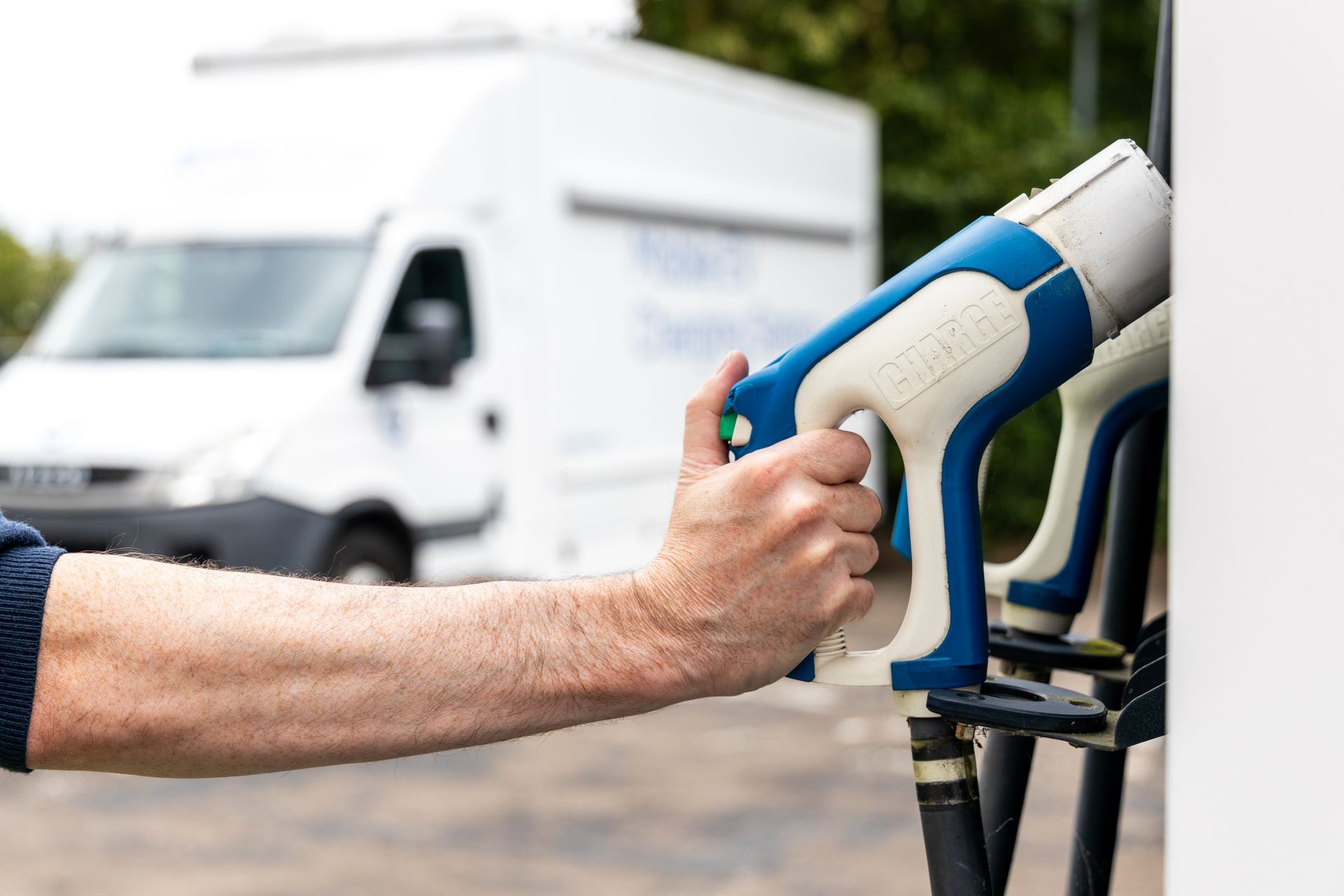
- Tethered Chargers: These units have a cable permanently attached, just like a petrol pump hose. You just pull up, grab the plug and connect it to your car. You will often find these at supermarkets or as part of DC rapid charger setups.
- Untethered Chargers: These are essentially just sockets waiting for you. You need to use the Type 2 cable that came with your EV (or one you bought separately) to connect your car to the charge point. This is the most common type you will find in public car parks and at workplaces.
It is always a smart move to keep your own Type 2 cable in the boot. It means you are ready for any untethered charger you come across, giving you far more options and flexibility when you are out and about. Without it, you will find a huge chunk of the public AC network is off-limits.
Mobile charging solutions powered by Type 2 technology offer an incredible opportunity for entrepreneurs and businesses to meet the growing demand for on-demand power. ZAPME provides robust, vehicle-mounted charging units that can be deployed anywhere, from roadside emergencies to fleet depots and public events. Explore our innovative mobile charging solutions and discover how you can start your own profitable charging service by visiting ZAPME.