

Dual Electric Car Charger: Boost Revenue & Install Easily
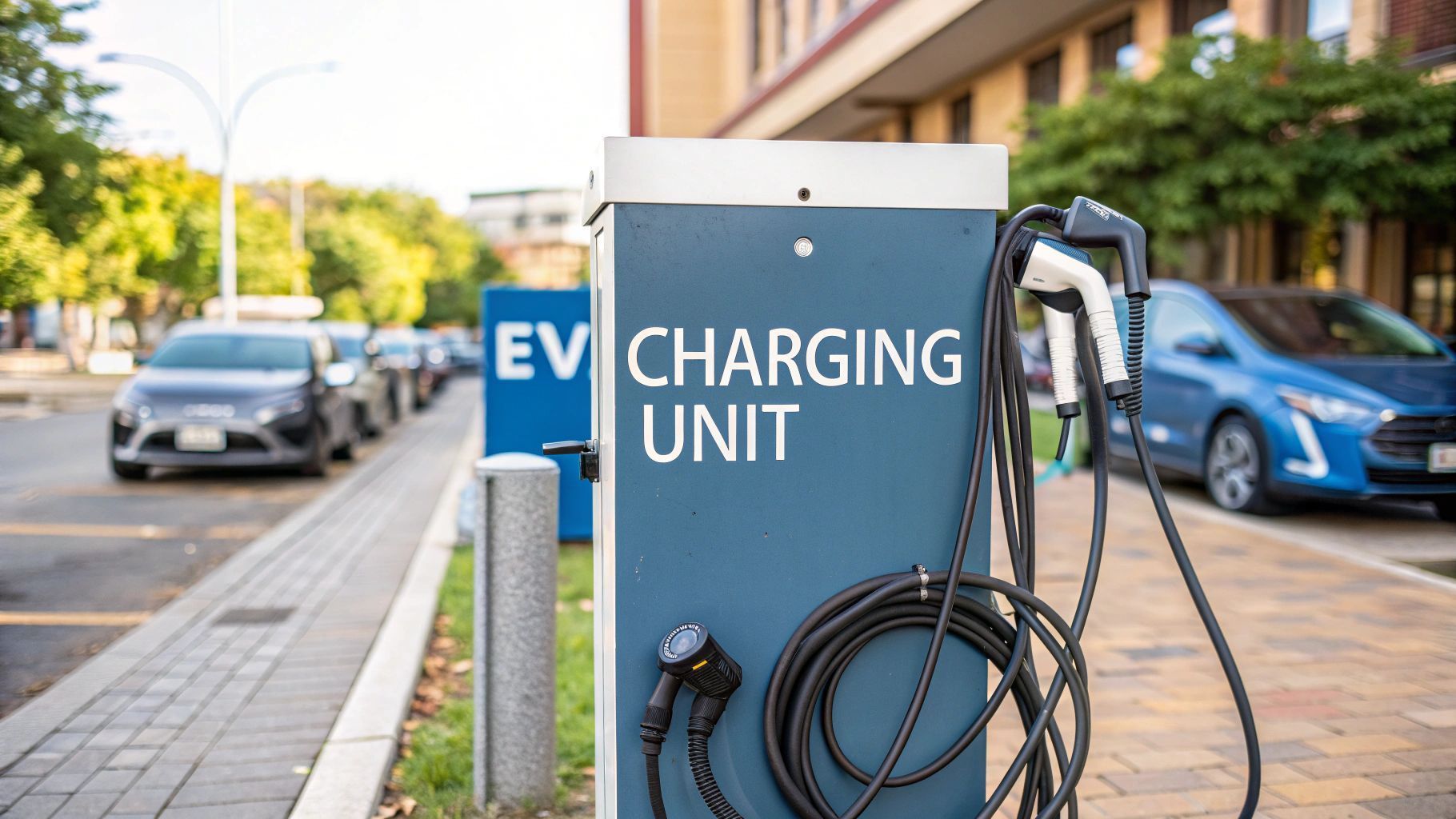
A dual electric car charger is, quite simply, a single charging unit designed to power up two electric vehicles at once. It’s a smart way to optimise both space and your electrical setup, especially in places where demand for charging is growing but physical room or power capacity is tight.
Why Dual EV Chargers Are Becoming a Familiar Sight in the UK
The UK's push towards its net-zero targets is putting electric vehicles in the fast lane. As more and more drivers swap their petrol and diesel cars for EVs, the pressure is on to provide efficient, accessible charging infrastructure. This shift is creating fresh challenges—and big opportunities—for homeowners and businesses alike.
This isn't just a feeling; the numbers back it up. The UK's public charging network is expanding at a serious pace to keep up with all the new EVs on the road. For example, the number of public chargers grew from around 18,000 in 2020 and is on track to hit over 55,000 by 2025 . It’s a clear sign that smarter, more capable charging solutions are needed.
When One Port Just Isn't Enough Anymore
For a growing number of people, a single charging port is fast becoming a bottleneck. Think of a typical two-car family where both vehicles are electric or a business that wants to offer charging for staff and customers. Installing two separate chargers is not only expensive but can be a real headache to wire up. A dual electric car charger solves this problem elegantly by doubling your charging capacity from a single electrical connection.
This trend isn’t just about adding more plugs. It’s about installing smarter, more efficient hardware. A dual charger is a strategic asset that maximises your return on investment, whether it’s on your driveway, in a public car park or powering a commercial fleet.
The Mobile Charging Opportunity
Looking beyond fixed installations, this technology is also unlocking a massive opportunity for mobile charging operators. Imagine deploying a vehicle-mounted dual charger at a music festival, a corporate event or even in a residential street with no off-street parking. This kind of flexibility means you can take charging directly to where the demand is highest, building a profitable business model from the ground up.
An operator can generate serious income from per-kWh fees and session charges, all without the huge overheads of a permanent site. For a deeper look into this model, explore our comparison between stationary vs mobile solutions. It’s an approach that transforms charging from a static utility into a dynamic and profitable service.
How a Dual Electric Car Charger Works
At its heart, a dual electric car charger is a remarkably efficient bit of kit. The easiest way to get your head around it is to think about your household electrics. A single EV charger is like a standard wall socket—it powers one appliance at a time with a set amount of juice.
A dual electric car charger , however, is more like a modern, intelligent extension lead. It draws power from a single electrical circuit but has the built-in smarts to share that power between two separate vehicles. This single-point installation is its defining feature, letting you double your charging capacity without the hassle and cost of running a second electrical line from your fuse box.
Power Management and Load Balancing
The real magic happens in how a dual charger manages its power. It's important to know that not all of them work the same way and the difference is key. They generally use one of two methods: dedicated power or dynamic load balancing.
- Dedicated Power Per Port: Some units are built to deliver a fixed, constant amount of power to each of their two ports. For this to work, the site’s main electrical supply must be beefy enough to handle both cars charging at full tilt simultaneously. It's a powerful setup but it demands a much more robust electrical infrastructure.
- Dynamic Load Balancing: This is the smarter and far more common approach. The charger has a total power capacity (say, 22kW ) that it intelligently divides between the two vehicles currently plugged in. If only one car is charging, it gets the full whack of available power.
When a second car plugs in, the charger automatically splits the power. A 22kW unit, for instance, might give 11kW to each vehicle. This clever trick ensures the main electrical circuit is never overloaded, making it a much safer and more adaptable solution for most UK homes and businesses.
The core benefit of load balancing is efficiency. It maximises the available power from a single connection, preventing the need for costly and disruptive grid upgrades while still ensuring both vehicles are charged effectively.
Connectors and Charging Speeds in the UK
Here in the UK and right across Europe, the Type 2 connector has become the universal standard for AC charging. It’s what you'll find on almost all home chargers and public destination points. Naturally, a dual electric car charger will come equipped with two Type 2 sockets or two tethered cables.
The demand for more of these charging points is only going one way, driven by rising EV ownership and government targets.
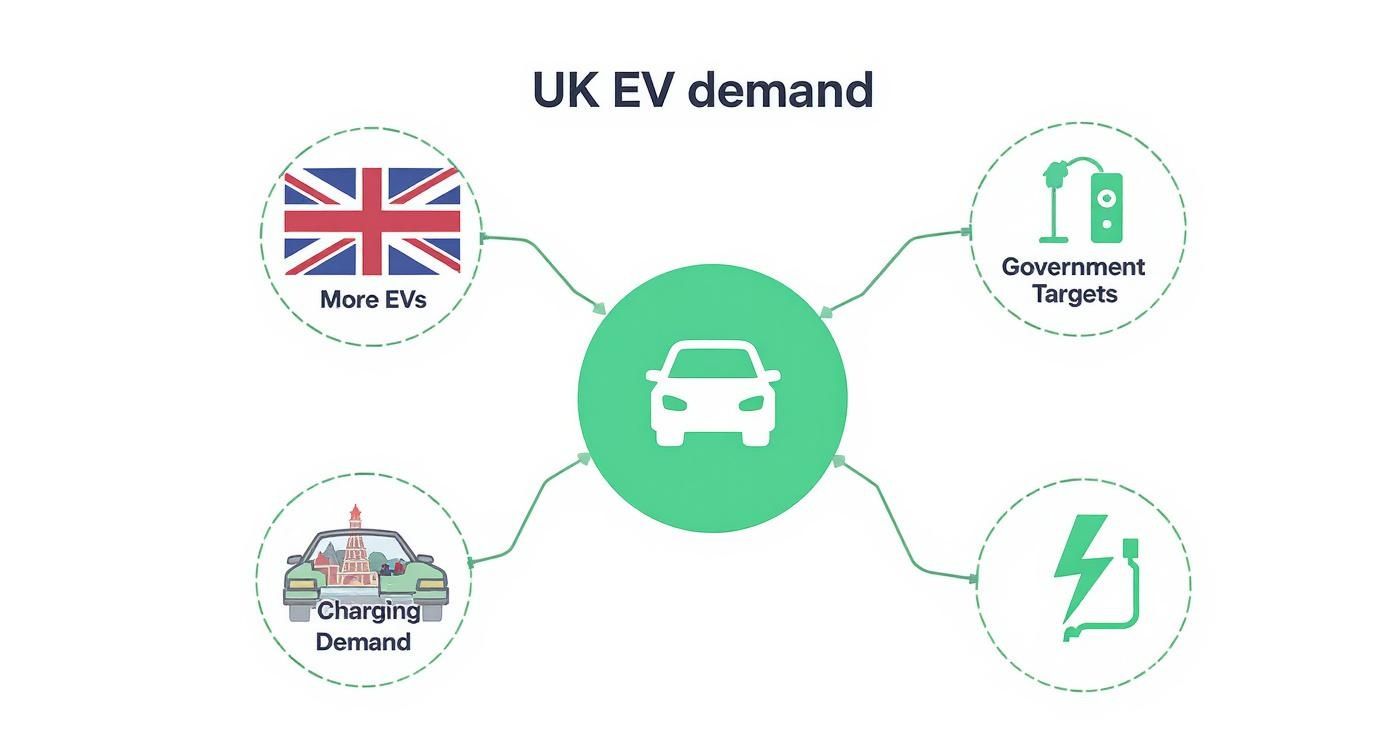
This cycle is clear: government policy encourages more people to switch to EVs, which in turn creates a pressing need for more widespread and efficient charging infrastructure to support them.
It's also crucial to remember that charging speed isn't just about the charger itself. Your vehicle's onboard charger plays a massive part. For example, if your car can only accept a maximum of 7.4kW , it won't charge any faster even if you plug it into a powerful 22kW port.
Getting to grips with your car's limits is vital for making the right choice. You can learn more in our guide on EV charging compatibility to make sure you invest in hardware that’s a perfect match for your needs.
Unlocking Profit with Mobile Dual Charging
While fixed dual chargers are a great solution for homes and businesses, the real commercial opportunity is out on the road. Mobile dual chargers shift the entire concept of EV charging from a static utility, like a lamppost, into a dynamic, profitable service you can take exactly where the demand is. It's a game-changer for agile operators.
Think about a huge outdoor music festival, a weekend farmer's market or a big corporate conference. These events draw thousands of EV drivers to places that often have little to no permanent charging infrastructure. A mobile dual charger operator can simply drive on-site and instantly offer a service people desperately need, turning a temporary "charging desert" into a revenue-generating hub.
The same idea works wonders in residential areas, especially for blocks of flats or terraced streets where off-street parking is a fantasy. An operator can schedule regular visits to these charging blackspots, providing a reliable, on-demand service that residents simply can't get otherwise. This model directly tackles one of the biggest hurdles to EV adoption in our cities.
Building Your Revenue Streams
The business model for mobile charging is beautifully simple yet incredibly powerful. Operators can generate income from several different streams at once, creating a business that's both robust and easy to scale. And because you're charging two vehicles with a single unit, you're massively boosting your earning potential every hour you're on the job.
Here are the main ways you can monetise a mobile dual electric car charger:
- Per-Kilowatt-Hour (kWh) Pricing: This is the classic model. You charge customers a set price for the energy they use, just like a petrol station. A rate of £0.65 per kWh is both competitive and profitable.
- Session Fees: On top of the per-kWh price, you can add a small, flat connection fee for every session. This guarantees a baseline income from every single transaction, even if a driver only needs a quick top-up.
- Convenience Premiums: In high-demand situations—think emergency roadside assistance or an exclusive event—your service is worth more. Drivers are more than willing to pay a premium for the convenience of on-the-spot charging when they're in a pinch.
By blending these streams, a mobile operator can build a seriously profitable business. The dual-port setup means you're serving two customers and earning from two vehicles at the same time, effectively doubling your hourly revenue compared to a single-port unit.
The Energy as a Service (EaaS) Advantage
One of the biggest hurdles for anyone wanting to become a charge point operator is the massive upfront cost of the hardware. This is where clever new models like Energy as a Service (EaaS) completely change the game. At ZAPME, we champion this approach because it tears down the financial barrier to entry for entrepreneurs.
EaaS is basically a subscription for your business. Instead of buying the mobile dual charger outright for a huge sum, you pay a manageable monthly fee. This covers the hardware, maintenance, software and support, letting you launch your business with minimal capital.
This model flips the script, turning a huge capital expenditure into a predictable operational cost. It makes it far easier for operators to scale up, adding more units to their fleet as their customer base grows without needing to find tens of thousands of pounds for each new charger. For a deep dive into how this works, check out the economics of mobile EV charging in our comprehensive guide .
A Realistic Financial Outlook
Let's run some numbers. Imagine a realistic day for an operator with a mobile dual charger. If you complete just five charging sessions per day , with each session delivering an average of 30 kWh , the revenue quickly adds up. At a competitive rate of £0.65 per kWh , you're looking at significant daily earnings.
And that's a conservative estimate. At a busy event or in a densely populated neighbourhood, the number of daily sessions could be much, much higher. The UK market is certainly ready for it. By mid-2025, the UK had over 84,000 public EV charging devices installed, a jump of 28% in just one year. That's a clear signal of the incredible momentum in this market. Dual chargers are a huge part of this growth, helping to meet the soaring demand for charging ports in busy cities and at popular destinations.
The true magic of the mobile model is its adaptability. An operator can use local data to pinpoint underserved areas or see which big events are coming up, deploying their chargers strategically. This data-driven approach ensures your assets are always positioned for maximum use and profitability—a luxury that owners of fixed chargers just don't have. This agility is your ticket to building a successful venture in the green economy.
Practical Use Cases for Dual Chargers
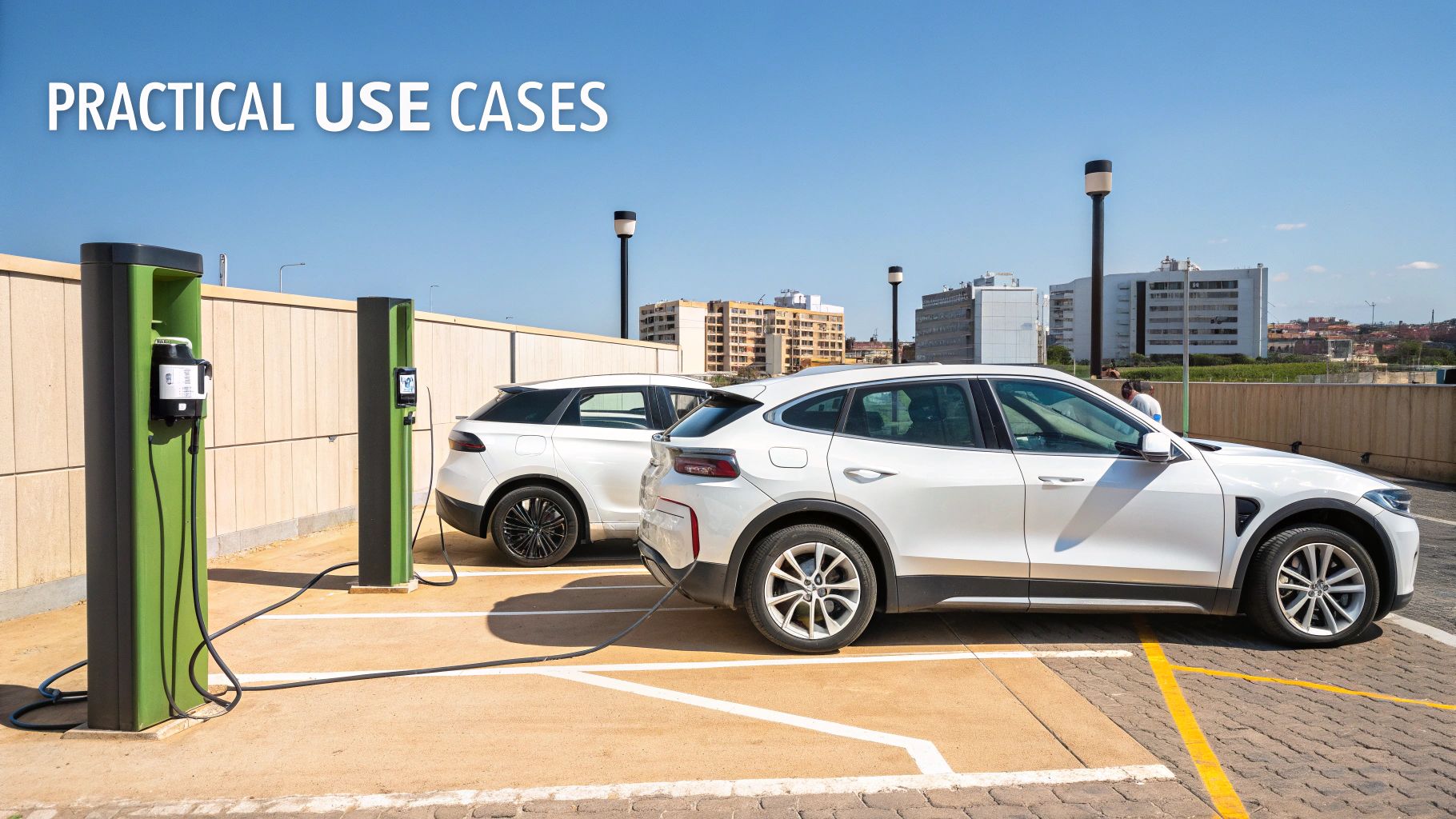
The real value of a dual electric car charger truly shines when you see it in the wild. Its design is a direct response to common charging headaches, from the family driveway to bustling commercial car parks. For many, it’s simply the most logical and cost-effective way to get more charging points on the ground.
This versatility is its greatest strength. A dual charger isn't a blunt instrument; it’s a smart tool that adapts to its surroundings. It solves different problems for different people, whether the goal is getting a home ready for the future or squeezing more revenue out of a commercial site.
Future-Proofing the Modern Home
At home, the switch to electric is often a slow burn. A family might start with one EV, knowing full well a second one is probably just a few years away. Putting in a single charger today feels sensible but adding another one later means calling the electrician back, paying for another installation and potentially more disruptive work.
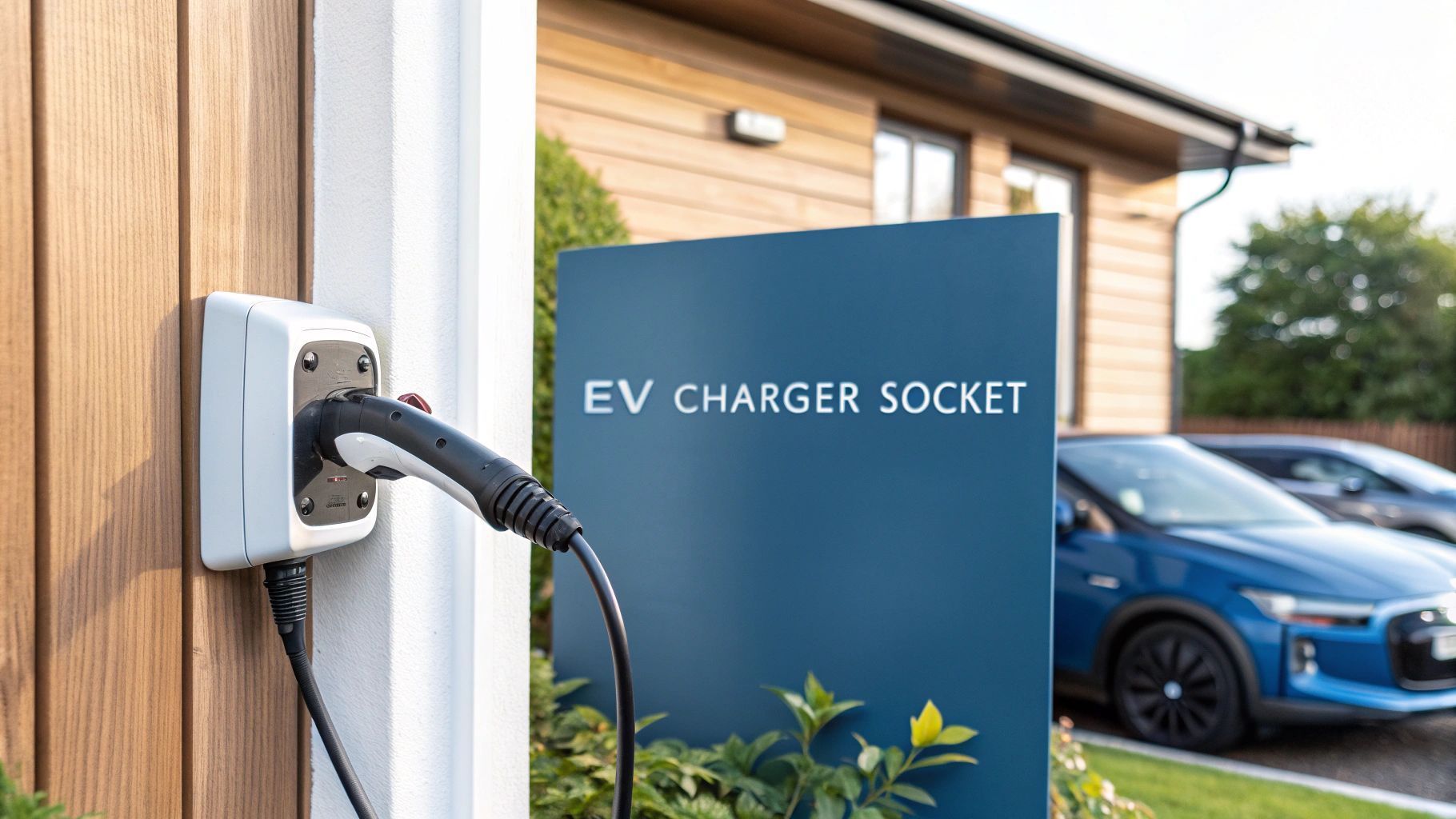
A dual electric car charger solves this problem elegantly. By installing one unit from the start, homeowners are ready for that second EV without any extra fuss or electrical upgrades. It’s a clever, forward-thinking investment that adds value to the property and prepares it for an all-electric future. All from a single installation.
Doubling Value for Businesses
For businesses, offering EV charging is no longer a perk—it’s an expectation. A dual charger allows a company to double its charging capacity for staff and customers with hardly any extra installation cost. This is a massive advantage in several key areas:
- Workplace Charging: Companies can look after twice as many employees' cars from a single spot, reducing the morning scramble for a plug and showing a genuine commitment to sustainability.
- Retail and Hospitality: A shopping centre or hotel can serve two customers at once, cutting down on queues and improving the overall visitor experience. This often translates to customers staying longer and spending more.
- Public Car Parks: Site operators can make the most of their available space and boost revenue. A dual charger doubles the number of chargeable bays per unit, which makes the return on investment look much healthier.
The core business benefit is pure efficiency. By servicing two vehicles from one spot, businesses become far more attractive to EV drivers and improve their bottom line, all without the cost and footprint of two separate units.
Powering High-Demand Commercial Operations
In fast-paced environments, the benefits are even clearer. For commercial fleets, ride-hailing services and taxi firms, rapid vehicle turnaround is everything. Time spent waiting for a charger is money down the drain.
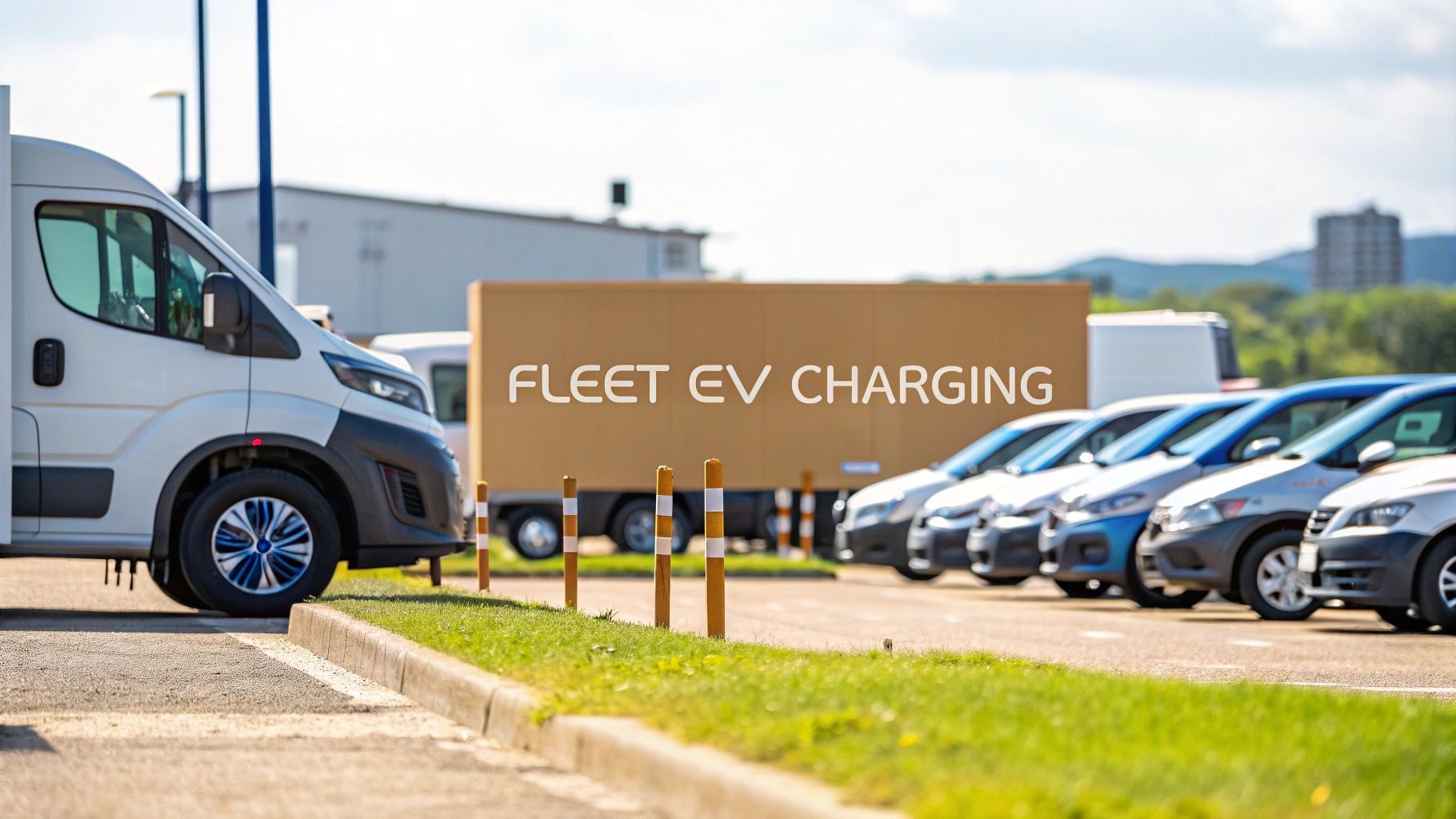
A dual electric car charger is a must-have here. A depot can charge two vans overnight from one station, ensuring the whole fleet is ready for the morning rush. In the same way, a dedicated hub for ride-hailing drivers can process cars much faster, keeping more drivers on the road earning money. This isn’t just a convenience; it’s fundamental to the business model.
These real-world examples show how the dual-port design tackles specific challenges head-on. It’s not just about adding another plug; it’s about rolling out a smarter, more scalable and more economical charging solution for a huge range of users across the UK.
Planning Your Dual Charger Installation
Putting in a dual electric car charger is certainly simpler than wrestling with two separate units but it’s not quite plug-and-play. A smooth installation comes down to careful planning. You need a solid grasp of your property’s electrical capacity and what the hardware demands – a job that absolutely needs a professional touch to keep everything safe, compliant and running efficiently.
The very first step is always a site assessment. A qualified electrician will need to take a look under the bonnet of your existing electrical system to see if it can handle the extra load. This is about more than just flicking a switch; it's about making sure your home or business can deliver the power safely, without constantly tripping circuits or, worse, creating a hazard.
Before you get started, it’s a good idea to understand how to calculate energy consumption to get a real sense of the electrical requirements and what your running costs might look like.
Single-Phase vs Three-Phase Power
The type of power supply your property has is a deal-breaker. Most UK homes are on a single-phase supply , which is more than enough for a standard 7kW dual charger. An installation like this will happily charge two EVs overnight.
On the other hand, commercial properties or some newer builds might be hooked up to a three-phase supply . Think of this as a much beefier connection, capable of supporting faster 22kW chargers. A 22kW dual charger can deliver a serious amount of power quickly, making it the perfect fit for businesses where getting vehicles back on the road is a priority. The right choice depends entirely on your site's infrastructure and what you need from your charger.
UK Regulations and Safety Standards
Let's be clear: installing an EV charger is not a DIY weekend project. In the UK, every installation has to meet strict safety regulations to protect your property and your vehicles. A certified installer is non-negotiable, as they’ll ensure the work ticks all these essential boxes:
- IET Wiring Regulations (BS 7671): This is the bible for all UK electrical wiring, ensuring the circuit is installed and protected correctly.
- Smart Charging Regulations: Since 2022, new charge points must have smart features. This allows them to schedule charging for off-peak hours, helping to balance the National Grid.
- DNO Notification: Your installer has to let your local District Network Operator (DNO) know about the new charger. This is to make sure the local grid can cope with the increased demand.
Sticking to these regulations isn't optional. Using a qualified professional doesn't just guarantee a safe installation; it also keeps your charger’s warranty valid. It’s the peace of mind that comes from knowing the job was done right.
Costs and Available UK Grants
The final bill for installation can vary quite a bit. You’ve got the cost of the dual charger unit itself, plus the labour for a professional installation. If your property needs its main fuse upgraded or requires serious digging for new cables, those factors will add to the total.
Thankfully, the UK government offers grants to help ease the financial burden. The Office for Zero Emission Vehicles (OZEV) runs funding schemes for specific situations, like the EV chargepoint grant for people in flats and rental properties, and the EV infrastructure grant for businesses installing chargers for staff and fleets. These can make a real dent in the upfront investment.
This support is part of a much bigger national picture. Looking ahead, the UK is gearing up to massively expand its EV charging infrastructure to support an estimated 9 million electric vehicles by 2030. The government's roadmap includes installing around 300,000 public charge points by 2030, backed by a £1.6 billion investment to keep up with the EV boom. You can find more insights into the UK's EV market stats and future plans from CITA EV Charger.
How to Choose the Right Dual Charger

Choosing the right dual electric car charger can feel like a big decision but it gets a lot simpler once you know what to look for. The goal is pretty straightforward: find a unit that handles your needs today, has one eye on the future and gives you the best value for your money. If you focus on a few key things, you’ll be able to make a choice you’re confident in.
The first big question is power output. In the UK, dual chargers typically come in 7kW and 22kW models. A 7kW unit is ideal for overnight charging at home, slowly and steadily topping up your batteries while you sleep. The more powerful 22kW models are a better fit for commercial sites where getting cars back on the road quickly is the top priority.
But hold on—more power isn’t always better. It’s vital to match the charger’s output with what your vehicle can actually handle. Many EVs have an onboard charger limited to 7kW or 11kW for AC charging. In that case, spending extra on a 22kW unit is just a waste, as your car simply can’t use that extra juice.
Essential Features to Compare
Beyond raw power, the best dual chargers are packed with smart features that just make life easier. This is what really separates a basic plug-on-the-wall from a genuinely useful long-term investment.
Keep an eye out for these key functions when you’re comparing different models:
- App Control: Being able to start, stop and schedule charging sessions from your phone is a huge win. It lets you take full advantage of cheaper off-peak electricity tariffs without even thinking about it.
- Energy Monitoring: A good app should also show you exactly how much electricity each car has used. This is brilliant for tracking your running costs at home or essential for businesses that need to bill different users.
- Durability and Weatherproofing: Let’s face it, the UK weather is famously unpredictable. A high IP rating (look for IP54 or above) is non-negotiable to make sure your charger can handle whatever the rain, dust and changing temperatures throw at it.
Balancing the Pros and Cons
Making the right call means weighing up the clear advantages of a dual charger against its potential drawbacks. Being honest about these factors means no nasty surprises down the line.
The biggest benefit is efficiency. You get double the charging capacity from a single installation, which saves a significant amount of money on electrical work compared to fitting two separate units. That space-saving design is also a massive plus for tight driveways or crowded car parks.
On the other hand, the initial cost for a dual charger is higher than a single-port model. You also have to remember that most units use load balancing, so when two cars are plugged in, the power is split between them. This means each vehicle will charge more slowly than if it had the charger all to itself.
Once you understand this trade-off between convenience and speed, you can decide if a dual charger is the perfect fit for your charging habits and your property.
Frequently Asked Questions
When you're looking into dual electric car chargers, a few common questions tend to pop up. Here are some straightforward answers to help you weigh up the performance, cost and day-to-day practicalities of making the switch.
Does Charging Two Cars At Once Make It Slower?
It can, yes. Most dual chargers are built with dynamic load balancing , a clever feature that automatically splits the available power between two connected vehicles. For instance, a 22kW charger will deliver a steady 11kW to each car when both are charging. But if only one car is plugged in, it gets the full 22kW hit.
Some models might offer a dedicated power output for each port but that usually demands a much beefier electrical supply from your property.
Is a Dual Charger Much More Expensive to Install?
While the unit itself costs more than a single charger, the installation is often only a little more. The real saving comes from the fact you only need one electrical circuit and one trench dug for the cable. This makes it far more cost-effective than installing two separate single chargers down the line.
The key financial benefit comes from avoiding the labour and materials needed for a second complete installation. You get double the charging capacity for a fraction of the price of two individual units.
Can Any Electrician Install a Dual EV Charger?
Absolutely not. Any EV charger installation must be handled by a qualified electrician with specific training and certification for EV charge points. This is non-negotiable, as they need to ensure the setup complies with all UK safety regulations, including the latest IET Wiring Regulations.
A certified installer also takes care of notifying your District Network Operator (DNO) to get confirmation that the local grid can handle the extra load.
Are Government Grants Available for Dual Chargers?
Yes, they are. The UK government, through the Office for Zero Emission Vehicles (OZEV), offers several grants to help bring down the upfront cost of installing charge points. These schemes include:
- The EV chargepoint grant , which is available for people living in flats and for rental properties.
- The EV infrastructure grant , designed for businesses that want to install chargers for staff and commercial fleets.
Taking advantage of these grants can significantly reduce the initial investment required for a dual charger.
Ready to explore flexible charging solutions that can go anywhere? ZAPME offers a range of mobile EV charging units, from compact roadside assistance models to high-capacity chargers for fleets and events. Discover our innovative Energy as a Service model at https://www.zapme.biz.