

EV chargers workplace: A Guide to Profit and Productivity
Installing EV chargers at your workplace is not just a nice-to-have perk anymore; it is a strategic move that signals your business is ready for the future. It acts as a powerful magnet for attracting and keeping top, eco-conscious talent, all while future-proofing your commercial property.
As the UK barrels towards an electric future, providing this facility shows genuine corporate responsibility and meets the growing needs of employees and clients who have already made the switch.
Why Workplace EV Chargers Are a Smart Business Move
The shift to electric vehicles is gaining serious ground across the UK and for businesses this is a clear opportunity to lead from the front. Installing EV chargers is a visible commitment to sustainability that sharpens your brand reputation and aligns your company with national environmental targets. It’s a practical step that speaks volumes to your staff, customers and the wider community.
Beyond the green credentials, workplace charging delivers real-world benefits that directly improve your operations and employee happiness. For staff who drive an EV, having a reliable place to charge during the workday is a game-changer. It eliminates range anxiety and the hassle of hunting for public charging points, making their commute simpler and less stressful. That sort of convenience is a highly-valued employee benefit in today's competitive job market.
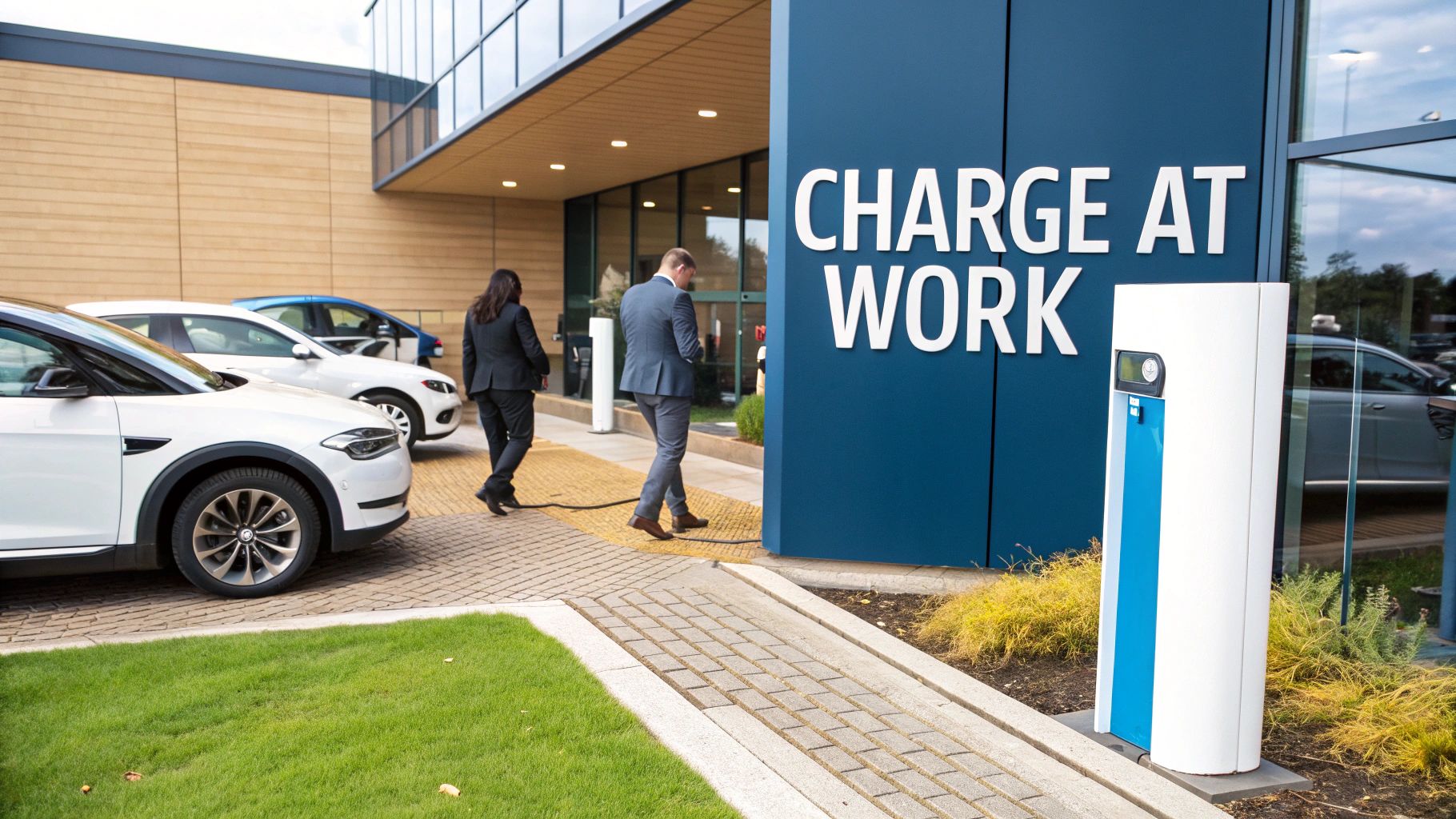
Attracting and Retaining Top Talent
In today's workforce, especially among younger generations, people actively look for employers whose values align with their own. A company that invests in green infrastructure like EV charging stations is immediately seen as progressive and responsible.
Think about it this way:
- A Real Competitive Edge: Offering workplace charging can be the deciding factor for a potential employee choosing between your company and a rival.
- Boosting Employee Loyalty: Existing staff feel valued and supported in their personal sustainability goals, which is a massive boost for morale and loyalty.
- Promoting Inclusivity: It ensures employees without access to home charging, like those living in flats or rented accommodation, are not left behind in the transition to EVs.
Government Support and Growing Demand
The UK government has been actively pushing this transition forward with various initiatives and workplace charging has grown massively as a result. The Workplace Charging Scheme (WCS), for instance, has been instrumental.
As of 1 July 2025, the WCS has funded the installation of 63,777 charging sockets in workplace car parks across the UK (not including schools). You can dive into the latest government EV charging statistics to see just how fast this is growing. This government backing proves just how important building this infrastructure is on a national scale.
By providing a place to plug in while you work, employers can entice more staff with EVs to commute in and even encourage other staff to make the switch to an EV. This is a simple but effective way to gain a competitive edge.
Ultimately, installing EV chargers at your workplace is an investment in your people, your brand and your future. It positions your business as a forward-thinking leader, ready to meet the demands of a changing world.
Laying the Groundwork for Your Charging Project
Rolling out a successful workplace EV charging system does not just happen. It all starts with smart, upfront planning. Before you even think about installing a single charger, you need to get a solid handle on your site’s capabilities and your team’s real-world needs. Getting this groundwork right is the key to investing wisely, dodging expensive mistakes and building a system that actually works for everyone from day one.
The first move is to map out your physical environment and electrical infrastructure. Think of it like a surveyor assessing the land before breaking ground. It does not have to be massively complicated but a bit of attention to detail here will save you a world of headaches later on.
Conduct a Thorough Site Survey
Your car park is the obvious starting point. Take a walk around and pinpoint the most practical spots for charging bays. You're looking for locations that are not only convenient for drivers but also simple and cost-effective to connect to power.
Keep these factors in mind during your walk-through:
- Proximity to Power: Where’s your main electrical switchboard? The closer your chargers are to it, the less you'll spend on digging trenches and running long, expensive cables.
- Accessibility and Safety: Are the spots you’ve picked well-lit and easy to get in and out of? You need enough room for cars to manoeuvre safely and you definitely do not want charging cables creating a trip hazard.
- Existing Infrastructure: Keep an eye out for any existing ducting or conduits. If you can repurpose them for your electrical cables, you could save a fortune on groundwork.
While you're sizing up the physical space, you absolutely must assess your building's electrical capacity. An overloaded circuit is not just an operational headache; it is a serious safety risk. A qualified electrician can tell you what your current peak load is and, crucially, how much spare capacity you have for new ev chargers workplace installations.
One of the most common pitfalls is underestimating the load that multiple chargers will add, especially when everyone plugs in during peak business hours. A professional assessment will tell you if your current setup is up to the job or if you need to plan for an upgrade.
Forecast Your Charging Demand Accurately
Once you know your site’s physical and electrical limits, it is time to figure out exactly what your charging needs look like. Right-sizing your installation is critical. Go too big too soon and you have wasted capital. Install too few and you will have a frustrated team queuing for a plug.
To get this right, you just need to gather some simple data about your people and your vehicles.
Audit Your Employee and Fleet Vehicles
Start by surveying your employees. This will give you a clear picture of who is driving electric now and who is planning to soon. A straightforward questionnaire can capture everything you need to know.
Here’s what you should be tracking:
- Current EV Drivers: How many people on your team already have a battery electric vehicle (BEV) or a plug-in hybrid (PHEV)?
- Potential EV Drivers: How many are planning to make the switch in the next year or two? A 2025 survey found that a staggering 98% of employees without workplace charging were keen to have it.
- Typical Dwell Times: How long are cars usually parked for? For most office staff, it’s about eight hours—the perfect amount of time for slower, more cost-effective Level 2 charging.
- Daily Mileage Patterns: Understanding the average daily commute helps you calculate how much of a top-up each car will actually need. Most UK commutes do not require a full charge from zero.
This data lets you build a realistic picture of demand. For instance, if you have 10 current EV drivers and another 15 planning to switch within a year, you can plan a phased rollout. Start with enough chargers for the early adopters and have a clear path for expansion.
To take your energy strategy a step further, you might consider how a solar battery backup system could integrate with your EV charging setup. This can boost your energy independence and help shave off those costly peak demand charges. A crucial part of this is understanding solar battery backup costs to see if it makes financial sense for your business. This kind of forward-thinking helps you build a scalable system that grows right alongside your team.
Choosing Between Fixed and Mobile Charging Solutions
When you're mapping out your workplace EV charging setup, one of the biggest calls you'll have to make is whether to go with traditional fixed units or embrace the flexibility of mobile chargers. For a long time, fixed chargers were the default option but they often drag along a whole host of hidden costs and logistical nightmares.
For many businesses, mobile charging is proving to be a much smarter and more profitable way forward. A mobile charger operator can turn what would be a major capital project into a nimble operational advantage and a new revenue stream.
The real difference comes down to the installation. Fixed chargers are bolted to the ground or a wall and that means digging trenches for cables and often paying for some serious electrical upgrades to your building. It is a process that can be slow, disruptive and expensive, with costs that can easily dwarf the price of the charger itself.
Mobile chargers, on the other hand, sidestep all of that. They are self-contained, portable units an operator can roll out instantly, right where they are needed. This lets you start offering charging services straight away, without waiting months for installers to finish, fast-tracking your ability to generate revenue.
This flow chart breaks down the foundational steps for any EV charging project, whether you go fixed or mobile. It really drives home why proper planning is non-negotiable from day one.
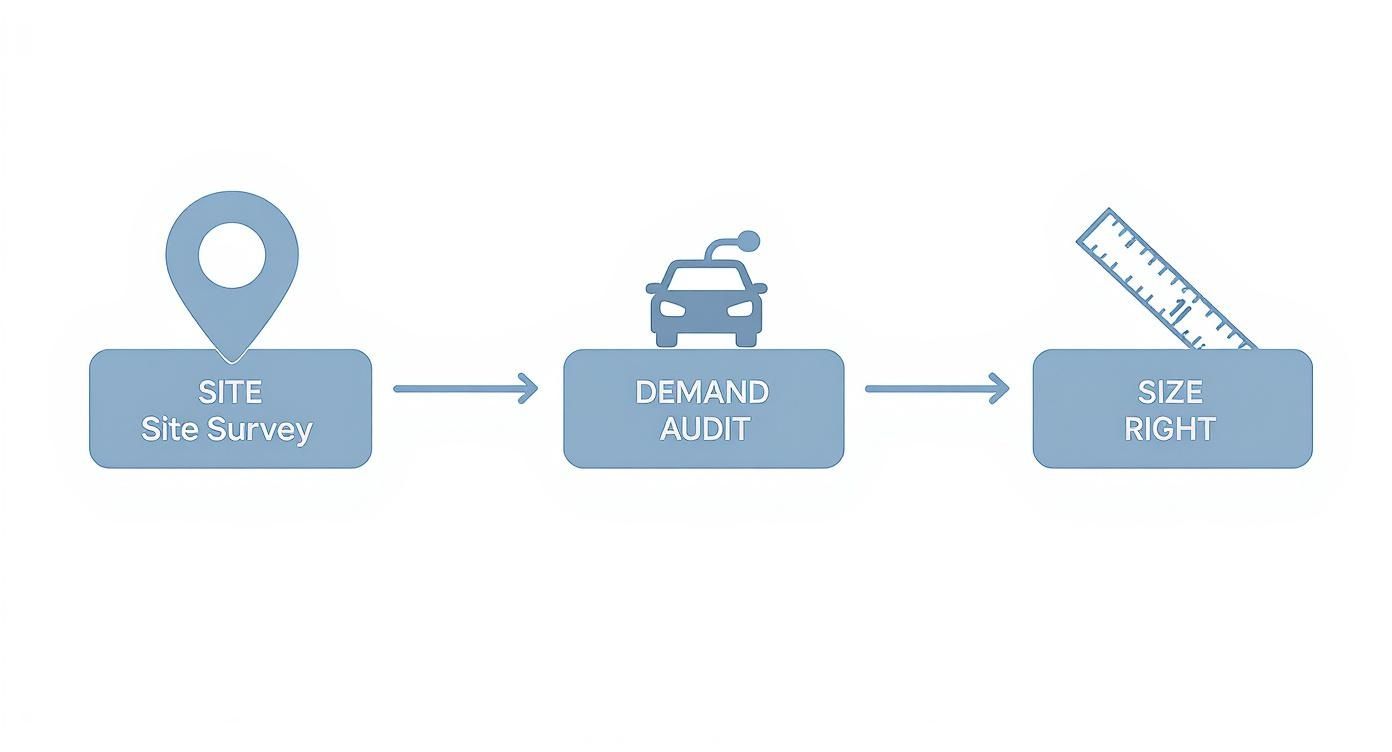
As you can see, a site survey, a demand audit and right-sizing your solution are the essential first moves. The insights you gain here will point you directly towards whether a flexible mobile or a permanent fixed solution is the right fit for your site.
The Financial Case for Mobile EV Chargers
If you are focused on the return on investment, the numbers behind mobile charging are incredibly compelling. The initial cash outlay for a mobile charger operator is drastically lower than for a similar fixed setup. You can forget about groundwork expenses, costly electrical upgrades and planning permission headaches.
This lower barrier to entry means an operator can kick off a charging service with minimal capital and then scale up as demand grows. You could start with just one mobile unit and add more over time, funding the expansion directly from the profits being made. It is a self-sustaining and highly scalable business model.
Mobile chargers effectively turn your car park into a dynamic, revenue-generating asset. You can adjust your charging capacity on the fly, responding to real-time demand without being locked into a fixed number of bays.
Let's talk about the potential revenue. With a mobile unit, an operator can buy electricity at a commercial rate—say, 25p per kilowatt-hour (kWh) —and set a user tariff of 50p per kWh . That is a 100% markup , generating a direct profit on every single charge. A single mobile charger servicing multiple vehicles throughout the day can quickly become a healthy and consistent source of income for the operator and your business.
Operational Agility and Scalability
Beyond the bottom line, mobile chargers give you an operational flexibility that is second to none. This adaptability is where they really leave their fixed counterparts in the dust, especially in busy, ever-changing workplace environments.
Think about these common scenarios:
- Large or Scattered Car Parks: Instead of installing dozens of fixed points across a massive site, a single operator with a mobile charger can service vehicles wherever they are parked, bringing the power directly to the car.
- Peak Demand Management: During busy periods like the morning rush, mobile units can supplement any existing fixed chargers you have, wiping out queues and keeping staff happy.
- Temporary Needs: Hosting a corporate event or have a temporary bump in your fleet size? Mobile chargers can be brought in instantly to meet short-term demand without any permanent commitment.
- Fleet Operations: For depot-based fleets, a mobile charger can efficiently top up multiple vans or cars overnight without needing a dedicated charging bay for every single vehicle.
This flexibility lets you get the most out of your charging resources. A mobile charger is never idle; it is always on the move to where it is needed most, maximising its use and its ability to make money. This is a world away from fixed bays, which can sit empty for huge chunks of the day. For a deeper dive into the two approaches, you can learn more about the future of stationary vs mobile solutions and see how they stack up for different business needs.
Ultimately, choosing between fixed and mobile ev chargers workplace solutions comes down to your specific goals. If your priorities are rapid deployment, financial efficiency and the freedom to scale based on actual demand and profitability, then the advantages of a mobile charging model are pretty hard to ignore. It offers a smarter, more cost-effective path to providing a valuable service and opening up a new revenue stream.
Turning Your Car Park into a Profit Centre
Let's move past the operational perks and focus on something even more compelling: profit. Bringing mobile EV charging to your workplace does more than just modernise your car park—it opens up a direct and scalable revenue stream. This simple move transforms what is often just an operational cost into an active profit centre for your business.
The financial model is refreshingly straightforward. Unlike fixed installations, which demand a hefty upfront investment and can take years to pay back, mobile chargers offer a much quicker return. An operator can start generating income almost immediately, skipping the prolonged disruption and high costs of digging up your car park or overhauling your electrical systems.
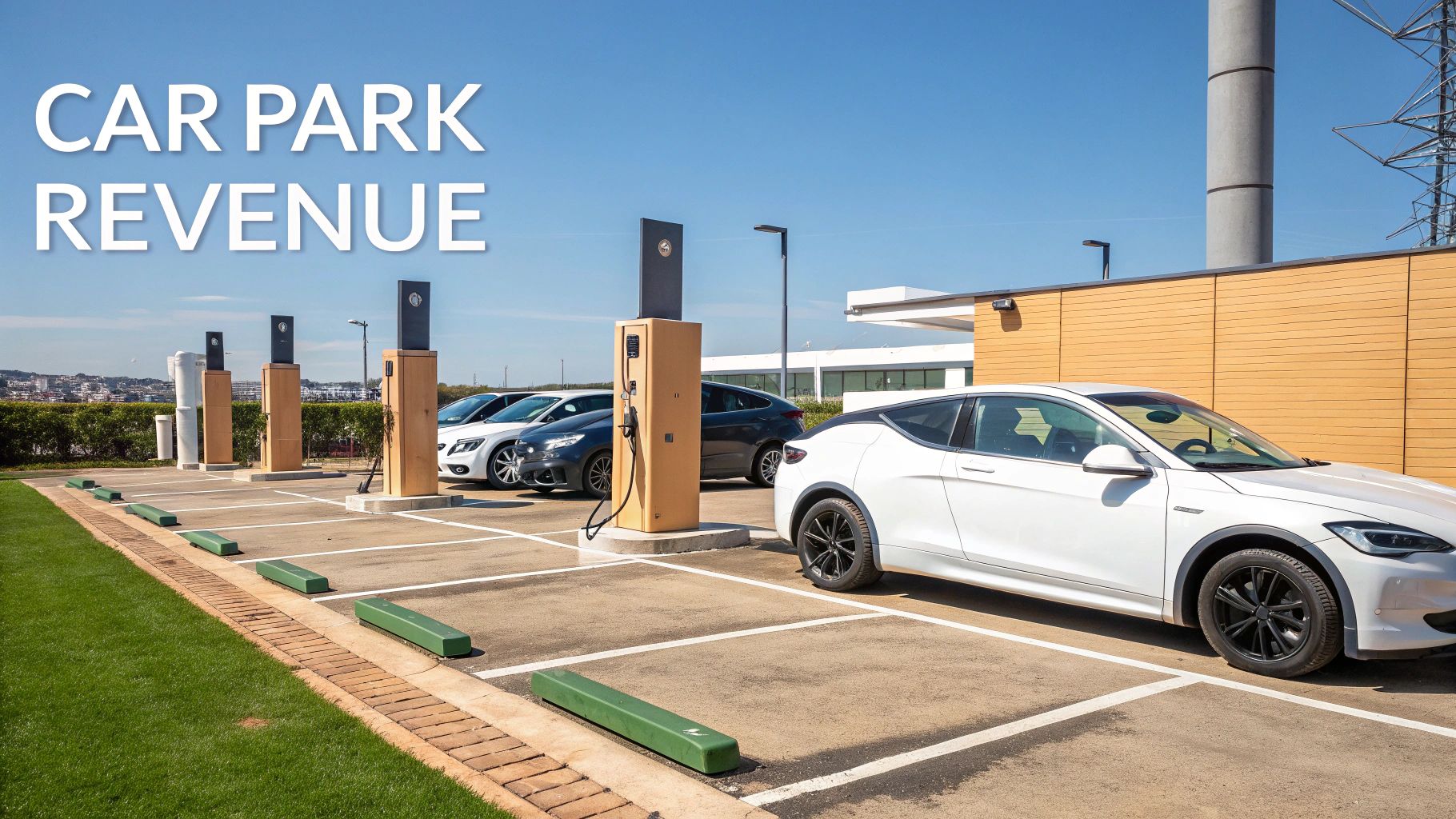
Building a Profitable Charging Model
At its core, your new revenue stream is built on the margin between your electricity cost and the price you charge drivers. It is a simple but powerful business model.
The UK's workplace EV charging market is booming and savvy businesses are already cashing in. Many are setting rates that deliver a 100% markup on their electricity costs. For example, if your business pays 25p per kWh for electricity and you charge employees 50p per kWh , the car park suddenly starts generating consistent, predictable income.
It really is that simple: you buy electricity at a commercial rate and sell it at a premium. To get a firm grip on the numbers, it is worth taking a moment to learn how to calculate a kilowatt-hour , as this is the fundamental unit of energy you will be selling.
Setting Your Tariffs and Billing Models
One of the biggest advantages of running your own mobile charging service is flexibility. You can shape your pricing to fit your business goals and your team's needs, creating a system that is both fair and profitable.
Here are a few popular billing structures you could consider:
- Pay-As-You-Go (PAYG): This is the easiest model. Users simply pay for each kilowatt-hour (kWh) they use. It is transparent and ideal for occasional users like visitors or clients.
- Employee Subscriptions: Why not offer your staff a monthly subscription? This could cover a set amount of charging or give them access to a discounted rate. It creates predictable income for you and a valuable perk for them.
- Tiered Pricing: You could set different rates for employees, visitors and perhaps even the general public if you have the capacity. This lets you prioritise your team while still making the most of wider demand.
Managing payments is completely painless with modern app-based systems. A dedicated app lets you set your prices, track usage and process payments automatically. Drivers can find a charger, book a slot and pay, all from their smartphone—a smooth, hassle-free experience for everyone.
The real beauty of a mobile charging model is how easily it scales. An operator can start with just one unit, gauge the demand and use the initial profits to fund more chargers. This organic growth strategy minimises financial risk and ensures your investment always matches actual usage.
A Practical Profit Example
To make this tangible, let’s crunch the numbers for a single mobile charger operator. The calculation is basic but it perfectly illustrates the impressive margins on offer.
Let's use a common scenario:
- Your commercial electricity cost is 25p per kWh .
- You set the user tariff at 50p per kWh .
- This gives you a healthy profit margin of 25p per kWh .
Now, think about a typical workday. One mobile charger can easily service several vehicles, delivering an average of 20 kWh to each car.
Here's a sample calculation showing how a mobile charger can quickly become a reliable source of income for the operator.
Sample Mobile Charger Profit Calculation
| Metric | Scenario A (Moderate Use) | Scenario B (High Use) |
|---|---|---|
| Total Energy Delivered | 60 kWh | 120 kWh |
| Total Revenue (@ 50p/kWh) | £30.00 | £60.00 |
| Total Electricity Cost (@ 25p/kWh) | £15.00 | £30.00 |
| Daily Gross Profit | £15.00 | £30.00 |
As you can see, the profits add up fast. With just one mobile unit, an operator could generate between £300 and £600 in gross profit every month .
Start adding more chargers to the fleet and those earnings multiply, creating a significant new income stream. For any organisation looking to invest in workplace charging, that financial return is a seriously powerful incentive.
Navigating Funding and Safety Compliance
Rolling out a mobile EV charging solution for your workplace is about more than just the chargers themselves. You also need a solid plan for funding and a watertight approach to safety. Getting these financial and legal pieces right from the very beginning is what separates a smooth, successful deployment from a problematic one.
The good news is that you do not have to go it alone. There are government incentives available to soften the initial financial hit and the health and safety guidelines are clear and manageable. By tackling these two areas head-on, you'll build a charging service that is not just effective but also compliant and completely safe for your team and property.
Securing Funding For Your Project
For UK businesses, one of the first places to look for financial help is the Workplace Charging Scheme (WCS). It is a government grant specifically designed to help cover the costs of buying and installing EV charge points.
This voucher-based scheme can seriously cut down your initial investment. It is open to a huge range of businesses, charities and public sector organisations, provided you tick a few boxes.
To be eligible, you generally need to have:
- Off-Street Parking: Your site must have dedicated off-street parking for your staff or fleet.
- Declared Need: You'll need to demonstrate a current or future requirement for EV charging.
- Registered Business: Your organisation has to be officially registered in England, Wales, Scotland or Northern Ireland.
The grant offers up to £350 per charging socket and you can apply for a maximum of 40 sockets across all your sites. That means a single business could get up to £14,000 in support, which can make a massive difference to your budget.
While the application process might look a bit intimidating at first, it's actually quite straightforward. But grants are not the only route. For more flexible financial arrangements, it is worth exploring other avenues. You can find more detail on financing options for EV chargers that can help you get your project off the ground with minimal upfront capital.
Upholding Health and Safety Obligations
Safety is completely non-negotiable. When you introduce any new equipment into the workplace, you have a duty of care and mobile chargers are certainly no exception. A robust health and safety plan is essential to protect people, prevent damage and ensure your charging operation runs smoothly day in, day out.
Your starting point, and the most critical step, is to carry out a comprehensive risk assessment. This is all about spotting potential hazards before they become problems and putting sensible control measures in place to mitigate them.
Key Safety Protocols to Implement
- Smart Cable Management: Cables trailing across walkways are an obvious trip hazard. Your day-to-day procedures must include using proper cable protectors or ramps and you have to ensure cables never block pedestrian paths or emergency exits.
- Regular Equipment Maintenance: Every mobile charging unit needs to be inspected and maintained by a qualified technician on a regular basis. This includes formal Portable Appliance Testing (PAT) to certify that they remain electrically safe to use.
- Operator Training: The people moving and using the chargers need to know exactly what they are doing. This means full training on safe handling, correct connection and disconnection procedures and what to do in an emergency.
- Physical Protection: Your charging points are a valuable asset. To protect both the chargers and the vehicles from accidental bumps and scrapes, it is a good idea to look into EV protection barrier solutions to prevent costly damage.
By making these safety practices a core part of your daily operations, you’ll create a secure environment that meets all UK health and safety laws. This protects your team, safeguards your business from liability and ultimately makes your venture into workplace charging a responsible and successful one.
Your Questions on Workplace Charging Answered
As businesses start looking seriously at introducing EV charging, a few key questions always seem to pop up. Getting to grips with the details, especially the benefits of mobile charging, can make the path forward a lot clearer and give you confidence in your decision. Let's tackle some of the most common queries with straightforward, practical answers.
One of the first things on everyone's mind is profitability. Can you actually make money from this? With a mobile charger operator, you are creating a direct revenue stream by buying electricity at your commercial rate and selling it to drivers at a markup.
For example, if you buy electricity for 25p per kWh and set your user tariff at 50p per kWh , that is a 100% markup on every single charge. A single mobile unit serving multiple vehicles throughout the day can quickly become a healthy source of income, with potential gross profits of several hundred pounds a month per charger for the operator.
How Can We Offer Charging Without Disrupting Operations?
This is where the flexibility of mobile ev chargers workplace solutions really comes into its own. Unlike fixed installations that demand groundwork, planning permission and potential electrical overhauls, mobile units can be deployed instantly. No disruption to your daily business.
Getting started with minimal fuss looks like this:
- Take stock of your needs: First, figure out how many EV drivers you have on site and get a feel for their typical parking times.
- Start with one unit: A mobile charger operator can begin small and simply add more units as demand grows. This avoids any big, upfront operational changes.
- Use an app-based system: Modern charging solutions run on simple apps for booking and payment, meaning there is very little admin for your team to worry about.
This approach lets you introduce charging services smoothly. You can test the waters and prove the business case before committing to a larger fleet of chargers.
What if Employees Hog the Chargers All Day?
Charger availability is a genuine concern in any workplace. We've all heard stories about the 'squatting' issue—where an employee leaves their fully charged car plugged in all day, blocking the bay for everyone else. It is a real headache with fixed charging points.
Mobile charging solves this problem by its very nature. The operator simply moves the charger to the next vehicle once a car has enough charge. This keeps the asset working efficiently and ensures fair access for all staff, turning a potential point of conflict into a smooth, managed service.
Some fixed systems try to tackle this with idle fees but a managed mobile service is a far more elegant and proactive solution. It guarantees the charger is always working and earning revenue, not sitting idle next to a full battery. This dynamic approach keeps efficiency high, fairness a priority and your whole team happy and charged up.
Ready to turn your car park into a flexible and profitable asset? ZAPME offers pioneering mobile EV charging solutions designed for the modern workplace. Discover how our Energy as a Service (EaaS) model can work for you.