

EV Chargers at the Workplace: A Guide to Profit and Installation
Thinking about installing EV chargers at your workplace ? It's more than just a nice-to-have perk these days. It is a strategic move that future-proofs your business, helps you attract top talent and supports your company’s sustainability goals.
Done right, it can even open up a whole new revenue stream.
Why Workplace EV Charging Is Your Next Smart Investment
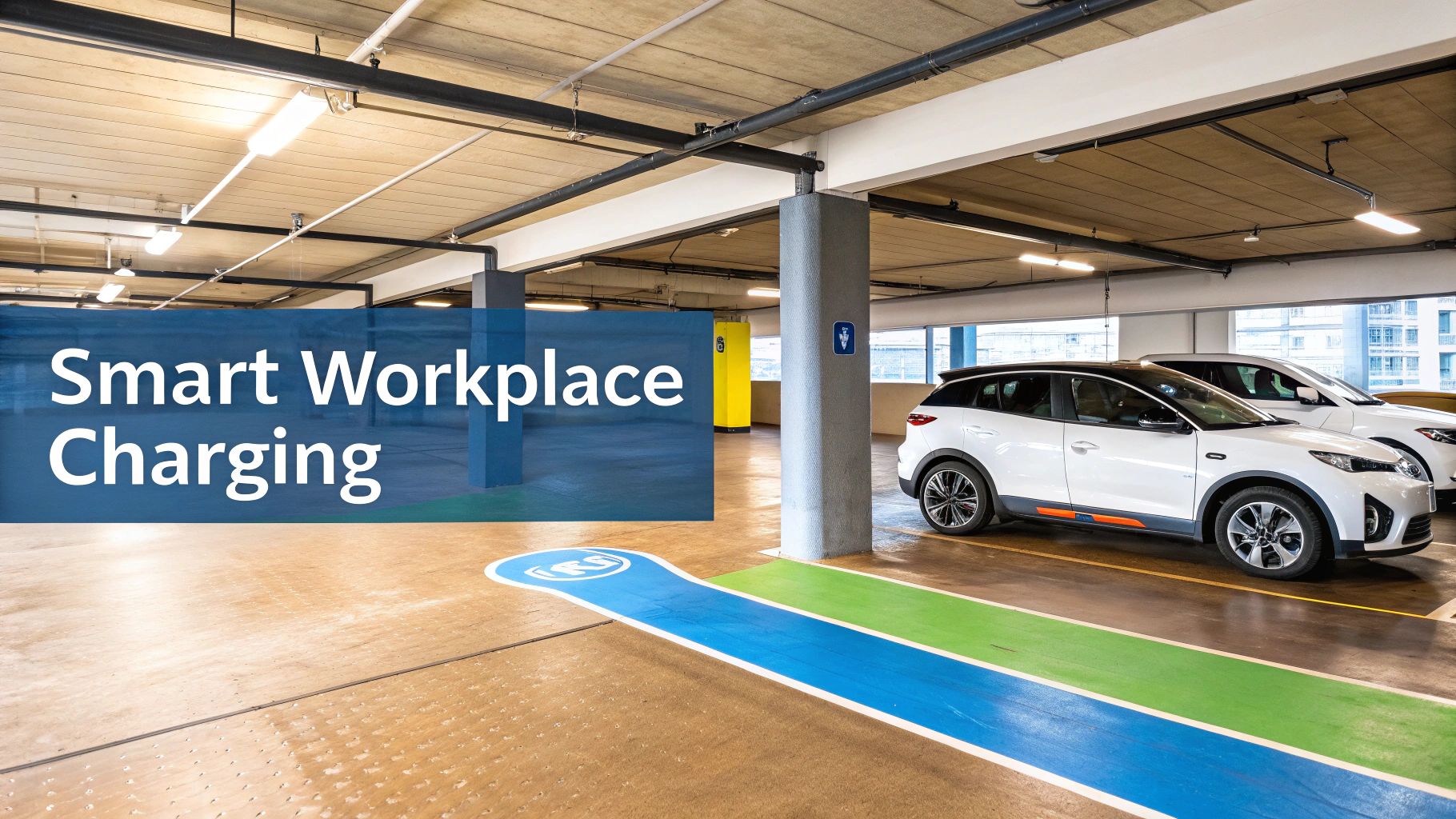
The conversation has moved on from if you should offer EV charging to how you should implement it. As more people switch to electric vehicles, employees do not just want charging facilities at work—they are starting to expect them. For anyone without a driveway at home, workplace charging is an absolute game-changer.
This is not just about keeping your team happy. Installing EV chargers sends a powerful message about your commitment to sustainability which is a massive draw for skilled professionals. In fact, a 2024 survey found that 61% of EV drivers see employer-provided charging as proof of environmental responsibility which directly improves how they feel about the company culture.
The Financial Upside of Mobile Charging
Fixed charging points certainly have their place but mobile and portable chargers bring a level of flexibility—and financial opportunity—that is hard to ignore. Instead of being a sunk cost bolted into a few specific parking bays, mobile units can serve multiple vehicles all day long, no matter where they are parked.
This agility opens up a clear route to profitability. Imagine managing a small fleet of mobile chargers to offer an on-demand charging service not just for your own staff but for visitors and even neighbouring businesses. You can explore this further in our guide on how to profit with a portable charging station for electric cars. Suddenly, your car park transforms from a static piece of tarmac into a dynamic service hub. An operator of a mobile charger can make a substantial profit, turning a simple amenity into a new revenue stream.
By turning your workplace into a charging destination, you are not just supporting the electric transition; you are building a new, scalable revenue model that can deliver a significant return on investment.
In this guide, we’ll walk you through the whole process. We’ll cover everything from figuring out your site's power capacity to choosing the right mix of chargers and launching a charging service that benefits your business, your team and your bottom line.
Evaluating Your Site for EV Charger Installation
Before you even think about which EV chargers to buy, you need to get to grips with your site. This is not just a box-ticking exercise; it is the foundation of a practical, cost-effective plan that will serve your business for years to come. A proper site survey is the only way to kick things off.
Start by taking a walk around your car park. Look at it with a fresh pair of eyes. Where do people naturally park? Pinpointing the high-traffic areas and the most convenient spots is crucial for placing chargers where they’ll actually get used. You will want to think about how close they are to building entrances, whether they are accessible for everyone and how you’ll run cables from your main power source.
Getting this initial mapping right helps you imagine the day-to-day experience. The last thing you want is a bank of expensive chargers tucked away in a forgotten corner or worse, installed in a way that creates bottlenecks and frustration. A bit of foresight here saves a lot of headaches later.
Understanding Your Electrical Capacity
Here’s the single most important part of your survey: figuring out your current electrical capacity. This one factor will determine how many chargers you can support without having to pay for a costly and time-consuming grid upgrade. The goal is simple: do not overload your existing supply.
To do that, you need to be comfortable with two key terms: kilowatts (kW) and kilowatt-hours (kWh) .
- kW (Kilowatts): Think of this as the speed or rate of charging. A higher kW number means a faster charge. For most workplaces, a 7kW charger is a great option, delivering a steady top-up over the course of a working day.
- kWh (Kilowatt-hours): This is the amount of energy stored in a vehicle’s battery, like litres of petrol in a tank. A typical EV today might have a 60kWh battery.
Understanding the difference is fundamental to good planning. You need to work out the total daily energy demand (kWh) your fleet or employees will pull and then make sure your site has enough power (kW) to deliver it without everything grinding to a halt. For a deeper dive, our complete UK commercial EV charging installation guide breaks it all down.
Calculating Your Daily Energy Needs
Working out your energy demand does not have to be a dark art. A simple calculation can give you a surprisingly solid starting point. Let us take a typical office with ten employees who drive EVs and need to recharge during the day.
If each person drives an average of 30 miles to the office and their car manages around 3.5 miles per kWh , they’ll need about 8.6 kWh to cover their commute home. Multiply that by ten employees and you are looking at a total daily demand of 86 kWh .
By understanding your daily kWh demand, you can make informed decisions. This calculation reveals you do not necessarily need ten high-power chargers running simultaneously; a more strategic approach can manage the load effectively and keep costs down.
A commercial fleet depot is a different beast entirely. These vehicles often return to base running on fumes and need a full recharge overnight. A fleet of five electric vans, each with a 75kWh battery, could require a whopping 375 kWh every single night. This is a much heavier lift and calls for more serious power planning.
This is why the planning phase is so critical. It tells you whether your current electrical supply can handle the load or if you need to look at smart solutions like load balancing. This technology intelligently shares the available power across all your chargers, making sure you never trip a circuit. It’s a clever way to get the most out of what you already have, without forking out for a major grid upgrade.
Ultimately, a thorough site evaluation gives you the hard data you need to build an EV charging solution that is not just effective but also scalable and budget-friendly.
Choosing Your Chargers: Mobile vs. Fixed Solutions
Once you’ve got a clear picture of your site's potential, the next big decision is picking the right charging technology. This choice does not just affect your initial budget; it shapes your entire operational strategy. It is a classic standoff: the established reliability of fixed charging points versus the dynamic flexibility of modern mobile EV chargers.
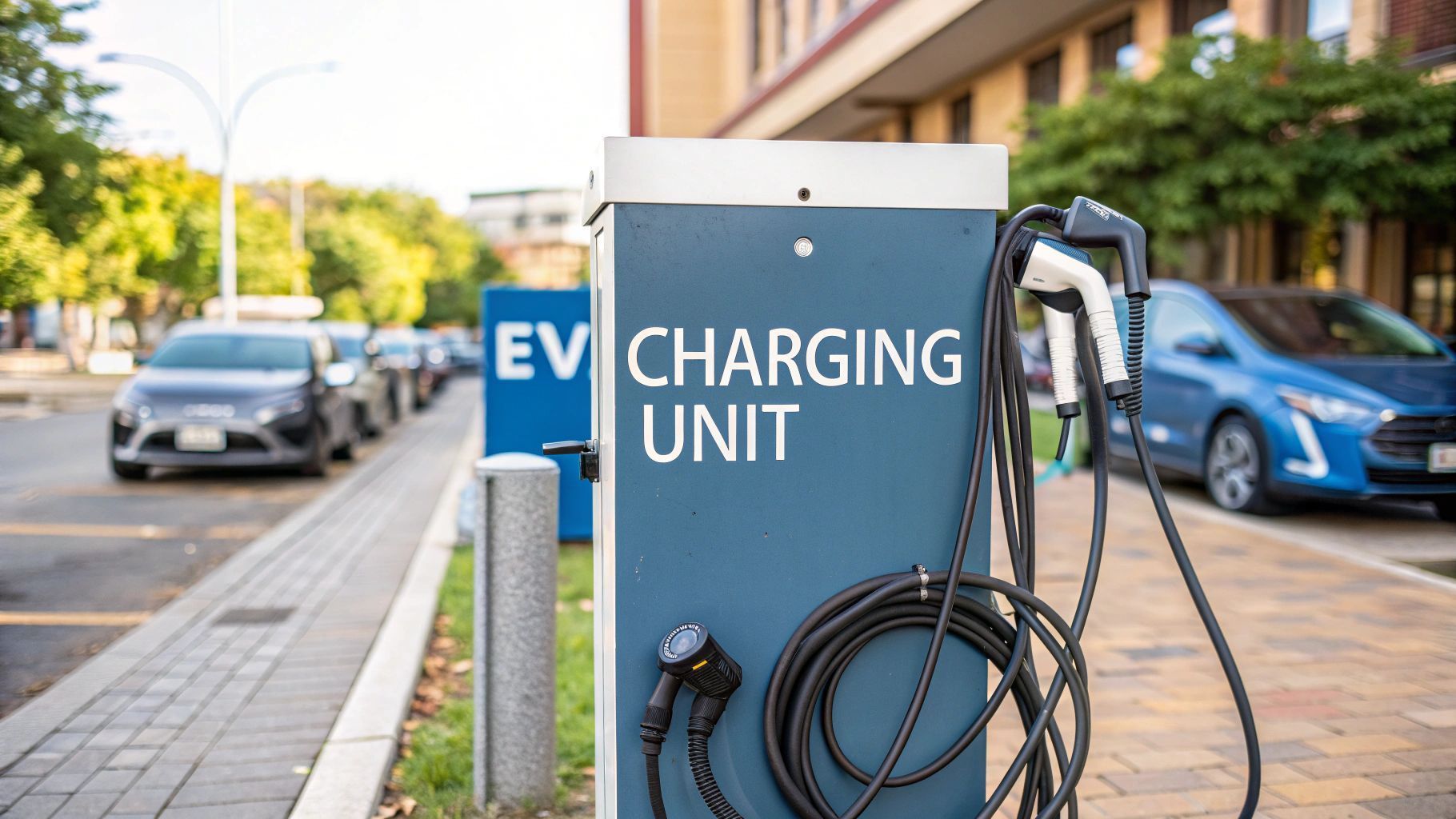
Fixed chargers are what most people picture. They’re bolted down in dedicated bays, ready to deliver a consistent, high-power charge. They are a solid, predictable choice for businesses with straightforward needs, like assigned parking for executives or dedicated spots for overnight fleet charging.
The problem is, their permanence is also their biggest drawback. Installation often means digging trenches for armoured cables which is disruptive, messy and expensive. Want to add more chargers later? That means more digging, more disruption and more cost. Fixed units also lock you into charging at specific locations, creating logistical headaches if those bays are occupied or if charging needs pop up elsewhere.
Unlocking Flexibility with Mobile Charging
Mobile EV chargers offer a completely different way of thinking. Instead of bringing the car to the charger, you bring the charger to the car. It’s a simple shift but it changes everything. Suddenly, you can sidestep the need for costly civil engineering works and turn every single parking space into a potential charging spot.
This kind of flexibility is a game-changer for facilities and fleet managers. Picture this: several employees need a top-up but your few fixed bays are already taken. With a mobile unit like a ZAPME charger, an operator can simply wheel the charger to each vehicle in turn, providing an on-demand service without any infrastructure bottlenecks.
This approach neatly gets around the common problem of 'charger squatting'—where a fully charged EV stays put, blocking the bay for others. With mobile units, the service is active and dynamic, making sure every charging asset is used efficiently.
The image below breaks down the foundational steps of checking your power supply, assessing your space and planning the layout. You will find these stages become far simpler when mobile chargers are part of the mix.
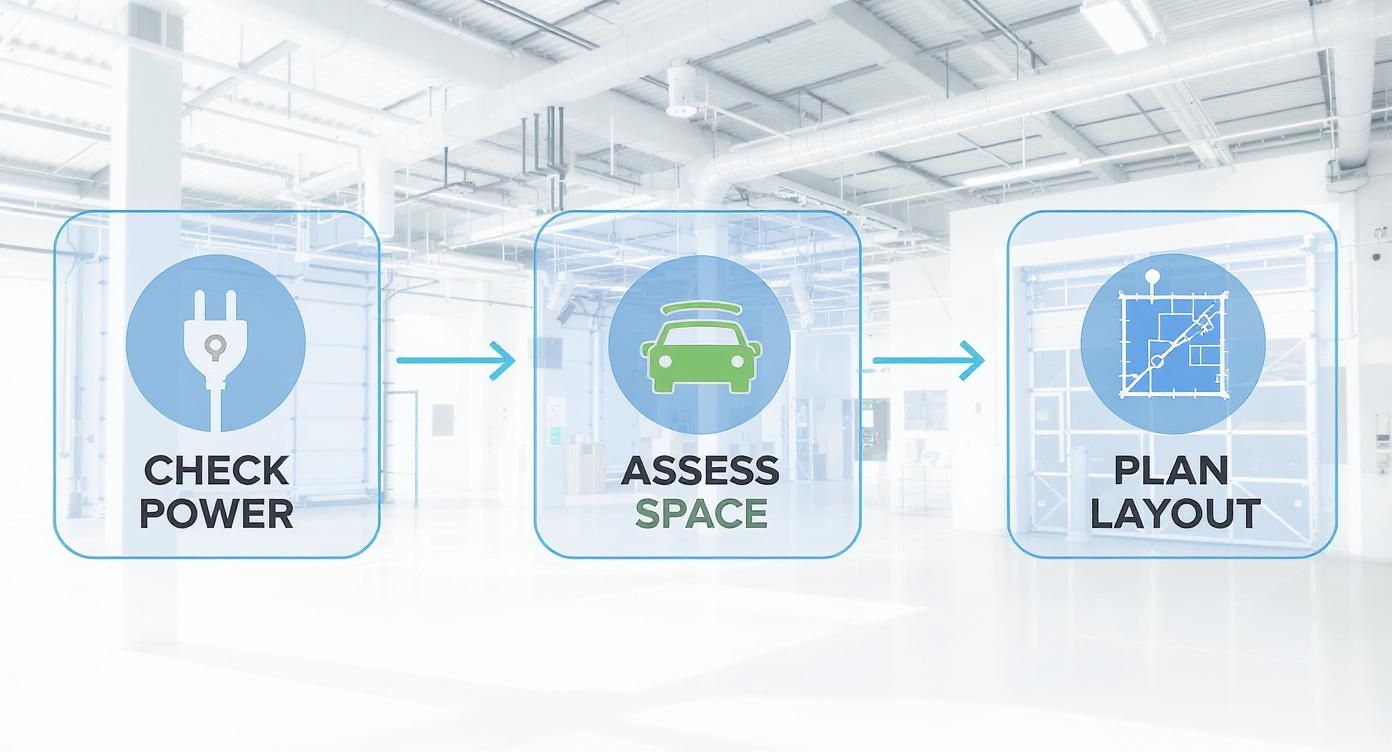
Whether you go for fixed or mobile solutions, a clear site plan is non-negotiable. But what this process highlights is how mobile chargers can dramatically reduce the complexity and cost tied to the power and layout stages.
The Financial Advantage of Going Mobile
Perhaps the most compelling argument for mobile EV chargers is their potential as a revenue-generating asset. Fixed chargers are almost always a capital expense, a facility you provide. Mobile chargers, on the other hand, can be operated as a profitable service from day one.
Think about the income an operator could generate from a single mobile unit. An operator can build a tiered service, offering different charging speeds or durations at various price points. This service can be offered not just to your employees but also to visitors, clients and even tenants in nearby buildings, creating a brand-new income stream.
Let us break down the numbers. If you charge a modest premium over your electricity cost—say, £0.15 per kWh —and a single mobile unit delivers an average of 150 kWh per day, that's a profit of £22.50 from just one unit, every single day.
Over a standard working year of 250 days, a single mobile charger operator could generate over £5,600 in profit. With a small fleet of five units, that figure climbs to over £28,000 annually, turning your car park into a significant profit centre.
This model completely flips the perception of workplace charging. It stops being a cost centre or a passive employee perk and becomes an active commercial service delivering a real return on investment. The ability to deploy charging wherever it's needed maximises the unit's uptime and earning potential in a way a fixed charger simply cannot.
You can dive deeper into this comparison by reading our analysis on the future of EV charging, stationary vs mobile solutions.
To help clarify the trade-offs, here’s a direct comparison of the two approaches in a workplace setting.
Mobile vs Fixed EV Chargers: A Workplace Comparison
| Feature | Mobile EV Chargers | Fixed EV Chargers |
|---|---|---|
| Installation | No civil works needed. Plug-and-play setup. | Requires groundworks, cabling and potential grid upgrades. |
| Scalability | Highly scalable. Add new units as demand grows. | Costly and disruptive to scale. Requires new installations. |
| Flexibility | Charge any vehicle in any parking space. | Charging is tied to specific, dedicated bays. |
| Capital Cost | Lower initial outlay per unit. No installation costs. | High upfront cost for both hardware and installation. |
| Operational Model | Can be operated as a profitable service from day one. | Typically a capital expense or an employee benefit. |
| Space Utilisation | Turns the entire car park into a charging zone. | Requires dedicating premium parking spaces to charging. |
| Downtime Risk | One unit down? Others can cover. No single point of failure. | A single faulty unit can render a bay unusable. |
This table shows that while fixed chargers have their place, mobile solutions offer a far more agile and commercially savvy path for most businesses looking to implement workplace charging.
Creating the Right Technology Mix
For many businesses, the smartest strategy is not an 'either/or' choice but a hybrid approach. A few fixed chargers can serve predictable, high-demand roles, while a fleet of mobile units provides the flexibility to meet fluctuating demand and monetise the service across your entire site.
This blended model gives you the best of both worlds. It provides the security of permanent infrastructure for mission-critical fleet vehicles while empowering you with the agility to serve a diverse range of needs and capitalise on commercial opportunities. By understanding the distinct advantages of each technology, you can design a workplace charging ecosystem that is efficient, scalable and financially astute.
Securing Funding and Calculating Your ROI
Bringing EV chargers to your workplace involves an upfront investment but the financial hurdles are often lower than you might think. With the right funding and a smart operational strategy, your charging infrastructure can quickly become a profitable asset. It’s all about looking beyond the initial expense and focusing on the return.
The UK government is actively pushing businesses to install EV charging points, offering targeted grant schemes to ease the transition. These programmes can significantly cut the initial capital you need, making the switch much more manageable for businesses of all sizes.
Tapping into Government Grants
The main source of funding for businesses is the Workplace Charging Scheme (WCS) . It’s a straightforward voucher-based scheme designed to help cover the upfront costs of buying and installing EV chargepoints.
For businesses, charities and public sector organisations, the grant covers up to 75% of the total costs of purchase and installation, with a cap of £350 per socket . You can claim for a maximum of 40 sockets across all your sites which is a substantial boost.
The Workplace Charging Scheme has been a major driver for adoption. Since its launch in 2016, the WCS has funded the installation of 63,777 charging sockets in UK workplace car parks (excluding schools) by 1 July 2025. In the 12 months leading up to that date, 7,924 new sockets were installed, showing just how much momentum is behind workplace charging.
To really soften the financial blow, it is worth exploring the various Energy Efficiency Grants for Businesses out there. These can often be combined with charging-specific grants to create a powerful financial package.
Monetising Mobile Chargers: Your Path to Profit
While grants are a great start, the real financial win is in your return on investment (ROI). This is where mobile EV chargers really come into their own, turning what could be a simple facility into a revenue-generating service.
Unlike fixed chargers which are often just seen as a cost centre, mobile units can be actively monetised from day one. The business model is simple: you offer a pay-per-charge service to employees, visitors or even neighbouring businesses.
Because mobile chargers can serve any vehicle in any parking bay, you are not limited by dedicated infrastructure. That flexibility maximises how often each charging unit is used and in turn, its earning potential.
Calculating Your Earnings Potential
Let us break down how much an operator could actually make from a single mobile charger. The key is to set a charging tariff that covers your electricity cost and adds a healthy profit margin on top.
Imagine your commercial electricity rate is £0.25 per kWh . You decide to offer a convenient charging service priced at £0.45 per kWh . That’s a clear profit of £0.20 for every kilowatt-hour delivered .
Now, let us see how this plays out in a typical workday with a ZAPME mobile unit:
- Daily Charging Target: A single operator can realistically deliver 100 kWh of charge by servicing multiple vehicles throughout the day.
- Daily Profit: At a profit of £0.20 per kWh, that works out to £20 profit per day (£0.20 x 100 kWh).
- Annual Profit: Over a standard 250-day working year, that one mobile charger operator could generate £5,000 in net profit .
Scale that up to a small fleet of just five mobile units and you are looking at an impressive £25,000 annually . This income stream can quickly pay off the initial investment and start contributing directly to your bottom line. Suddenly, EV chargers at your workplace shift from being an expense to a genuine profit centre.
Managing Operations And Ensuring Safety
You’ve chosen your chargers and sorted the funding. Now comes the real work: shifting your focus to the day-to-day practicalities of running a safe, smooth and efficient charging service.
Getting the operations right is not just about having the best hardware. It’s about having crystal-clear procedures, well-trained staff and an absolute commitment to health and safety. This is the point where your investment truly starts to pay off.
This is about much more than just supplying power. It is about creating a frictionless experience for every single user, whether they are driving a company fleet vehicle or just an employee topping up their personal car.
By integrating your chargers with fleet management software, you can unlock invaluable data. Suddenly, you are tracking energy use, monitoring battery levels and scheduling charging sessions to hit those cheaper off-peak electricity tariffs. Charging stops being a chore and becomes a strategic asset.
Establishing Clear Operational Procedures
When you are dealing with mobile charging units, you absolutely need a documented process. Your team needs to know precisely how to deploy, operate and retrieve the chargers without a second thought. Who handles the bookings? How are payments taken? What is the protocol when a vehicle is fully charged? Figuring this out upfront prevents headaches later on.
A simple but solid workflow might look something like this:
- Booking System: Set up a dedicated app, an online portal or even a straightforward sign-up sheet to manage charging requests.
- Deployment: A trained operator wheels the mobile charger to the vehicle, connects it and starts the session.
- Monitoring: The operator can then keep tabs on the charging status, either through a management app or by quick physical checks.
- Completion & Billing: Once the car's full, the operator disconnects the unit and payment is processed automatically through the system.
This kind of structured approach is becoming more important by the day. After all, EV chargers at the workplace are now a common sight. Workplace charging in the UK has exploded, with an estimated 33,000 sockets now installed across the country—a number that rivals the entire public charging network. It just goes to show how vital workplaces have become to our national charging infrastructure.
Prioritising Health And Safety
Nothing—absolutely nothing—is more important than the safety of your people. Modern EV chargers are built to incredibly high standards but a busy car park always introduces risks that you need to manage proactively. At the heart of it all is a solid safety framework that includes robust electrical safety considerations for all your charging kit.
Your safety plan should lock down three key areas:
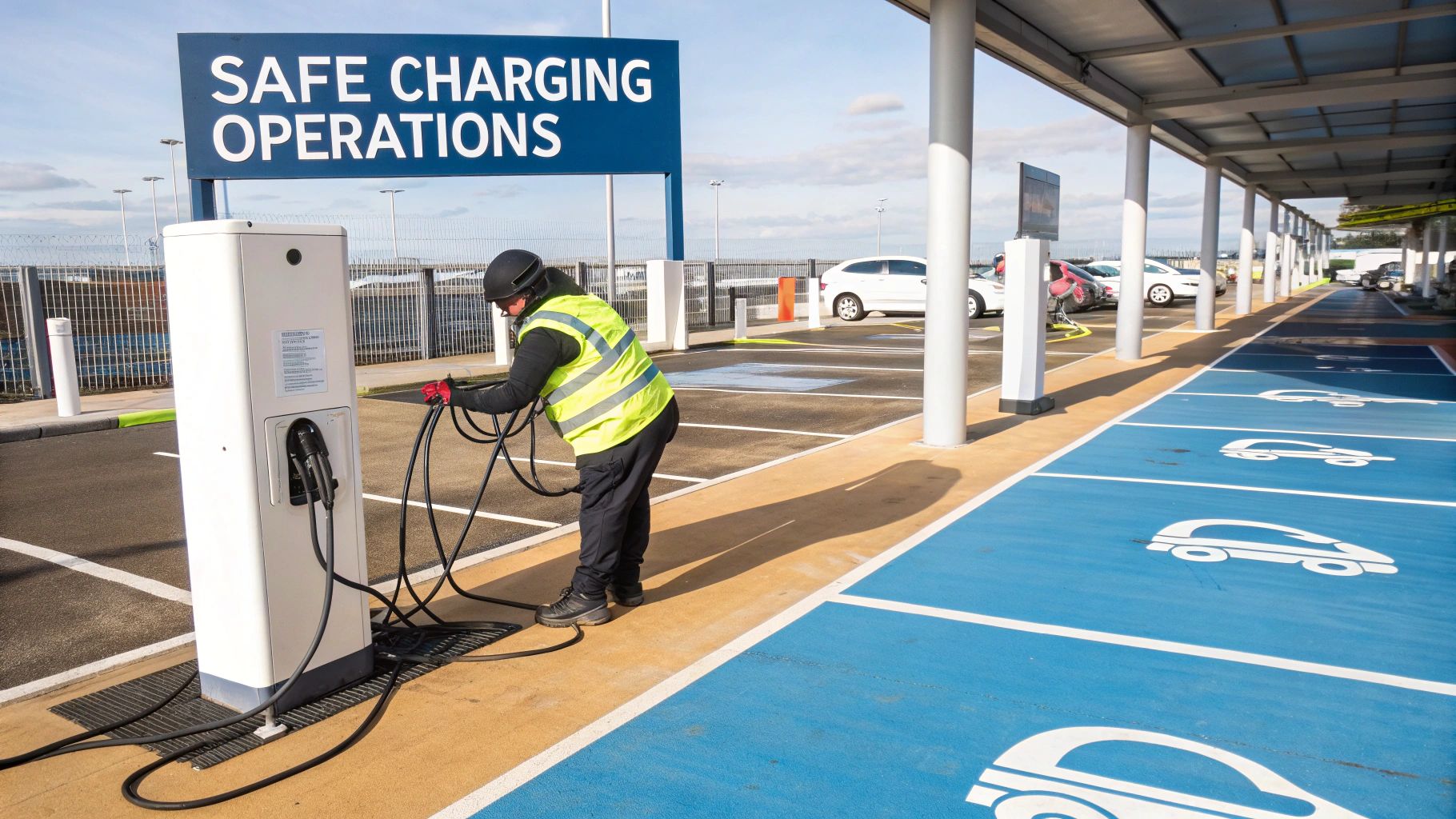
- Cable Management: Trailing cables are a massive trip hazard. Use high-visibility cable protectors and map out clear, designated routes for moving any mobile chargers.
- Staff Training: Anyone who operates a charger needs full training. This should cover safe handling, proper connection procedures, emergency stops and basic troubleshooting.
- Routine Maintenance: Put together a simple checklist for daily and weekly inspections. This means checking cables for wear and tear, making sure connectors are clean and confirming that all safety features are working as they should.
A proactive approach to safety is non-negotiable. By implementing smart cable management and regular maintenance checks, you can create a secure charging environment that protects your team and gives you complete peace of mind.
Picture a bustling car park at a multi-tenant office building. An operator using a ZAPME mobile charger follows a set path, using floor-mounted cable ramps to cross pedestrian walkways safely. They are trained to position the unit to cause minimal obstruction, ensuring there is always clear access for other vehicles and emergency services. That’s the standard of professionalism you should be aiming for.
Got Questions About Workplace EV Charging? We've Got Answers
As you've seen, planning, funding and running a workplace EV charging setup involves a fair few moving parts. It’s only natural to have some final questions before you commit. We hear the same queries from employers and fleet managers all the time, so let us tackle them head-on.
Getting these practical points ironed out will help you move forward with confidence, knowing you’re choosing a solution that’s right for your business.
How Much Money Can an Operator Make From a Mobile Charger?
This is usually the first—and most important—question that comes up. A mobile charger is not just another piece of kit; it is a potential revenue stream waiting to be tapped. Exactly how much an operator can make boils down to your electricity tariff and the price you set for the service.
Let us run through a conservative, real-world example. If your commercial electricity costs you £0.25 per kWh and you bill employees or visitors £0.45 per kWh, you are making a clean £0.20 profit on every single kWh you deliver.
- Daily Potential: A single operator with one mobile charger can comfortably deliver around 100kWh during a typical workday, moving between several vehicles.
- Daily Profit: That works out to a profit of £20 per day from just one unit (£0.20 x 100 kWh).
- Annual Profit: Over a 250-day working year, that single mobile charger operator could generate £5,000 in pure profit .
Now, imagine an operator has a small fleet of five mobile units. Suddenly, your annual profit could jump past £25,000 . This is how you turn a standard car park into a genuine profit centre.
How Do We Stop People Hogging the Chargers?
Ah, 'charger squatting'—the bane of fixed charging points. We’ve all seen it: a fully charged car just sitting there, plugged in, blocking the bay for hours. Mobile chargers completely sidestep this headache.
Because the service comes directly to the vehicle, there's no need to dedicate prime parking bays to charging. Your entire car park is now serviceable. An operator simply wheels the charger over to the next car on the list, meaning no bay is ever out of action. This active, managed approach keeps your assets working and earning, not sitting idle.
The real magic of mobile EV charging is its operational flexibility. You eliminate the logistical nightmare of fixed bays and create a dynamic service that responds to real-time demand. It keeps everything flowing and makes the whole process far more efficient.
What’s the Best Type of Charger for a Standard Workplace?
For most office environments, a Level 2 charger is the sweet spot. These units deliver a steady, consistent charge that’s perfectly matched to a typical 8-hour workday. A few hours hooked up to a Level 2 charger will easily replenish the battery after an average commute.
DC fast chargers, on the other hand, are overkill for this setting. They are designed for public hubs where drivers need a massive power boost in under an hour. For a workplace, slower and steadier charging is more practical and it puts far less strain on your electrical infrastructure. Mobile chargers from providers like ZAPME give you this ideal Level 2 charging speed but with the game-changing benefit of portability.
Will This Disrupt Our Business Operations?
The beauty of bringing mobile EV chargers to the workplace is just how little disruption they cause. Forget the chaos of installing fixed points—no digging trenches, no laying armoured cables and no costly grid upgrades.
Mobile chargers are essentially plug-and-play. You can start offering a charging service the moment they arrive on-site. This means you’re up and running faster and can start seeing a return on your investment almost immediately, without the downtime and hidden costs of a traditional installation.
Ready to turn your car park into a profitable, future-ready asset? ZAPME provides cutting-edge mobile EV charging solutions that eliminate installation costs and create new revenue streams from day one. Discover how our portable chargers can transform your workplace by visiting us at https://www.zapme.biz.