

A UK Driver's Guide to EV Charging Plugs
Staring at a public charge point can sometimes feel like trying to solve a puzzle. You’re faced with a bunch of different sockets and it brings back memories of the days before USB-C became the standard for phones when every brand had its own unique connector. This guide is here to cut through that confusion for UK drivers, turning uncertainty into confidence when it comes to EV charging plugs .
Your Guide to UK EV Charging Plugs
Getting to grips with the world of electric vehicles often starts with one simple but vital question: how do I actually charge this thing? The answer is all about understanding the different types of EV charging plugs as each one is designed for a specific job. It’s not just about the physical shape of the connector but also the speed and type of power it can deliver to your car's battery.
The first and most important idea to grasp is the difference between AC (Alternating Current) and DC (Direct Current) charging.
- AC Charging: This is the slower, more common type of charging you’ll do at home or at places like supermarkets and car parks. The power from the grid is AC so your car’s onboard converter has to turn it into DC power to fill the battery.
- DC Charging: You’ll hear this called rapid or ultra-rapid charging. This method is much faster because it bypasses your car's internal converter entirely. The charger itself supplies DC power straight to the battery, making it perfect for quick top-ups on long journeys.
Understanding this distinction is the key to using the UK's charging network effectively. As of June 2025, the UK’s public network had grown to 82,369 charging devices spread across more than 40,000 locations. It just goes to show how many options are out there once you know what you’re looking for.
The Profit in Mobile Power
While the number of fixed charge points is climbing, there's a massive opportunity in mobile charging. Operators can build a strong business by providing on-demand power right where it is needed most. A mobile charger operator can earn significant revenue from a mix of per-kWh energy sales and service call-out fees, particularly for emergency roadside assistance. This model offers incredible flexibility and solves a critical problem for stranded EV drivers or at temporary locations like events and festivals. For a solid overview of the various types of charging infrastructure where these plugs are used, have a look at a comprehensive guide to electric car charging stations.
A successful mobile charging business can generate thousands of pounds per month per unit. By delivering the right power with the right plug at the right time, operators transform a logistical problem for drivers into a highly profitable solution.
By understanding the different EV charging plugs and what they do, you can plan your journeys and charging stops without any guesswork. If you want to get familiar with the specific terms used in the industry, feel free to explore our detailed EV charging glossary for clear, simple definitions. Now, let’s break down everything else you need to know.
The Two Main UK EV Plugs You Need to Know
Getting your head around EV charging plugs in the UK and Europe has become refreshingly simple. While a few different connector types are floating around globally, your day-to-day charging will almost always involve just two main standards.
Once you understand the specific job of each plug, you’ll have the confidence to pull up to any charge point and know exactly what to do.
This clarity is vital as the public charging network continues its rapid expansion. Driven by a surge in electric vehicle ownership and strong government support, the UK's infrastructure has grown at a phenomenal rate. By late 2023, there were over 46,000 public charging points across the country, including almost 9,000 rapid chargers . You can learn more about these EV charging statistics and see how they’re making long-distance electric driving easier than ever.
This diagram breaks down the two fundamental types of charging—AC and DC—which are delivered by the main plug types we're about to cover.
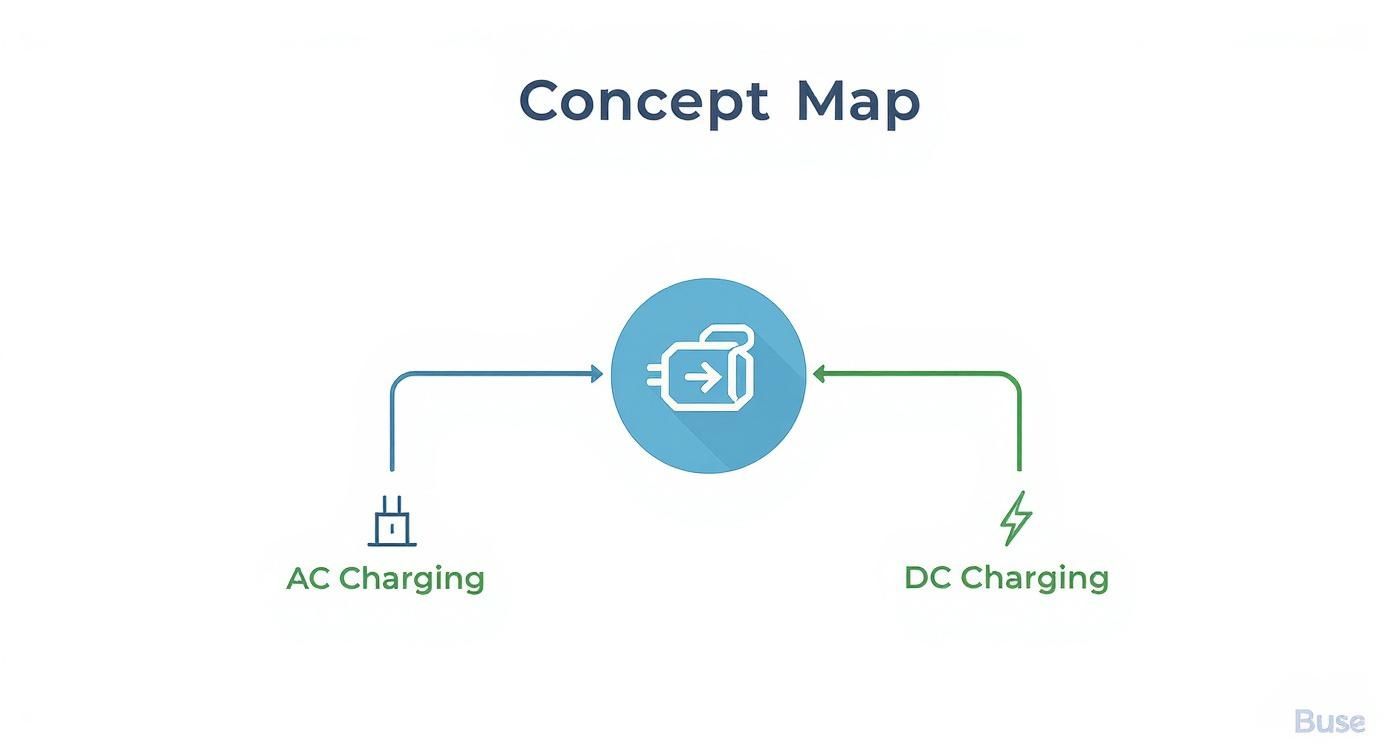
As you can see, it's a clear split between the slower, more common AC charging and the high-speed DC charging used for rapid top-ups on the go.
To make things even clearer, here’s a quick overview of the plugs you'll encounter.
UK EV Charging Plug Types at a Glance
This table provides a simple comparison of the most common EV charging plugs in the UK, what they do and where you're most likely to find them.
| Plug Type | Charging Type | Typical Power | Commonly Found |
|---|---|---|---|
| Type 2 | AC (Slow/Fast) | 3.6kW - 22kW | Home, workplace, supermarkets, public car parks |
| CCS Combo 2 | DC (Rapid/Ultra-Rapid) | 50kW - 350kW+ | Motorway services, dedicated charging hubs |
| CHAdeMO | DC (Rapid) | Up to 50kW | Older rapid charging sites (for legacy EVs) |
Think of Type 2 and CCS as the modern standards, while CHAdeMO is there to support older vehicles. Now, let's look at each one in more detail.
The Everyday Hero: Type 2 Plug
Think of the Type 2 plug as the universal workhorse for AC charging in the UK. It’s a versatile seven-pin connector that has become the mandatory standard for all new electric vehicles sold in Europe.
Whether you're plugging into a 7kW wallbox at home, a charger at the local supermarket or a lamppost unit on a city street, you’ll be using a Type 2 socket. Its widespread adoption means you rarely need to worry about compatibility for your routine charging.
- Charging Type: AC (Slow and Fast)
- Common Locations: Home wallboxes, workplace chargers, public car parks and supermarkets.
- Key Feature: Its universal acceptance across all modern EVs in the UK makes it the default choice for everyday charging.
Simply put, the Type 2 plug is all about convenience and accessibility for the regular, slower charging sessions that make up the bulk of an EV driver's routine.
The Rapid Refueller: CCS Combo 2 Plug
When you need to add serious range quickly on a long journey, the Combined Charging System (CCS) Combo 2 plug is your go-to. This powerful connector is essentially a Type 2 plug with two large DC pins added underneath, creating a 'combo' shape.
This clever design allows the same socket on your vehicle to accept both slow AC and rapid DC power.
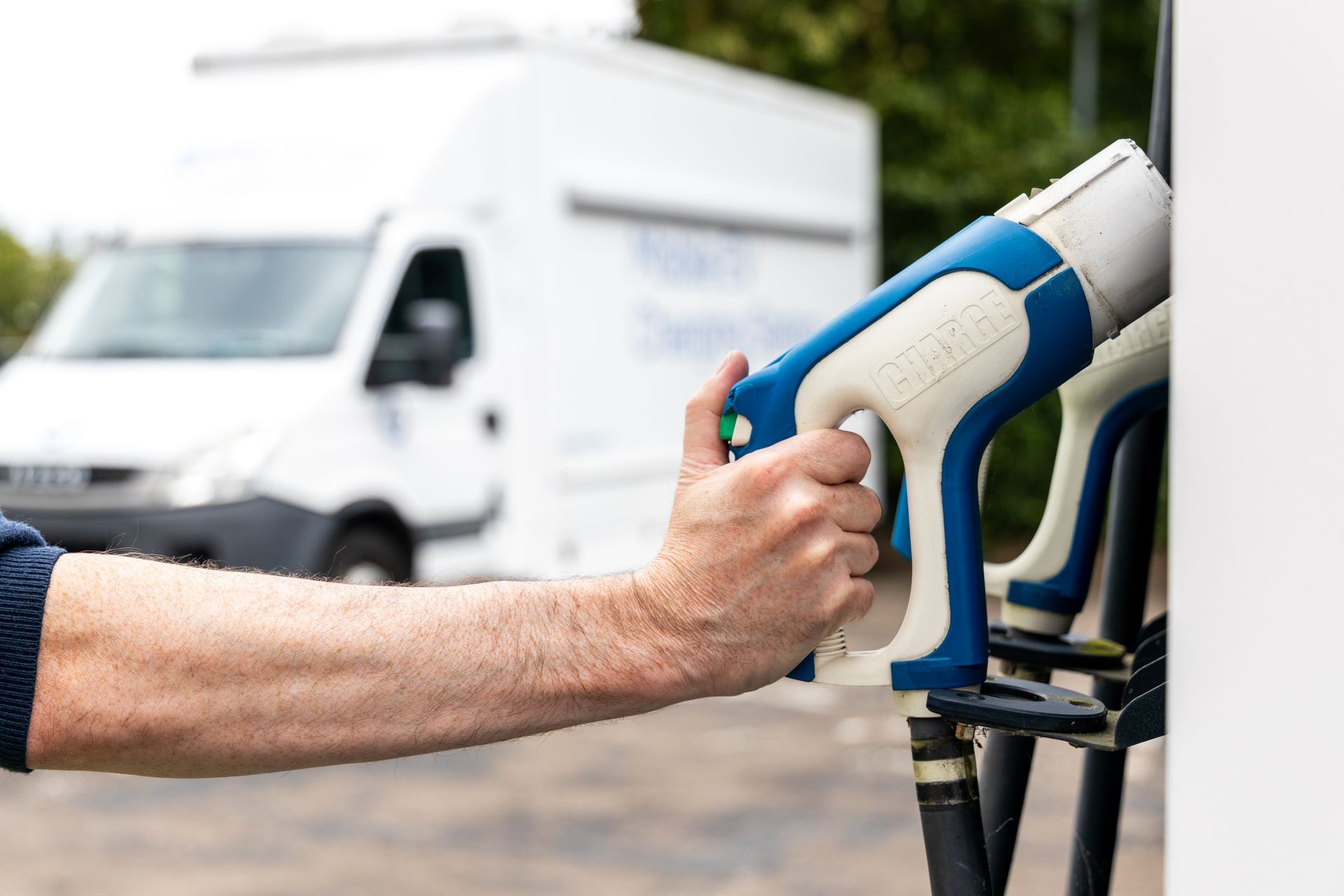
You’ll find CCS plugs at dedicated rapid and ultra-rapid charging hubs, typically located at motorway service stations or along major A-roads. These chargers deliver high-power DC electricity directly to your car's battery, bypassing the slower onboard converter.
A CCS charger is the EV equivalent of a petrol station pump. It's designed for speed, capable of adding over 100 miles of range in as little as 20–30 minutes, depending on the car and the charger's power output.
This makes it indispensable for drivers on long-distance trips, effectively knocking range anxiety on the head by providing quick and efficient refuelling stops.
What About the Legacy CHAdeMO Plug?
While Type 2 and CCS dominate the UK landscape, you might still encounter the CHAdeMO plug. This was an early standard for DC rapid charging, championed by Japanese manufacturers like Nissan and Mitsubishi.
You'll most likely see it on older models of the Nissan Leaf and the Mitsubishi Outlander PHEV.
CHAdeMO is a large, round connector that is gradually being phased out in Europe in favour of the more versatile CCS standard. However, many older rapid chargers still feature a CHAdeMO connector alongside a CCS one to support these legacy vehicles. If you drive a newer EV, you'll likely never need to use it but it’s useful to recognise it.
How Plugs and Power Determine Charging Speed
An EV charging plug might just look like a connector but the power flowing through it is what dictates how quickly you can get back on the road. Understanding this link—between the physical plug in your hand and the real-world time spent at a charge point—is what turns confusion into confidence for any EV driver.
Think of it like filling a swimming pool. You could use a standard garden hose, which is a bit like slow AC charging at home with a Type 2 plug. It gets the job done but it’s going to take a while. Now, imagine switching to a firefighter's hose. That's your DC rapid charging with a CCS plug—a massive volume of water, delivered incredibly fast. The nozzle is different but the real game-changer is the sheer force of the power behind it.
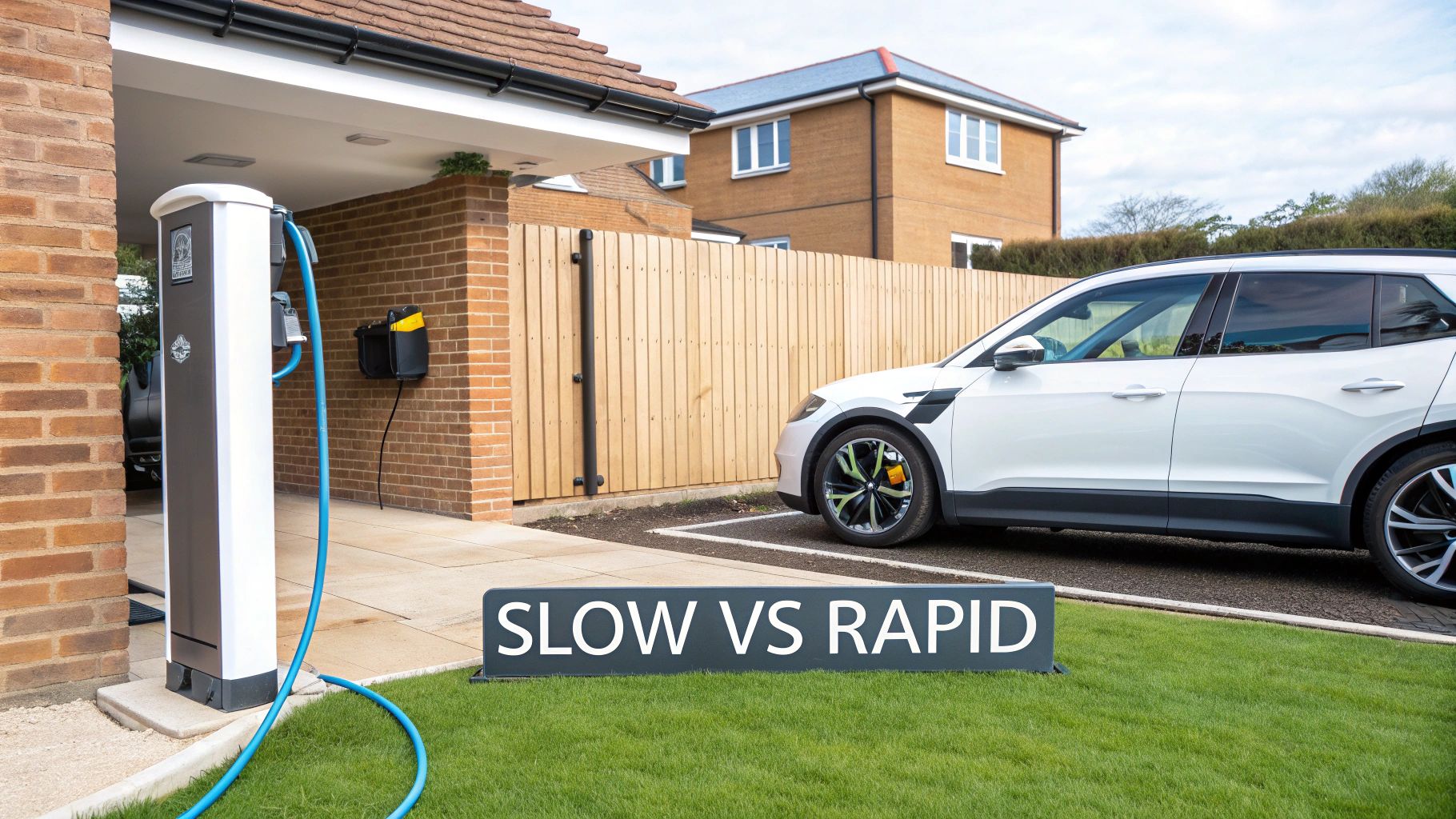
This analogy gets right to the heart of EV charging speeds. The plug type (like a Type 2 or CCS) determines what kind of power your car can accept but it’s the charger's power rating, measured in kilowatts (kW), that determines how much of that power it receives at any given moment.
Understanding Charging Levels
Here in the UK, charging speeds are generally split into three main categories. Each one serves a different purpose and suits different situations, directly shaping how you plan your journeys and daily routine.
-
Slow Charging (Up to 3kW): This is your typical charge from a standard 3-pin domestic socket. It’s the 'trickle charge' method, adding just a few miles of range per hour. It’s really best for overnight top-ups on smaller batteries or as a last resort in an emergency.
-
Fast Charging (7kW to 22kW): This is the sweet spot for AC charging and the most common type you'll find at homes with dedicated wallboxes, at the office and in public car parks. A 7kW charger is the standard for home installation and will comfortably charge most EVs overnight, making it perfect for daily driving.
-
Rapid & Ultra-Rapid Charging (50kW+): Now we’re in the territory of DC charging, using CCS plugs. Rapid chargers kick off at 50kW and can add around 100 miles of range in roughly 30-40 minutes. The even beefier ultra-rapid units, delivering 150kW or more, can do the same in as little as 15-20 minutes for cars that can handle it.
The power of the charger directly correlates to the speed of the charge. A higher kilowatt (kW) rating means more energy is transferred to your car’s battery in less time, drastically reducing your waiting period.
This relationship between power and time is fundamental. Your battery's capacity is measured in kilowatt-hours (kWh). To get a better handle on this crucial metric, you can dive into our guide on how to calculate a kilowatt-hour .
Why Not All Charging Sessions Are Equal
So, how can a 150kW ultra-rapid charger add 100 miles in minutes while a 7kW home unit takes hours? It all comes down to the raw power delivery. A 150kW charger is pushing out over 20 times more power every second than a 7kW home charger.
But it’s not quite as simple as just plugging into the fastest charger you can find. Your car has a say in the matter too.
Every EV has a maximum charging speed it can accept for both AC and DC power. For example, if your car's top DC charging rate is 100kW , hooking it up to a 350kW ultra-rapid charger won't make it charge any faster than 100kW . The vehicle’s battery management system simply won't request more power than it can safely handle.
On top of that, charging speed isn't a straight line. It follows a 'charging curve', starting fast when the battery is low and then slowing down significantly as it gets closer to full—usually after hitting about 80% . This is designed to protect the battery’s health and ensure its longevity. It’s also why it’s often much quicker to charge from 10% to 80% and get back on your way, rather than waiting for that final 20%.
Once you understand these factors—the charger's power, your car's limits and the charging curve—you can plan your stops effectively, manage your expectations and truly see why not all EV charging plugs and sessions are created equal.
The Business of Mobile EV Charging
While fixed charging points are an essential part of the picture, they only solve one piece of the EV puzzle. There's a massive and growing commercial opportunity in taking the power directly to the vehicle. For entrepreneurs and businesses ready to jump into the EV service market, mobile charging is a flexible and highly profitable new frontier.
This approach flips the old model on its head. Instead of waiting for drivers to find a charger, you deliver on-demand power exactly where it is needed most. That could be for a stranded EV on the side of a motorway or at a bustling outdoor event that needs temporary infrastructure.
The core advantage is simple but powerful: you’re selling convenience at a premium. A driver who has run out of battery is not just buying electricity; they are buying a solution to a critical problem. This opens up a business model built on rapid response and high-value service.
Building a Profitable Mobile Charging Model
The financial potential here is substantial, built on two main revenue streams: call-out fees and energy sales. A realistic business model shows how a single operator can generate a significant daily income just by combining these two elements.
Picture a common scenario: a driver runs out of charge on a busy A-road. Your mobile unit gets dispatched to provide an emergency top-up. Here’s how the revenue breaks down:
- Service Call-Out Fee: This is your flat-rate charge for attending the location, just like a traditional roadside assistance service. It covers your operational costs and guarantees a profit margin on every job regardless of how much energy is dispensed.
- Per-kWh Energy Sales: On top of that, you charge for the electricity provided. This is typically priced at a premium compared to fixed public chargers, reflecting the convenience and urgency of the service you're offering.
A single mobile charging unit could realistically handle multiple call-outs every day. For example, completing just three to four emergency jobs could generate several hundred pounds in daily revenue. Over a month, this turns what was a driver's major headache into a reliable and lucrative income source for your business.
The real value isn't just in the electricity itself but in its delivery. Mobile charging operators are selling time, convenience and peace of mind—commodities that customers are more than willing to pay for.
This model isn't just for emergencies either. You can provide scheduled charging for fleets at depots that have not installed their own infrastructure, offer power at construction sites or set up temporary charging hubs at festivals and sporting events. Getting to grips with the wider landscape of mobile energy solutions provides a great framework for understanding how power can be delivered flexibly, a principle right at the heart of this business.
Maximising Your Customer Base with Versatile Plugs
To really succeed in mobile charging, your gear has to be able to serve the widest possible range of vehicles. This is where having a charger compatible with the dominant EV charging plugs becomes a critical business advantage.
A mobile unit equipped with both Type 2 and CCS Combo 2 connectors ensures you can help virtually any modern electric vehicle on UK roads.
- Type 2 compatibility lets you provide AC charging for vehicles that might only need a small top-up or for older models.
- CCS Combo 2 is the powerhouse, offering DC rapid charging that can get a stranded driver back on their journey in the shortest possible time.
This versatility maximises your potential customer base. You’re no longer limited to serving just one type of vehicle; you can confidently answer any call-out, knowing you have the right connection. This capability transforms your mobile unit from a niche service into an all-purpose energy solution for the entire EV world.
Tapping into a Growing Market Need
The need for mobile charging is directly tied to the explosive growth of the EV market itself. While the public network is expanding, it is still playing catch-up in many areas, creating 'charging deserts' where drivers can easily get caught out.
According to official UK government statistics, the public charging network grew to approximately 86,798 charging points by the end of October 2025. These were spread across 44,142 locations , which shows impressive growth but also highlights that coverage is far from universal. You can explore this expansion and the strategy behind it by reading the full government report on electric vehicle charging infrastructure.
This gap between EV adoption and infrastructure saturation is precisely where mobile charging thrives. It provides an essential safety net for drivers and a scalable business opportunity for operators. By offering a reliable and fast solution, you position your business as a crucial player in the ongoing shift to electric mobility.
Navigating Adapters and Compatibility Issues
So, what happens when your car’s socket doesn’t match the charger’s plug? While the UK's charging landscape has become wonderfully standardised around Type 2 and CCS , you can still run into the odd compatibility problem, especially with older or imported electric vehicles. This is where charging adapters come in, acting as a crucial bridge between mismatched connectors.
An adapter is basically a go-between cable that lets an EV with one type of socket connect to a charger with a different plug. Think of it like a travel plug adapter you’d use for your phone abroad; it doesn't change the electricity, it just allows a physical connection. In the EV world, it’s your backup plan for almost any situation.
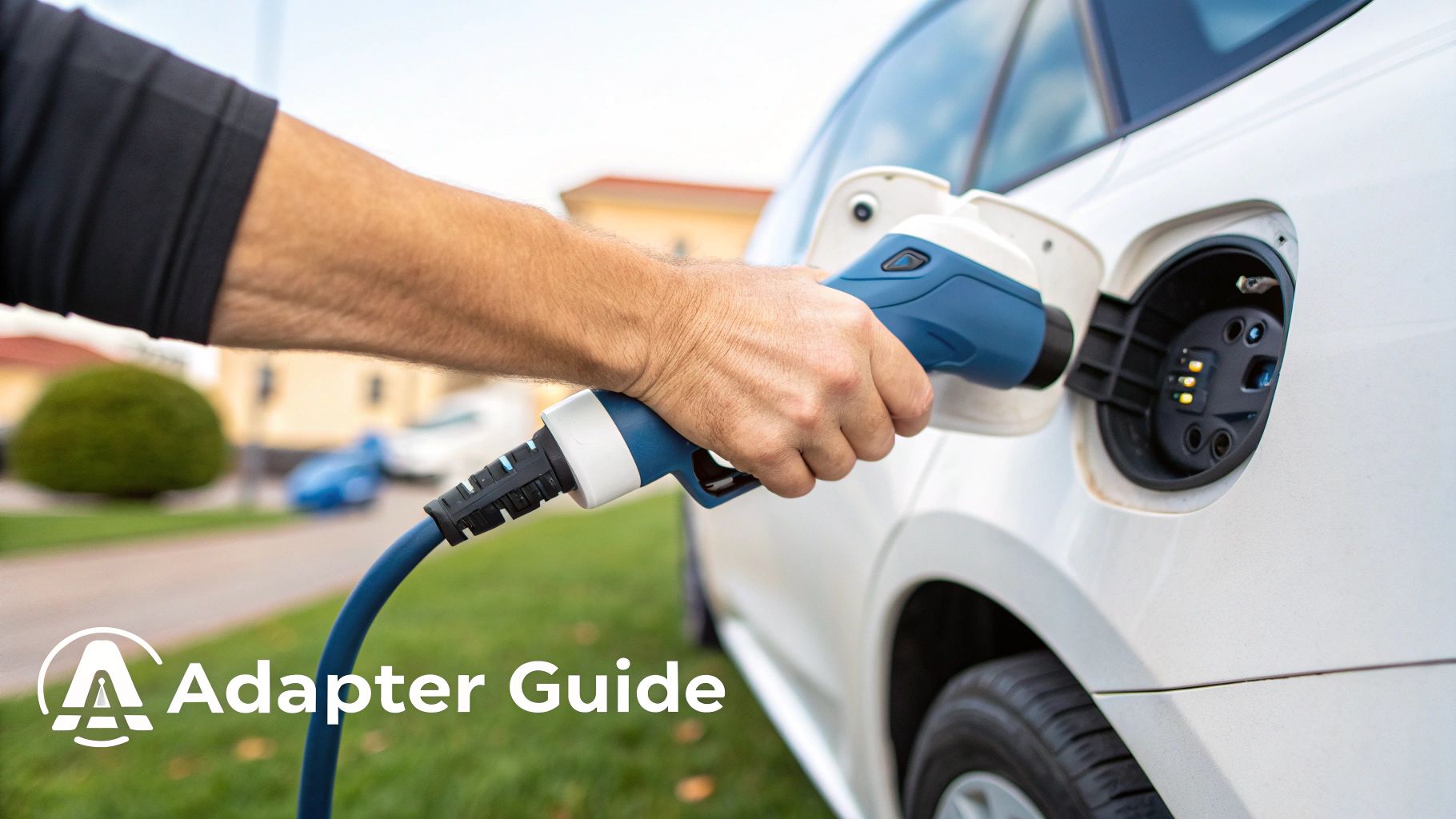
This ability to connect different standards is particularly valuable for mobile charging operators. Having the right adapter on hand means a single mobile charging unit can service a much wider range of vehicles, turning a potential dead end into a completed job.
Common and Safe Adapter Scenarios
As the industry continues to rally around Type 2 and CCS , adapters are becoming less of a daily necessity. However, they remain absolutely essential for certain drivers, most commonly for connecting older vehicles to the modern charging network.
A classic example is a Type 1 to Type 2 adapter cable . Some older imported EVs, like early Nissan Leafs or Mitsubishi Outlander PHEVs, came fitted with a Type 1 socket for AC charging. Since virtually all public AC chargers in the UK now use a Type 2 socket, this adapter is the key for those drivers to access the public network.
Adapters are practical tools for bridging the gap between legacy vehicle technology and modern charging infrastructure. When used correctly, they ensure no driver is left behind in the transition to electric mobility.
For a mobile charging service like ZAPME, carrying a Type 1 to Type 2 adapter is simply smart business. It immediately expands the potential customer base to include owners of these older vehicles, ensuring no call for help goes unanswered because of a simple mismatch of EV charging plugs .
Adapters to Avoid and Safety First
Not all adapters are created equal and your safety should always be the top priority. The golden rule is simple: never use an adapter for DC rapid charging . Adapters claiming to connect a CCS vehicle to a CHAdeMO charger (or vice versa) are not officially supported by car manufacturers and carry significant safety risks.
These uncertified DC adapters can bypass the crucial safety communication protocols between the car and the charger. This could lead to overheating, serious damage to your car's battery or even create a fire hazard. For this reason, it's vital to stick to the native DC plug your car was designed for. No exceptions.
When you do need an adapter for AC charging, always follow these safety tips:
- Purchase from reputable suppliers: Only buy certified, high-quality equipment from trusted brands. Do not cheap out.
- Check for damage: Regularly inspect your adapter for any signs of wear and tear, like frayed wires or cracked casings.
- Ensure a secure fit: A loose connection can cause electrical arcing and overheating. Make sure the plugs are firmly seated and click into place.
By putting safety first and understanding which adapters are appropriate, you can handle compatibility issues with confidence. If you're looking for the right equipment, you can find the best electric car charger adapter in the UK with our helpful guide.
Your Guide to Confident EV Charging
Getting your head around EV charging plugs can feel like learning a new language. But once you know the basics, what seemed like a complex puzzle becomes a simple, everyday task. This guide has shown that for UK drivers, it really boils down to two main players: Type 2 for your regular AC top-ups and CCS for when you need that rapid DC power on the move.
The real confidence boost comes from knowing which plug to use and when. Think of it like this: for the daily grind and overnight charging at home, the steady and reliable Type 2 connector is your best friend. It’s perfect for keeping your battery topped up without any fuss. But for those long-haul journeys up the motorway, the powerful CCS plug is the one you need to get you back on the road in minutes, not hours.
As the UK’s charging network continues to expand and improve, plugging in your EV will only get easier. With thousands of public charge points already available, range anxiety is quickly becoming a thing of the past for drivers who know their stuff.
Understanding the difference between AC and DC charging and being able to spot the right plug is probably the most practical skill any EV driver can have. It puts you in control, saves you time and takes all the stress out of the process.
So, get out there and explore the UK with confidence. Now that you have a clear grasp of the different ev charging plugs , you’ve got the power to choose the right charger, every single time, making every journey a smooth one.
Your EV Charging Questions, Answered
As you get to grips with the world of EV charging, a few practical questions are bound to pop up. Technology moves fast so here are some straightforward answers to the queries we hear most often from UK drivers.
Can I Use a Tesla Supercharger for My Non-Tesla EV?
Yes, in many cases, you can. Tesla has been steadily opening up its UK Supercharger network to other brands, which is great news for all EV drivers. The key is that these accessible stations are fitted with the standard CCS Combo 2 connector, making them compatible with most modern electric cars.
To get started, you’ll need to download the Tesla app. This is how you find a participating Supercharger, begin the charging session and handle payment. It’s a good idea to check the in-app map before you set off as not every site is open to all EVs just yet.
What’s the Difference Between a Tethered and an Untethered Home Charger?
This really comes down to convenience versus a cleaner look. A tethered home charger has the charging cable permanently attached to the wall unit. It’s incredibly convenient – you just park up, grab the cable and plug in. No need to rummage around in the boot for your own cable.
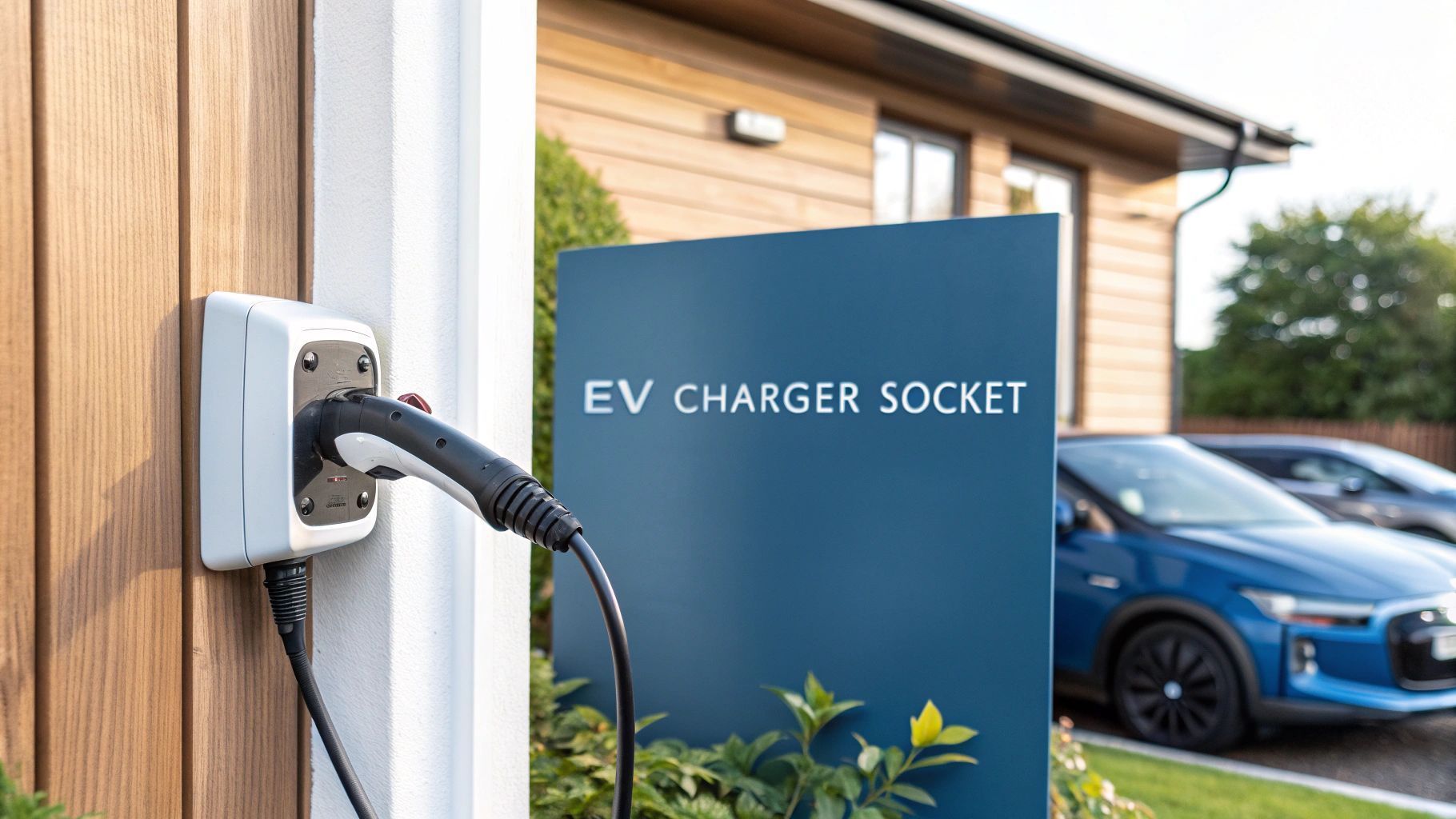
An untethered home charger , on the other hand, is just a socket. You use the separate charging cable that came with your vehicle to connect the car to the wallbox. This setup looks a bit tidier on the wall and offers flexibility, though this is less of a concern now that Type 2 has become the standard.
Do I Need a Special Plug at Home to Charge My EV?
While you can technically plug your car into a standard 3-pin domestic socket for a 'trickle charge', it's incredibly slow and not something we'd recommend for regular use. We’re talking over 24 hours for a full charge on some models and it can put a real strain on your home’s wiring.
For safe, efficient and much faster charging, you’ll want a dedicated home charge point installed. These are typically 7kW units that use a Type 2 plug and they can charge your car about three times faster than a regular socket.
A professional installation by a qualified electrician is non-negotiable. This ensures the unit is safely integrated into your home's electrical system, meets all UK safety regulations and gives you complete peace of mind.
Ultimately, a professionally fitted charge point is the safest and most practical way to handle your daily charging needs.
For businesses and fleet operators needing to solve charging challenges on the move, ZAPME offers versatile mobile EV charging units compatible with all major UK plug types. Discover how you can provide on-demand power and build a profitable service at https://www.zapme.biz.