

A Guide to UK DC Fast Charge Technology
Think of your EV like a big water bottle. Your home charger is a slow, steady tap – it gets the job done but it takes hours. A DC fast charge is the fire hose. It fills the bottle in minutes by getting the electricity into the right format before it even reaches your car. This allows for a powerful, direct current to be blasted straight into the battery, slashing charging times.
How DC Fast Charge Technology Works
To really get what makes DC fast charging so different, we need to touch on the two types of electrical current: Alternating Current (AC) and Direct Current (DC). The power that comes out of your wall sockets and from the National Grid is AC. It’s great for travelling long distances but an EV battery can only store energy as DC.
Here’s the crucial difference. When you plug into a slower Level 1 or Level 2 charger at home or work, AC electricity flows into your car. An onboard converter inside the vehicle then has to do the hard work of changing that AC into DC so the battery can store it. This little converter can only handle so much power at once, which is why those chargers take all night.
A DC fast charge station flips the script entirely. It has a massive, powerful converter built right into the charging unit itself. This external unit grabs high-voltage AC power straight from the grid and transforms it into high-voltage DC on the spot.
By completely bypassing your car's smaller, slower internal converter, a DC fast charge unit can deliver a huge amount of power directly to the battery. This direct-to-battery approach is why it can take an EV to 80% in as little as 20 to 60 minutes .
The Core Components and Process
The magic behind a DC fast charge isn't just a brute-force power dump; it’s a sophisticated, controlled conversation between the charger and your car.
- The Power Conversion Unit: This is the heart of the station. It does the heavy lifting of converting grid AC into high-voltage DC – a job far too big for your car's own systems.
- The Battery Management System (BMS): Think of your car’s BMS as the mission controller. It’s in constant communication with the charger, telling it exactly how much power the battery can safely handle at any given moment. You can dive deeper into this process in our guide on how a supercharger works.
- The Cooling System: Shifting this much energy around generates a lot of heat. Both the charging station and the vehicle use advanced liquid cooling systems to keep temperatures in check, protecting the battery's health and ensuring its longevity.
The Growing UK Network
This technology isn't some niche solution anymore; it's rapidly becoming the backbone of the UK’s public charging infrastructure. In a recent example of this explosive growth, a massive 1,598 new ultra-rapid chargers (150kW+) were installed in just the first half of a year.
This rapid expansion shows a clear demand from drivers for faster, more convenient ways to top up. For any business or fleet operator, getting to grips with how DC fast charging works is the first step towards realising its potential for keeping vehicles on the road where they belong.
So, How Fast is 'Fast'? Understanding Charging Speeds and Power Levels
The kilowatt (kW) rating on a DC fast charger can seem a bit abstract but it’s the single most important number for figuring out how long you’ll be waiting. Put simply, the higher the kW number, the faster the charger can pour energy into your vehicle’s battery. This is what separates a quick top-up from a long, drawn-out stop.
In the UK, you’ll mostly come across two main types of DC chargers. The established workhorses of the public network are the ‘rapid’ chargers , which typically deliver 50kW . Then you have the ‘ultra-rapid’ chargers , which pack a much bigger punch at 150kW or even an incredible 350kW , seriously cutting down the downtime for cars that can handle that speed.
The difference here isn't just a small step up; it fundamentally changes how you can use an EV. A 50kW unit might add around 100 miles of range in 30-40 minutes—perfectly fine if you’re stopping for lunch. A 350kW unit, on the other hand, could add that same range in under 10 minutes, making it feel much more like a quick stop for petrol.
DC Fast Charger Power Levels and Typical Charging Times
To put these numbers into context, here’s a quick comparison of what you can expect from different power levels when charging a typical 60kWh EV battery from a low state of charge.
| Charger Type | Power Output (kW) | Estimated Time (20-80%) | Best Use Case |
|---|---|---|---|
| Rapid | 50kW | 45-60 minutes | Topping up during a planned stop (lunch, shopping). |
| Ultra-Rapid | 150kW | 15-25 minutes | Quick turnarounds on long journeys, high-use fleet vehicles. |
| Ultra-Rapid | 350kW | <15 minutes | For high-end EVs designed for maximum speed; the closest to a fuel stop. |
As you can see, jumping from a rapid to an ultra-rapid charger makes a huge difference, turning a lengthy break into a brief pause.
It’s All About the Charging Curve
But here’s a crucial point: charging speed isn’t a flat line. A vehicle won’t just plug in and suck down power at its maximum rate from 0% all the way to 100%. The whole process is managed by the charging curve , a unique profile for every EV model.
Think of it like boarding a train. When the carriages are empty, the first few passengers can hop on and find a seat in seconds. As the train fills up, it naturally takes longer for new people to find a spot. An EV battery works in a very similar way.
The charging session is at its fastest when the battery’s state of charge is low, usually somewhere between 10% and 50%. Once the battery gets fuller, especially after hitting 80% capacity , the vehicle’s Battery Management System (BMS) deliberately slows things right down to protect the battery cells from heat and long-term damage.
This is exactly why most EV drivers and fleet managers aim for that 20% to 80% sweet spot. Pushing for that last 20% can often take as long as the first 60% did, making it an inefficient use of both time and money, especially at a busy public charger. To get a better handle on the units involved, take a look at our guide on how to calculate a kilowatt-hour.
What Really Determines Your Charging Speed?
The number on the side of the charger is just one piece of the puzzle. Several other factors come into play, dictating how quickly your vehicle actually charges.
- Your Car’s Maximum Speed: Every EV has a cap on how fast it can accept a DC charge. If your vehicle’s limit is 100kW , plugging into a 350kW station won’t make it go any faster. It will simply draw power at its own 100kW maximum.
- Battery Temperature: Batteries are a bit like us—they have a preferred temperature range. If the battery is too cold on a winter morning or too hot after a long drive, the BMS will restrict the charging speed to keep it safe. Some newer EVs have a handy preconditioning feature that warms the battery up as you navigate to a fast charger, ensuring you arrive ready for the best possible speeds.
- Sharing is Not Always Caring: Some charging hubs are designed to split their total power output across multiple bays. If two cars plug into a station that shares a 150kW supply, each vehicle might only get 75kW .
Keeping these variables in mind gives you a much more realistic picture of what a DC fast charge session looks like. It’s a dynamic dance between the car, the charger, and even the weather—all of which have a say in your true speed.
Navigating Connectors and Vehicle Compatibility
Knowing the raw power of a DC fast charger is one thing but can you actually plug your vehicle into it? That’s the real question. Thankfully, the world of EV connectors isn't as confusing as it might seem. Here in the UK and across Europe, the landscape has pretty much settled into a straight shootout between two main standards.
For fleet managers and drivers, getting this right is a critical piece of the puzzle. Pulling up to the wrong charger means frustration and wasted time. The good news is the industry is decisively moving towards a single, unified standard, which makes these decisions easier with each passing day.
The Two Main Contenders: CCS and CHAdeMO
The connector you’ll see almost everywhere across the UK is the Combined Charging System , or CCS . You can think of it as the modern industry favourite. It’s a clever bit of design, combining a standard AC charging port with two chunky DC pins just below it, all in one neat plug. Pretty much every new European and American EV sold today comes with a CCS port, making it the undisputed dominant standard.
The other plug you might still spot is CHAdeMO . This standard got its start in Japan and is usually found on vehicles from Japanese manufacturers, like the Nissan Leaf. While it was a genuine pioneer in DC fast charging, CHAdeMO is now being phased out in favour of CCS on newer models—even by the brands that once championed it.
The industry's shift towards CCS is undeniable. For any business investing in fleet vehicles or charging infrastructure, focusing on CCS compatibility is the only way to future-proof your operations and guarantee access to the widest possible network of rapid chargers.
Real-World Vehicle Compatibility
Let's make this crystal clear by looking at some of the most popular vehicles on UK roads:
- Vehicles with CCS: This is the big one. Almost all modern EVs use this standard, including models from Tesla, Volkswagen, Audi, BMW, Hyundai, and Kia. If you've bought a new EV in the last few years, it almost certainly uses CCS.
- Vehicles with CHAdeMO: This is now mainly for older models. The most common examples you'll see are the Nissan Leaf (pre-2021 models) and the Mitsubishi Outlander PHEV.
While many older charging hubs offer both connector types, you'll notice that newer installations often prioritise CCS, which just shows where the market is heading. It’s always smart to check a charging map app before you set off to confirm a station has the plug you need. To simplify things even further, you can check our detailed guide on UK EV charger connector types.
The chart below really drives home the performance difference you can expect.
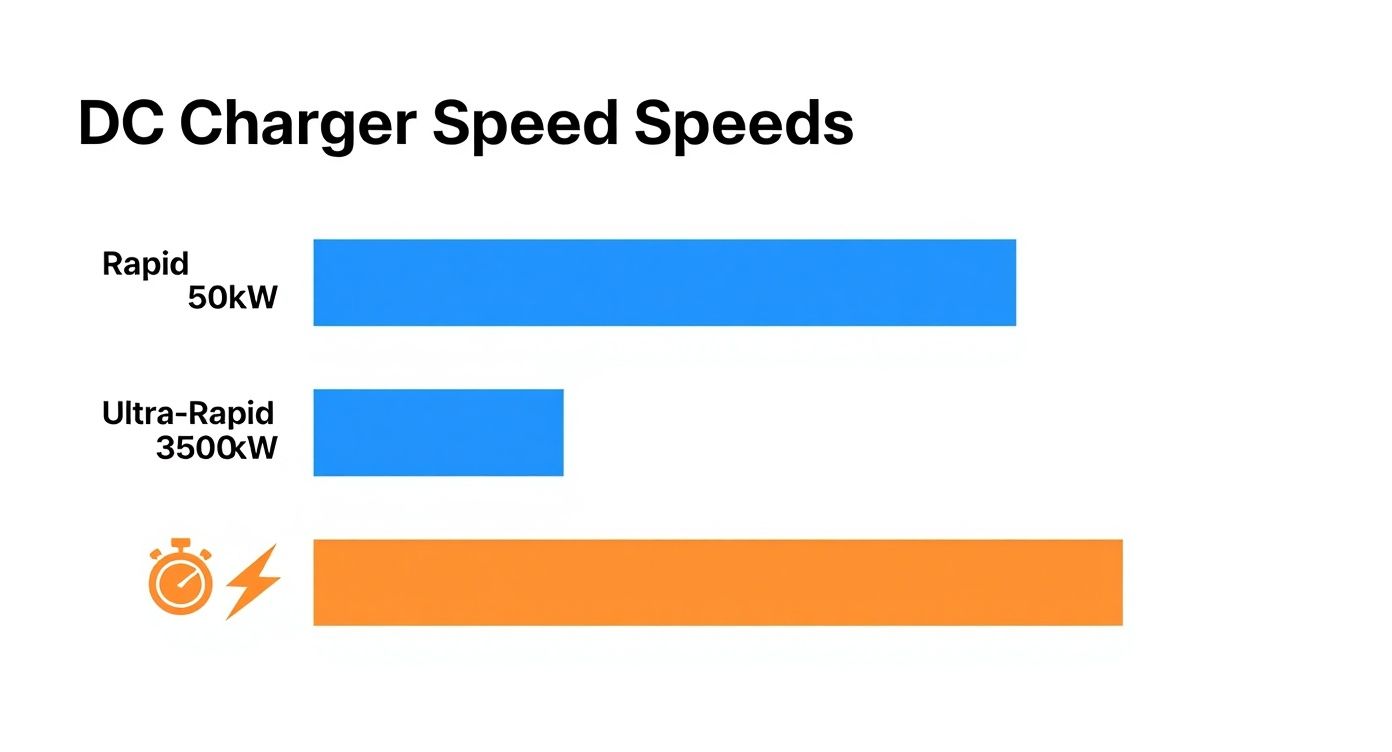
This visualisation highlights the massive time savings offered by ultra-rapid units, which are almost exclusively equipped with CCS connectors. As the UK's charging network expands, the focus is squarely on building out this faster, more efficient infrastructure, ensuring that vehicles using the modern standard get the best possible experience on the road.
The Realities of Installing Fixed Fleet Charging
Having your own dedicated, on-site DC fast charging hub sounds like the perfect solution for an electric fleet but the dream often obscures a far more complicated—and expensive—reality. Getting chargers installed isn't just a matter of buying the hardware; it's a full-blown infrastructure project, packed with hidden hurdles that can stall your operations for months, if not years.
For any fleet manager, downtime is lost revenue. Committing to a fixed installation means bracing for a long and often unpredictable journey through civil works, grid connections, and a maze of regulatory approvals. It’s a path that demands deep pockets and a lot of patience.
The process kicks off with a detailed site assessment, which is about much more than just picking a few parking spots. It involves proper surveys to see if the ground can handle excavation, concrete foundations, and trenches for high-voltage cables. Get this foundational step wrong, and you can expect costs to spiral later on.
The Long Road of Grid Connection
Getting the local grid ready is often the single biggest obstacle. A bank of high-power DC fast chargers puts an enormous strain on the local electricity grid—a level of demand it almost certainly wasn't designed for.
You can't just plug these things in. Your local Distribution Network Operator (DNO) has to carry out a detailed grid capacity study to determine if the local substation can even support the extra load. In many industrial and urban areas, the grid is already stretched thin, meaning a connection is far from guaranteed without costly upgrades.
If the DNO decides the local infrastructure can't cope, the responsibility for funding the upgrade often lands squarely on you, the business owner. This could mean paying for new substations and high-voltage cabling, with costs that can easily dwarf the price of the charging hardware itself.
This process is notoriously slow. Lead times for grid upgrades can drag on for several months to well over a year. All the while, your investment is tied up and your fleet's electrification plans are stuck in limbo, waiting for the power to be switched on.
Unpacking the True Costs and Burdens
The financial commitment for a fixed DC fast charging installation is significant and comes from all angles. The initial capital outlay is just the start. When budgeting for fixed infrastructure, it's vital to factor in all the electrical and installation expenses. For a deep dive, this guide on EV charger installation costs provides a great breakdown.
Beyond the hardware and grid connection, there are plenty of other costs and ongoing headaches to consider:
- Civil Engineering Works: This covers everything from digging trenches and laying foundations to resurfacing the site. It’s labour-intensive work that’s crucial for a safe and solid installation.
- Ongoing Maintenance Contracts: DC fast chargers are complex machines. They need regular servicing to stay reliable and safe, and these service contracts represent a major ongoing operational expense.
- Energy Management: High-power charging leads to hefty energy bills, often with complex tariffs and demand charges. Managing this requires smart software and careful oversight to avoid getting stung by peak-time costs.
When you add it all up, these factors create a huge barrier to entry. For many businesses, the high upfront investment, long and uncertain timelines, and constant operational burdens make fixed infrastructure impractical. This reality check is exactly why so many are now looking for more agile and flexible charging solutions that can bypass these major hurdles altogether.
Unlocking Profit with Mobile DC Fast Charging
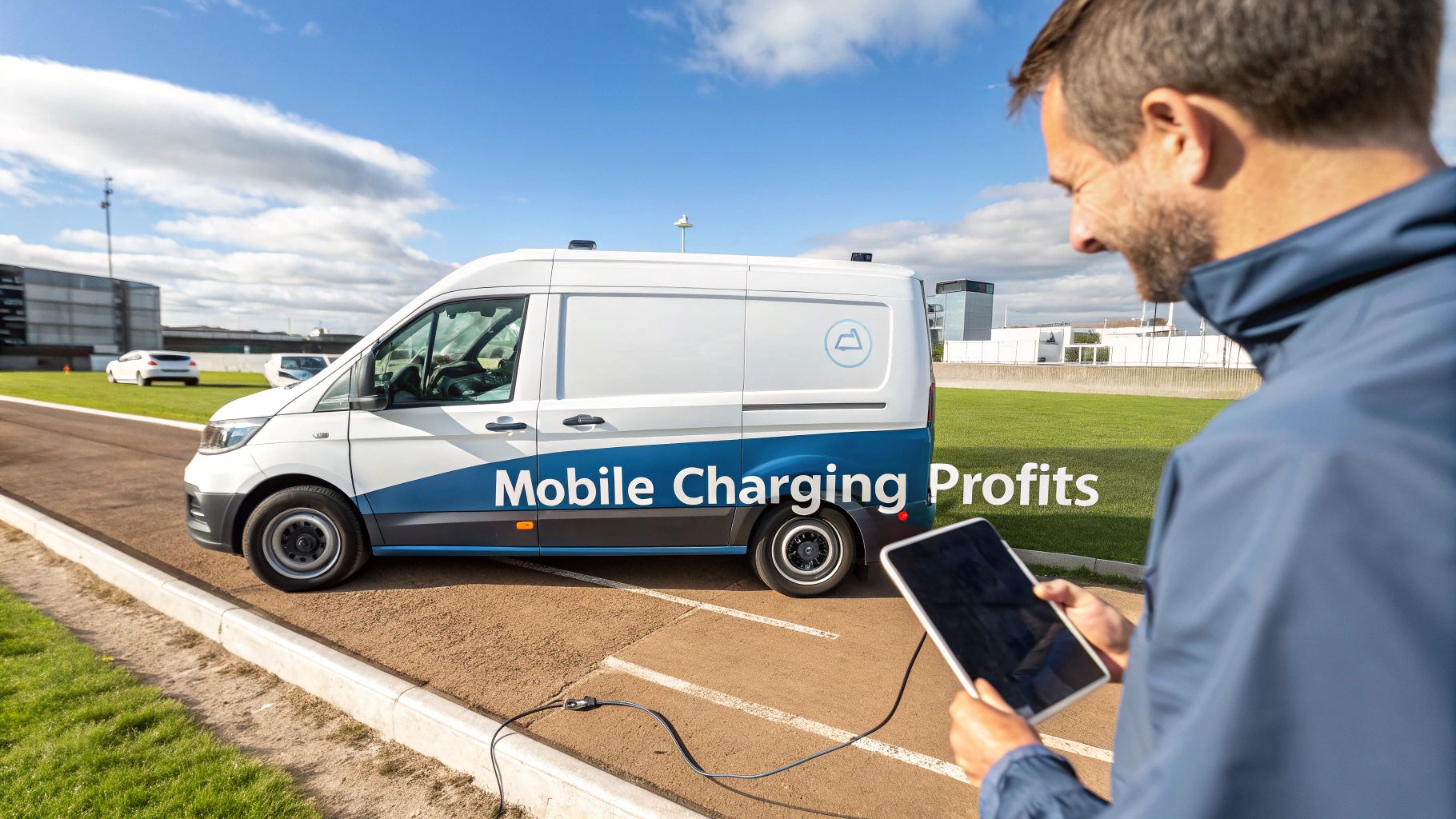
While fixed charging installations come with major financial and logistical hurdles, a far more agile and profitable approach is emerging. Mobile DC fast charging completely changes the game for businesses. It transforms what was once a static, high-cost asset into a flexible, revenue-generating service.
Put simply, it moves charging from a fixed location to wherever the demand is greatest. This ‘charging-as-a-service’ model allows operators to deliver rapid power precisely when and where it's needed most. Instead of waiting for customers to come to a charger, you take the charger directly to them. This unlocks entirely new markets and powerful income streams that fixed infrastructure just can’t access.
The core advantage is freedom from the grid. Mobile units like the ZAPME range are self-contained, battery-powered systems, meaning they bypass the lengthy and expensive process of DNO approvals and grid upgrades. You can be up and running almost immediately, ready to serve clients and generate income.
The Key Advantages of Going Mobile
Choosing a mobile DC fast charge solution offers a distinct set of benefits that directly tackle the pain points of fixed installations. It’s not just about dodging the negatives but about embracing a proactive and flexible business strategy.
This approach lets an operator be nimble, responding to market needs in real-time without being anchored to a single location. The power to deploy rapid charging on demand is a serious competitive edge.
Here’s what you gain as an operator:
- Bypass Grid Connection Delays: As we’ve mentioned, waiting for grid upgrades can take months, sometimes years. Mobile charging cuts this delay out entirely, letting you launch your service straight away.
- Zero Installation Costs: Forget civil engineering works, digging trenches, and pouring concrete foundations. Your asset is the vehicle-mounted charger itself, not a permanent fixture in the ground.
- Flexible Deployment: You can position your charging service at events, business parks during peak hours, or depots needing temporary top-ups for their fleet. You go where the money is, maximising your asset's use.
- Emergency Roadside Service: A stranded EV with a flat battery is a modern-day emergency. A mobile DC fast charge unit becomes a vital recovery tool, offering a premium service that drivers are more than willing to pay for.
Mobile DC fast charging isn't just an alternative; it's a strategic shift. It turns the charging process from a passive utility into an active, on-demand service with multiple avenues for generating significant profit.
Building the Business Case: A Clear Path to Profit
So, how does a mobile DC fast charger translate into actual revenue? The earning potential is substantial because you can stack multiple income streams from a single asset. You aren't just selling electricity; you're selling convenience, speed, and peace of mind.
The business model is built on providing a premium, on-demand service. Let's break down the primary ways an operator of a mobile charger, such as a ZAPME unit , can build a profitable enterprise.
First and foremost is direct energy sales. You can set a per-kilowatt-hour (kWh) rate for the energy dispensed. Given the premium nature of the service, this rate can be set significantly higher than that of a fixed public charger. For instance, if public chargers are around 70p/kWh, an on-demand mobile service could easily command £1.00/kWh or more .
Lucrative Revenue Streams for Operators
Beyond simply selling energy, an operator can introduce other fees that reflect the value of the service being provided. This is where the profitability of a mobile DC fast charge operation truly shines.
- Premium Call-Out Fees: For emergency roadside assistance or an unscheduled on-demand charge, a flat call-out fee is standard practice. This could range from £30 to £75 or more , depending on the time of day and location, before any electricity is even dispensed.
- Service Contracts: You can establish lucrative contracts with local businesses, taxi firms, or delivery fleets that need predictable, on-site charging without investing in their own infrastructure. These recurring revenue contracts provide a stable financial foundation.
- Event Charging Services: Music festivals, sporting events, and corporate functions are prime opportunities. You can charge a day rate to the event organiser or operate on a pay-per-charge basis for attendees, tapping into a captive market.
Let’s run through a hypothetical model to see how quickly the revenue can build. Imagine an operator with a mobile charging unit completes just four jobs in a single day.
| Job Type | Call-Out Fee | Energy Dispensed | Energy Price | Total Revenue |
|---|---|---|---|---|
| Emergency Roadside | £50.00 | 30 kWh | £1.00/kWh | £80.00 |
| Fleet Top-Up (Contract) | £0.00 | 40 kWh | £0.85/kWh | £34.00 |
| On-Demand (Office Park) | £30.00 | 25 kWh | £1.00/kWh | £55.00 |
| Emergency Roadside (Night) | £75.00 | 30 kWh | £1.10/kWh | £108.00 |
| Daily Total | £277.00 |
This simple model, based on just four daily jobs, generates a daily revenue of £277 . When you extrapolate that over a working month, it demonstrates a powerful return on investment. The mobile charger becomes a flexible, high-yield asset that puts you in complete control of your earning potential.
Got Questions About DC Fast Charging? We’ve Got Answers.
As DC fast charging becomes a common sight across the UK, it’s only natural for drivers and fleet operators to have a few questions. This technology is a big leap from filling up at the pump or even plugging into a slower AC charger overnight, so a bit of curiosity is expected. Let's clear up some of the most common queries.
Getting your head around these details demystifies the whole process. It gives you the confidence to make smart decisions, whether you’re a fleet manager mapping out your charging strategy or a driver planning a long-distance trip.
Will Frequent DC Fast Charging Damage My EV Battery?
This is probably the number one concern for anyone new to electric vehicles. It’s true that rapid charging generates more heat than a gentle overnight AC charge but the idea that it causes serious damage to modern EV batteries is mostly a myth.
Every EV comes with a clever bit of kit called a Battery Management System (BMS) . Think of it as a personal bodyguard for your battery. It’s constantly monitoring the temperature and voltage of every cell. If it senses any stress, it automatically throttles back the charging speed to protect the battery’s long-term health. That’s exactly why you’ll see the charging rate drop off a cliff once you get past 80% full.
For the vast majority of drivers who mix it up—using fast chargers for long journeys and slower AC for daily top-ups—the impact on battery life is minimal. While DC charging is the hero for on-the-go speed, a full understanding of your options, including dedicated electric car home chargers , gives you the complete picture of battery care. The best practice is simple: use DC fast charging when you need the speed, not for every single top-up.
How Much Can I Actually Earn with a Mobile DC Fast Charger?
The earning potential for a mobile DC fast charging unit is both significant and incredibly flexible. Unlike a fixed charger bolted to the ground, your revenue isn't tied to one spot. You can chase multiple income streams by taking the power directly to where it's needed most.
Revenue typically comes from a few key areas:
- Per-kWh Energy Sales: You set your own price for the electricity you sell. Because you're offering a premium, on-demand service, you can command a higher rate than a public station, often somewhere between 75p to over £1.00 per kWh .
- Call-Out Fees: For emergency roadside rescues or scheduled top-ups, you can add a flat call-out fee. This charge, maybe £40-£75 , covers the convenience of bringing the charger to the customer and is billed before you even start dispensing energy.
- Contracted Services: You can lock in stable, recurring revenue by setting up service agreements with local businesses like taxi companies or delivery fleets. They get the convenience of on-site charging without the massive capital investment.
Let’s run the numbers. Completing just four or five charges a day—a mix of emergency call-outs and scheduled fleet services—could easily bring in £200-£400 or more . Suddenly, that mobile charger isn't just a piece of equipment; it's a high-return business on wheels.
What's the Difference Between a Rapid and an Ultra-Rapid Charger?
In the UK, these terms are just a simple way of classifying a charger’s maximum power output. It all comes down to how quickly they can pour energy into your car and, consequently, how long you’ll be waiting.
‘Rapid’ chargers are the dependable workhorses you see everywhere on the public network. They typically deliver power from 50kW up to 149kW . For a typical EV, that’s usually enough to get you to 80% in about 30 to 60 minutes —perfect for a stop during lunch or a bit of shopping.
‘Ultra-rapid’ chargers are the next level up, offering 150kW or more . If your vehicle can handle it, these powerhouses can add 100 miles of range in as little as 10 to 15 minutes . This kind of speed makes them essential for major motorway services and key transport routes where getting drivers back on the road quickly is the top priority. The fundamental difference is the massive reduction in waiting time.
Are All EVs Compatible with All DC Fast Chargers?
No, they're not universally compatible. It all depends on the type of charging port your car has. The good news is that things have become much simpler in the UK and Europe as the industry has rallied around a single standard.
The overwhelming majority of new EVs sold today use the CCS (Combined Charging System) connector. It has become the go-to standard for virtually all European and American car makers. If you've bought a new EV in the last few years, it's almost guaranteed to have a CCS port.
Some vehicles, especially older models from Japanese brands like the Nissan Leaf, use the CHAdeMO connector. While you'll still find many older charging hubs that have both CHAdeMO and CCS plugs, new installations are almost exclusively focused on CCS. It's crucial for drivers to know which connector their car needs and to use an app like Zap-Map or PlugShare to check that a station has the right plug before they head out.
For businesses looking to skip the headaches of fixed installations and jump into the profitable world of on-demand charging, ZAPME offers a complete, ready-to-go solution. Our vehicle-mounted mobile DC fast chargers provide the power and flexibility to serve any customer, anywhere.
Discover how you can launch your own charging-as-a-service business by visiting https://www.zapme.biz.