

A Guide to 3 Phase Voltage UK Systems
In the UK your standard household electrical supply is around 230V . It’s the familiar single-phase power that runs everything from your telly to your toaster. But for bigger jobs – think commercial sites, industrial machinery and especially rapid EV charging – a much beefier 400V three-phase supply is the go-to standard.
Single Phase vs Three Phase Power Explained
To get your head around the UK’s electrical grid it’s best to start with the two main types of power feeding our homes and businesses. Most residential properties get by perfectly well on a single-phase supply.
Think of it like a single cyclist pedalling. They provide power in steady but separate pushes. It’s more than enough for everyday appliances which is why our guide to EV charging at home often focuses on chargers designed for this very setup.

But when you need serious, uninterrupted power for businesses, industrial sites or rapid EV charge points, single-phase just won’t cut it. That's where the 400V three-phase supply comes in.
The Power of Three
Now, picture three cyclists pedalling together, perfectly timed so their pushes overlap. The result is a smooth, continuous and far more powerful stream of energy. That’s the essence of three-phase power. It delivers a constant, reliable flow of electricity that can handle much heavier loads without breaking a sweat.
This difference is central to how the UK’s power grid is structured. Local substations step down high-voltage electricity to serve different needs. While homes typically get the 230V single-phase feed, commercial properties like shops, factories and supermarkets are almost always given a three-phase supply to cope with their much higher energy demands.
This dual-voltage approach creates a clear divide between what’s possible at home versus a commercial site.
For a clearer picture, here’s a quick breakdown of the key differences:
Single Phase vs Three Phase UK Supply at a Glance
| Feature | Single Phase Supply | Three Phase Supply |
|---|---|---|
| Nominal Voltage | 230V (Phase-to-Neutral) | 400V (Phase-to-Phase), 230V (Phase-to-Neutral) |
| Power Delivery | A single alternating current (AC) wave | Three synchronised AC waves, 120° apart |
| Typical Use | Homes, small offices, light commercial | Industrial sites, data centres, large retail, rapid EV charging |
| Power Output | Lower, suitable for standard appliances | Up to three times higher, for heavy-duty equipment |
| Wiring | Simpler (Live, Neutral, Earth) | More complex (Three Live wires, Neutral, Earth) |
| Efficiency | Good for smaller loads | More efficient for running large motors and machinery |
As you can see, three-phase isn’t just a bit more powerful; it’s a completely different class of supply designed for heavy lifting.
This upgrade is becoming less of a 'nice-to-have' and more of a necessity, especially for the transport sector. It’s the bedrock that enables:
- Rapid EV Charging: You can’t run high-speed chargers that top up a battery in minutes on a standard home supply. They need three-phase power.
- Heavy Machinery Operation: It’s essential for running large motors and industrial equipment without causing voltage drops or system overloads.
- Large-Scale Commercial Use: It supports the immense and complex electrical needs of data centres, factories and big retail spaces.
Getting to Grips with UK Three-Phase Voltage
If you’ve ever looked into a UK three-phase supply you’ll almost certainly have seen two numbers thrown around: 400V and 230V . At first glance it seems contradictory. How can a single supply have two different voltages?
It's actually quite straightforward once you know what’s being measured. Both voltages are present simultaneously in the same system and the difference simply comes down to where you measure from.
The bigger number, 400V , is what we call the phase-to-phase voltage . This is the electrical potential you get when you measure between any two of the three live phase wires (for example between L1 and L2 or L2 and L3).
The lower figure, 230V , is the phase-to-neutral voltage . This is what you get when you measure between any one of the live phase wires and the neutral wire. Sound familiar? It should – this is the exact same nominal voltage you'd find in any standard single-phase home in the UK.
In essence, a three-phase supply gives you the best of both worlds. It provides the high-power 400V punch needed for heavy-duty machinery and rapid EV charging while also delivering standard 230V circuits for everyday things like lights and sockets, all from a single connection.
Frequency and Harmonisation
Voltage is only half the story; frequency is the other critical piece of the puzzle. In the UK and right across Europe the grid runs at a standard frequency of 50 Hz (Hertz). This consistency is vital for everything from electric motors to sensitive electronics, ensuring all equipment operates at the correct speed and timing. The incredible stability of this frequency is a hallmark of a well-managed national grid.
The specific voltages we use today didn't just happen by accident. They are the result of a major standardisation push back in 1995. This effort to harmonise voltages across Europe centred on the 230V nominal level and fundamentally reshaped the UK's electrical regulations.
The GB voltage limits were officially set at 230V +10%/-6% , as laid out in the Electricity Safety, Quality and Continuity Regulations (ESQCR). Interestingly though the actual operating voltage delivered by UK distribution networks didn't change as the existing levels were already well within this newly defined range. For those who want to dive deeper the government has published a technical analysis of these standards.
This harmonisation is what allows equipment made in Spain, Germany or France to work perfectly and safely here in the UK. For any business planning an electrical installation or specifying new equipment, understanding these precise standards is non-negotiable for ensuring both safety and compliance.
Why Rapid EV Charging Demands Three Phase Power
The link between electrical theory and the booming electric vehicle market becomes incredibly clear when you look at charging speeds. Your standard 7kW home charger, running on single-phase power, is perfectly fine for topping up the car overnight. But for any commercial operation waiting eight to ten hours just isn’t going to cut it.
This is exactly where three-phase power comes in. It’s the key that unlocks much faster charging, making 22kW , 50kW and even ultra-rapid 150kW+ chargers possible. These powerful units can get an EV battery topped up in minutes, not hours, completely changing the game for drivers.
For businesses running vehicle fleets, depots and public charging hubs this speed is non-negotiable. It means getting vehicles turned around faster which means serving more customers and building a profitable business. In short, 3 phase voltage UK standards are the backbone of our entire public charging infrastructure.
Making Sense of the Voltages
To really get your head around how three-phase delivers such a punch you need to understand the difference between phase-to-neutral and phase-to-phase voltage.
This diagram shows the two key measurements in a UK three-phase system.
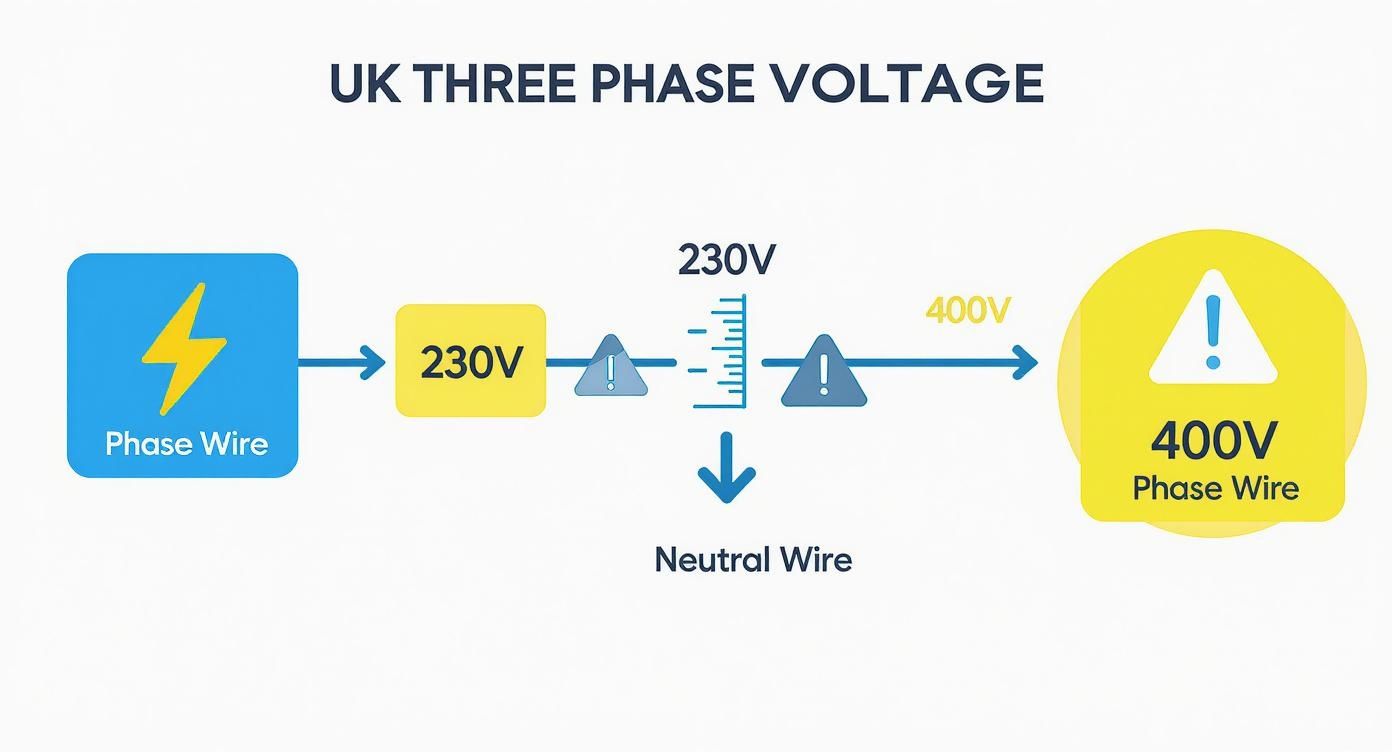
As the illustration shows, the voltage between any single phase wire and the neutral wire is 230V – just like at home. But the real magic happens when you measure between any two of the phase wires where you get a much beefier 400V . This higher voltage is what allows for so much more power to be delivered.
The Financial Opportunity of Mobile Charging
This access to serious power opens up some very lucrative doors, especially for mobile charging operators. A mobile unit like a ZAPME charger can simply connect to an existing three-phase supply on-site—whether that’s an industrial estate, a temporary event or a company car park—and start delivering rapid charging on demand.
By tapping into a three-phase connection a mobile operator can provide a service that rivals fixed charging stations but with far greater flexibility. This creates a powerful revenue stream by selling energy where it's needed most.
Imagine a mobile unit delivering 50kW of power. An operator could potentially bill over £20 per hour for each vehicle being charged. This model turns simple access to three-phase power into a profitable, scalable business. As the EV market grows so does the demand for this kind of convenient, high-speed charging, putting mobile operators in a perfect position to cash in. Understanding how many kilowatts are needed to charge an electric car helps to put this opportunity into perspective.
The Business Case for Mobile EV Charging Operators
The shift to electric vehicles isn’t just about changing how we drive; it’s a massive commercial opportunity waiting to be tapped. For the savvy entrepreneur the widespread availability of 3-phase voltage in the UK unlocks a flexible and seriously profitable business model: mobile EV charging.
Imagine having the power to deliver rapid EV charging exactly where it’s needed most. With a mobile charging unit you can plug into existing three-phase supplies at events, industrial estates, fleet depots or even service stranded drivers. You're selling high-demand power on the go, sidestepping the immense cost and logistical headaches of installing fixed charging posts.
Turning Power into Profit
At its heart this business is about turning access to three-phase power into revenue. Mobile charging operators can offer a premium service that drivers are more than willing to pay for, especially in charging ‘deserts’ or during peak demand.
It's a simple, effective model. By connecting a mobile unit to a common three-phase supply and delivering 50kW of power an operator could realistically bill over £20 per hour for each vehicle charging. This transforms a standard electrical connection into an immediate and significant income stream.
A mobile charging business thrives on agility. It's not about waiting for customers to find a fixed charger; it's about taking the charger directly to them wherever they are. This model turns downtime at a business park or a weekend festival into a prime earning opportunity.
This direct-to-customer approach also allows for dynamic pricing. You can adjust your rates based on location, time of day and immediate demand, making sure you’re always maximising your returns.
The Strategic Edge of Going Mobile
The real beauty of mobile charging lies in its ability to solve the biggest headaches in the EV market today. Operators gain a significant competitive edge by offering a service that is both incredibly convenient and genuinely powerful.
Here are just a few of the advantages:
- Targeted Service Delivery: You can position your units at high-traffic spots like business parks during the week, shopping centres on weekends or major sporting events. This guarantees a steady flow of customers right where they are.
- Essential Fleet Support: Offer ‘charging as a service’ directly to commercial fleets. Providing on-site top-ups for delivery vans or taxis helps them minimise vehicle downtime which is pure gold for their bottom line.
- Emergency Roadside Assistance: You can capitalise on a critical gap in the market by providing a rapid charge for EVs that have run flat. It's the modern-day equivalent of bringing a can of petrol to a stranded motorist.
- Lower Upfront Costs: Compared to the eye-watering expense of buying land, getting planning permission and installing permanent rapid chargers, investing in a mobile unit is a far more accessible way to get into the market.
Building a Business That Can Grow
One of the most attractive things about a mobile charging operation is how easily it scales. You can start with a single unit, test different locations and markets and then expand your fleet as your customer base grows. Your business isn't tied down to one physical spot; it's as mobile as the vehicles it serves.
By understanding the power of the 3-phase voltage UK network, entrepreneurs can build a robust and profitable business that directly meets the needs of the growing EV community. It’s about more than just selling electricity—it's about selling convenience, speed and peace of mind to an ever-expanding market.
How to Safely Identify a Three Phase Supply
Before you can tap into the power of a 3-phase voltage UK supply for something like mobile EV charging you first need to be sure it’s actually available at a property. Figuring this out often starts with a few simple visual checks but remember to always put safety first.
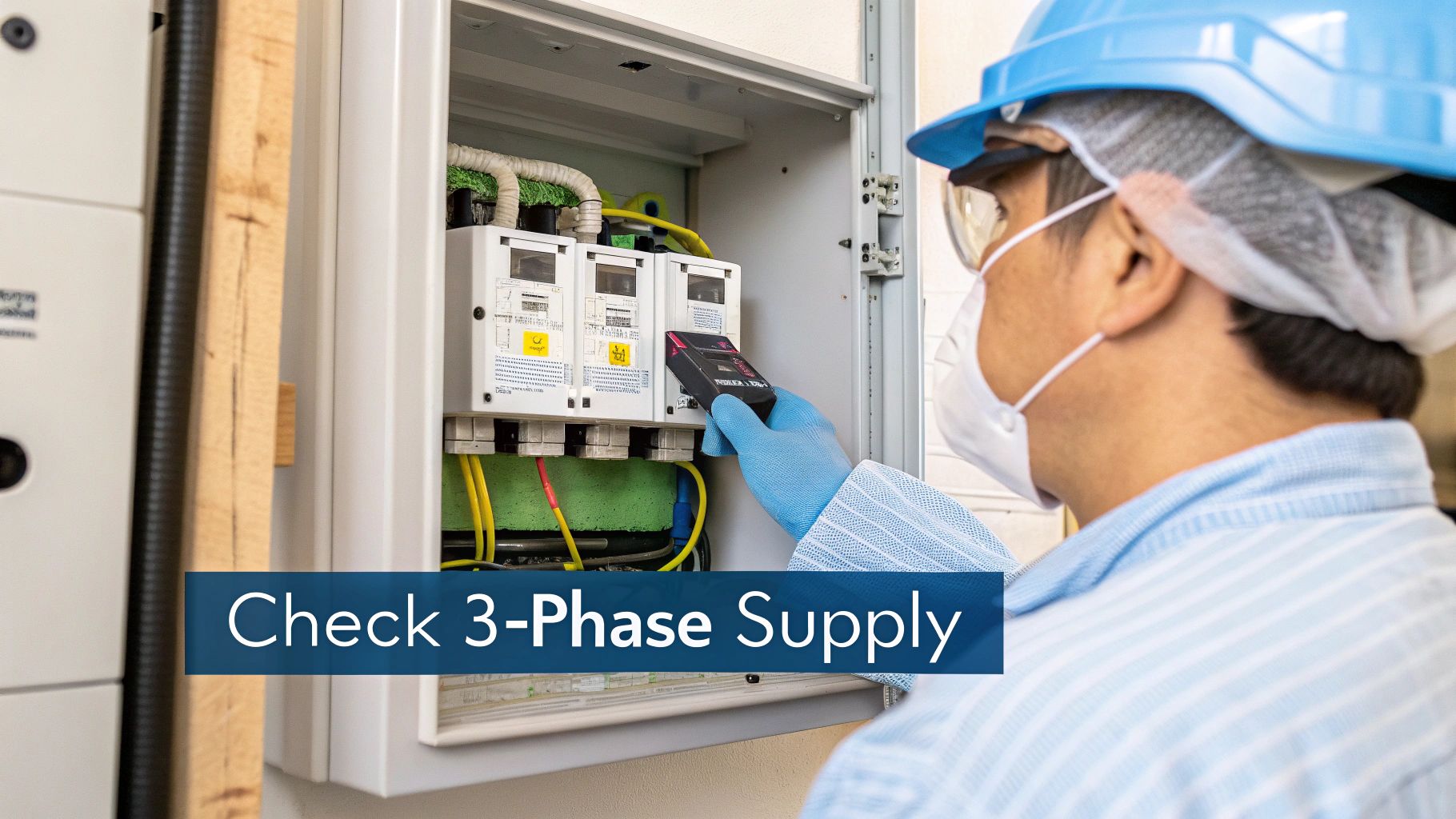
The biggest and most obvious clue is usually the main fuse carrier—often called the "cut-out"—right where the electricity supply enters the building. A standard single-phase supply has one chunky fuse. A three-phase setup on the other hand will have a much larger unit housing three separate fuses , one for each phase. This is the clearest visual giveaway you’ll find.
Another place to look is the electricity meter. Many modern meters will say right on the front if they're built for a three-phase system. Keep an eye out for labels or text that clearly states "Three Phase" or uses the symbol "3Ø".
Checking Wiring Colours
The wiring colours can also give you a good idea of what you’re dealing with and how old the installation is. Modern UK three-phase systems follow a harmonised colour code.
- Modern Colours (Post-2004): Brown (L1), Black (L2) and Grey (L3) for the phases, with Blue for the Neutral wire.
- Older Colours (Pre-2004): Red (L1), Yellow (L2) and Blue (L3) for the phases, with Black for the Neutral wire.
Wiring standards have changed quite a bit over the decades. Before 1964 for instance the UK used white for the second phase and you can still stumble across these historical installations. You can find out more about these UK electrical wiring conventions on Wikipedia. Seeing different or mixed colour schemes is a big red flag that you need to be extremely cautious.
Using a Multimeter for Confirmation
For anyone qualified and competent to work with electrics a multimeter offers the final, definite proof. By measuring the voltage between the different conductors you can confirm exactly what type of supply you have.
Crucial Safety Warning: Never, ever attempt to measure mains voltage unless you are a qualified electrician with the proper training and gear. The risk of serious injury or death from electrocution is incredibly high. If you have any doubt always call in a professional.
If you are qualified here’s what you should find:
- Phase-to-Phase Voltage: Roughly 400V when you measure between any two of the three phase wires (like L1 to L2 or L2 to L3).
- Phase-to-Neutral Voltage: Roughly 230V when you measure between any one of the phase wires and the neutral wire.
If you get both of these readings you can be absolutely certain it's a three-phase supply. For any business planning to run high-power equipment, confirming this is the essential first step.
Navigating a Three Phase Supply Upgrade
So you’ve realised you need a more powerful connection but your property is only running on a single-phase supply. What now? This means it’s time for an upgrade, a job that’s handled by your local Distribution Network Operator (DNO)—the company that owns and manages the cables and substations in your region.
Kicking things off means submitting a formal application for a new or modified connection. This isn't just a quick phone call; your DNO will need specific details about your power requirements so they can design a solution that actually works for you.
Key Information Your DNO Will Need
The single most important figure you’ll need to provide is your Maximum Import Capacity (MIC) , often just called your maximum demand. Think of this as the absolute peak amount of power you expect your site to pull from the grid at any one time, measured in kilovolt-amperes ( kVA ).
For any commercial site but especially one planning to run rapid EV chargers getting this number right is absolutely critical. You have to add up all your existing electrical loads—lights, heating, machinery—and then factor in the new chargers you want to install. If you underestimate you could end up with an undersized supply that trips out constantly. Overestimate and you’ll be paying for capacity you don’t need.
To get the ball rolling you’ll typically need to:
- Find your DNO: Figure out which company is responsible for the electricity network in your neck of the woods.
- Fill out an application: You can usually find this on the DNO’s website. You’ll need to include things like site plans and your calculated kVA demand.
- Get a formal quote: The DNO will take a look at your request and come back with a detailed quotation outlining the work involved and crucially, the costs.
Setting Realistic Expectations for Cost and Time
The price tag and timeline for a three-phase upgrade can vary wildly. A huge factor is how close your property is to the existing three-phase network. If there’s a main supply running right past your door you might get away with a bill for a few thousand pounds.
However, if your site is out in the sticks and they need to start digging up roads or pavements to lay new cables the costs can easily spiral to over £20,000 . The timescale can also stretch from a few weeks to several months depending on how complex the groundwork is.
It might sound daunting but breaking it down into these steps makes the project much more manageable. With the right information in hand you can work with your DNO to get the 3 phase voltage UK supply your business needs. If you're upgrading specifically for EV chargers our guide on how to install an EV charger in the UK offers some extra pointers.
A Few Common Questions About 3-Phase Power in the UK
To wrap things up let's run through some of the questions we hear all the time about 3-phase voltage in the UK . These quick answers should clear up a few final points, especially if you’re looking at it for your business or a new EV charging setup.
Can I Get a Three-Phase Supply for My House?
Technically yes but it’s incredibly rare and usually costs a fortune. Distribution Network Operators (DNOs) design their local networks to give standard single-phase power to homes.
Upgrading almost always means major new infrastructure work which is why it's a solution reserved almost exclusively for commercial sites with serious power needs.
What’s the Typical Cost to Upgrade to Three-Phase?
This is the big "how long is a piece of string?" question. Costs can swing wildly from a few thousand pounds to well over £20,000 .
The final bill depends entirely on your site. Key factors include how far you are from the existing three-phase network and how much digging is needed to run the new cables. You’ll need a bespoke quote from your DNO to get a real figure.
The one thing to remember is that the cost is highly site-specific. A business in a town centre with easy access might pay a fraction of what a rural site would be quoted for the same upgrade.
Does 400V Always Mean a Three-Phase Supply in the UK?
It certainly does. Within the UK's low-voltage system if you see 400V between conductors you're looking at a three-phase supply.
That 400V figure is the voltage measured between two of the three live phase wires. If you were to measure between any single phase wire and the neutral you’d see the familiar 230V we get at home.
Take the guesswork out of EV charging with ZAPME . Our vehicle-mounted, battery-powered rapid chargers bring the power to you, connecting to roadside EV chargers to recharge and deliver power wherever your fleet needs it.
Discover our flexible solutions at https://www.zapme.biz.